What is an application security consultant?
An application security consultant helps organizations identify, validate, and reduce security risks in the software they build or operate. Their work can include penetration testing, source code review, API testing, threat-focused assessments, and remediation planning. A strong consultant explains both technical impact and business risk, then provides clear evidence and practical guidance engineers can use to fix verified vulnerabilities.
What is web application security?
Web application security is the practice of protecting browser-accessible software, its APIs, data, users, and supporting services from unauthorized access, misuse, and disruption. It includes secure authentication, authorization, input validation, session handling, encryption, and monitoring. Testing evaluates whether weaknesses such as injection, broken access control, insecure workflows, or server-side flaws can be exploited by an attacker.
What does a web application penetration test include?
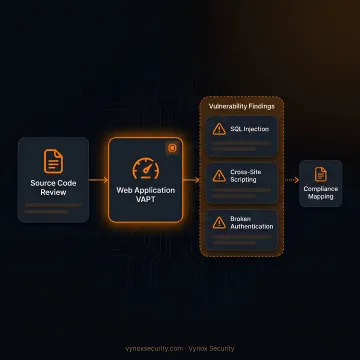
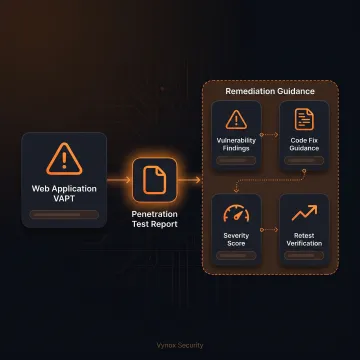
A web application penetration test typically includes reconnaissance, attack-surface mapping, manual exploitation attempts, and documented reporting. Vynox tests the OWASP Top 10, authentication and session controls, authorization across roles and tenants, business logic abuse, workflow weaknesses, injection vulnerabilities, SSRF, and relevant server-side attack chains. Each validated finding includes evidence, CVSS severity, reproduction steps, and remediation guidance.
How is manual penetration testing different from an automated scan?
Automated scanners efficiently identify known patterns and configuration issues, but they can produce false positives and rarely understand business logic or complex authorization flows. Manual penetration testing uses expert judgment to validate exploitability, chain weaknesses, test role and tenant boundaries, and assess real-world impact. Vynox uses AI-augmented tooling while keeping human-led validation and reporting at the center of every engagement.
How long does web application security testing take?
A typical Vynox web application pentest is delivered in 5–10 business days, depending on the agreed scope, application complexity, environments, and testing objectives. API security testing typically takes 3–5 business days. The engagement starts with scope confirmation, followed by manual testing and reporting. Continuous PTaaS engagements can align testing with releases, sprints, and ongoing remediation work.
Will the report support SOC 2 or ISO 27001 requirements?
Yes. Vynox provides assessor-ready reporting designed to support SOC 2 and ISO 27001 evidence needs. Findings are mapped to relevant control requirements, and reports include an executive summary, technical details, evidence screenshots, CVSS scores, reproduction steps, and remediation guidance. While Vynox is not a certifying audit firm, its testing deliverables help demonstrate independent security assessment and remediation progress.
Do you need source code for web application security testing?
Source code is not required for a standard web application penetration test because the application is tested externally as an attacker would interact with it. Source code access is useful when you want a dedicated code review to uncover implementation flaws that may not be reachable through the running application. The two services complement each other and can be scoped together.
Can Vynox retest vulnerabilities after our team deploys fixes?
Yes. Vynox offers retesting to verify that reported vulnerabilities have been remediated without introducing regressions. In PTaaS engagements, fixes deployed to staging can be verified the same day, helping teams close findings quickly and maintain an accurate view of security posture. Retest results provide clear confirmation of resolved, partially resolved, or still-open issues.