Introduction
Auditors increasingly expect penetration test evidence for ISO 27001 certification, yet the standard never once uses the words "penetration testing." This gap causes real confusion — organizations either over-invest in testing that doesn't satisfy their specific controls, or arrive at a surveillance audit with a vulnerability scan PDF and wonder why the auditor isn't satisfied.
The distinction matters: an ISO 27001 audit evaluates whether controls exist. A penetration test proves whether they actually work. Both are necessary to demonstrate a functioning ISMS. Documentation alone won't satisfy an auditor looking for operational evidence.
This article covers which Annex A controls penetration testing directly supports, how to scope a test to your ISMS boundary (including AI systems that most testing firms ignore), and precisely what evidence package your auditor needs from the engagement.
Key Takeaways
- ISO 27001 doesn't name pen testing, but auditors treat it as the standard method for validating technical controls under Clause 9.1
- Annex A controls A.8.8, A.8.29, A.8.16, and A.5.36 all benefit directly from pen test evidence
- Your pen test scope must map to your ISMS boundary — gaps create audit blind spots
- Auditors need four artifacts: a manual-methodology report, scope documentation, a remediation log, and a retest report
- AI systems within the ISMS boundary must be tested; LLMs, RAG pipelines, and agents require specialists, not generalist firms
Is Penetration Testing Required for ISO 27001?
What the Standard Actually Says
ISO 27001 does not mandate penetration testing by name. The standard is outcome-focused: it defines what must be achieved, not the exact method used to achieve it.
Clause 9.1 requires organizations to determine what will be monitored and measured, the methods used, who is responsible, and when results will be analyzed — with documented evidence of those results. It leaves the choice of monitoring mechanism entirely to the organization.
Clause 10.2 addresses nonconformity and corrective action — reacting to identified issues, evaluating causes, implementing fixes, and documenting evidence that corrective actions were effective.
Neither clause names a specific testing method. So why do auditors keep asking for pen test reports?
The Practical Reality
A-LIGN, a dual ANAB/UKAS-accredited certification body, recommends combining penetration testing with ISO 27001 audits specifically to demonstrate security effectiveness beyond documentation. It's not a normative requirement — but it reflects what experienced auditors expect to see.
The practical gap is this: a documented control policy tells an auditor that a process exists. It doesn't tell them whether that process would withstand an actual attack. Penetration testing provides that evidence. Specifically, it shows:
- Controls perform under real attack conditions, not just on paper
- Exploitable gaps exist (or don't) beyond what CVE scanners surface
- Remediation efforts actually closed the vulnerabilities they targeted
Organizations in healthcare, financial services, and cloud infrastructure face additional pressure from sector-specific regulations. DORA, for example, requires covered financial entities to test critical ICT functions at least annually, with selected entities conducting threat-led penetration testing every three years.
These are external regulatory mandates — not ISO 27001 requirements — but they layer on top of audit expectations and raise the evidentiary bar further.
Vulnerability Scan vs. Penetration Test
That regulatory pressure makes the definitional difference between a scan and a test more consequential. CREST draws a clear distinction: a vulnerability assessment uses automated tools to identify known configuration vulnerabilities without exploiting them; a penetration test combines manual and automated techniques to simulate an attack and attempts exploitation.
Auditors want proof that controls work under attack conditions — not just that known CVEs have been catalogued. A scanner report with a cover page does not meet that bar.
ISO 27001 Annex A Controls That Penetration Testing Supports
ISO 27001:2022 reorganized Annex A from 114 controls across 14 domains into 93 controls across 4 themes. Several controls have a direct relationship with penetration testing as an evidence mechanism. Applicability always depends on the organization's Statement of Applicability (SoA) — a single pen test report does not automatically automatically satisfy all of these controls.
A.8.8 — Management of Technical Vulnerabilities
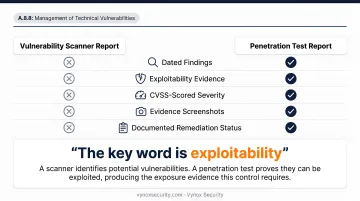
This control requires timely identification of technical vulnerabilities and evaluation of organizational exposure. A penetration test directly supports it by identifying exploitable vulnerabilities under controlled conditions, producing dated findings with exploitability evidence.
A well-structured pen test report — with CVSS-scored findings, evidence screenshots, and documented remediation status — serves as primary audit evidence for this control. The key word is exploitability: the control requires evidence of exposure evaluation, which a scanner report identifying potential vulnerabilities without exploitation cannot fully provide.
A.8.29 — Security Testing in Development and Acceptance
This control requires security testing to be defined and implemented during the development lifecycle. For organizations building SaaS platforms or API products, web application and API penetration testing directly satisfies this control — provided the test occurs before systems are accepted into production.
Auditors expect pre-release test evidence for systems handling personal or sensitive data. A post-deployment-only test addresses A.8.8 but leaves a gap in A.8.29 evidence.
A.8.16 — Monitoring Activities
A.8.29 addresses what happens before deployment. A.8.16 addresses what happens after — specifically, detecting anomalous behavior across networks, systems, and applications.
A penetration test that includes detection-focused scenarios — measuring whether SIEM or EDR tools actually fire when specific attack techniques are executed — provides real evidence of monitoring effectiveness. Auditors looking to verify this control want to see:
- Specific attack techniques executed during the test
- Documented SIEM/EDR alert responses (or confirmed gaps)
- Evidence the monitoring configuration was active during the test window
One important caveat: a point-in-time test report doesn't implement continuous monitoring. It validates that monitoring worked during the test window — supporting evidence for A.8.16, not a substitute for the control itself.
A.5.36 — Compliance with Policies, Rules, and Standards
This control requires regular review of compliance with the organization's security policies and standards. A penetration test that validates whether implemented controls are effective — not just present — is exactly the kind of documented review auditors expect to see. The distinction matters: a policy that exists on paper and a control that holds up under simulated attack are two different things.
Why Combining Pen Testing With Your ISO 27001 Audit Strengthens Both
Feeding the Risk Register and SoA
Penetration test findings feed directly into the ISO 27001 risk treatment process. When a finding confirms that a specific vulnerability is exploitable — not just theoretically possible — it changes the assessed risk level. That updated assessment belongs in the risk register and should inform the Statement of Applicability.
ISACA describes the SoA as the primary connection between risk assessment and risk treatment. Pen test findings that alter assessed risk or treatment decisions belong in the relevant risk and treatment records. Organizations that skip this step end up with an SoA that doesn't reflect their actual risk posture — which sophisticated auditors notice.
Closing the Improvement Loop
Clause 10.2 requires documented evidence that corrective actions were effective. A penetration test followed by remediation and a retest report creates exactly the documented cycle that satisfies this requirement:
- Identify — findings documented with CVSS scores and reproduction steps
- Fix — developer-ready remediation guidance with specific steps
- Verify — retest confirms fixes are resolved before the audit period closes
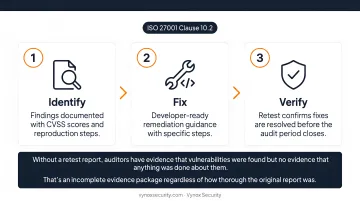
Without a retest report, auditors have evidence that vulnerabilities were found but no evidence that anything was done about them. That's an incomplete evidence package regardless of how thorough the original report was.
One Engagement for ISO 27001 and SOC 2
Organizations pursuing both ISO 27001 and SOC 2 can satisfy both frameworks with a single well-scoped engagement. The AICPA Trust Services Criteria provide verified overlap across two specific controls:
- CC4.1 — lists penetration testing among required evaluation activities
- CC7.1 — addresses periodic vulnerability testing and timely remediation
No authoritative source guarantees that one test automatically satisfies both frameworks. That said, when findings are mapped to both ISO 27001 Annex A controls and SOC 2 Trust Services Criteria in a single engagement, the practical result is one evidence package instead of two separate audit preparation cycles.
Vynox structures assessments this way by default — findings are mapped to both frameworks simultaneously, so organizations pursuing dual certification hand auditors a single, complete evidence pack rather than coordinating two separate engagements.
How to Scope a Penetration Test to Your ISMS Boundary — Including AI Systems
Aligning Scope to the ISMS Boundary
The pen test scope must map to the organization's documented ISMS boundary. Excluding production systems from scope creates audit blind spots that auditors will identify when they compare the test scope against the ISMS scope documentation.
Standard asset categories that fall within ISMS scope:
- Public-facing web applications
- Cloud infrastructure (AWS, GCP, Azure)
- APIs and microservices
- Internal networks and Active Directory
- Mobile applications
If the full ISMS boundary can't be covered in a single engagement, document a rotation plan with clear rationale — web application one year, internal network the next — showing that the full boundary is covered within a defined cycle. Undocumented exclusions draw far more scrutiny than a transparent rotation plan.
The AI Gap Most Organizations Miss
Organizations deploying LLMs, RAG pipelines, or autonomous agents face a scoping problem that didn't exist five years ago: these systems are part of the production environment, therefore within the ISMS boundary, but most traditional penetration testing firms have no methodology to test them.
ISO 27001:2022 creates additional obligations when AI stacks rely on third-party model APIs or cloud-hosted services. Two controls are directly relevant:
- A.5.23 — Information security for use of cloud services
- A.5.22 — Monitoring, review, and change management of supplier services
Both extend to what's inside the ISMS boundary. If your AI systems are in scope but untested, that's a gap auditors will identify.
Vynox's assessments cover AI-specific attack surfaces — prompt injection, RAG pipeline security, autonomous agent hijacking, model inversion — alongside traditional infrastructure, all within a single engagement scope and a single audit-ready report.
Choosing the Right Testing Approach
| Methodology | What It Simulates | ISO 27001 Context |
|---|---|---|
| Black-box | External attacker with no prior knowledge | Useful for testing perimeter controls |
| White-box | Full architecture access | Detailed internal validation |
| Gray-box | Partial knowledge (compromised credential scenario) | Preferred for most ISO 27001 engagements — reflects realistic insider-threat or credential-compromise scenarios |
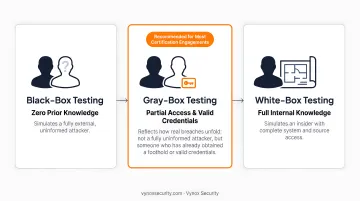
Gray-box is the practical choice for most certification engagements. It reflects how real breaches unfold: not a completely uninformed external attacker, but someone who has already obtained a foothold or valid credentials.
What Your ISO 27001 Auditor Actually Needs From a Pen Test
The Four-Component Evidence Package
Auditors expect four things, and a report missing any one of them creates problems:
- The pen test report — dated within the audit period, with a methodology section describing manual testing techniques (not just tool names), CVSS-scored findings with proof-of-concept evidence, and remediation status for each finding
- Scope documentation — mapping the test to the ISMS boundary, showing what was included and why
- A remediation log — tracking critical and high findings through assignment, remediation, and closure
- A retest report — confirming that critical and high findings were verified as resolved
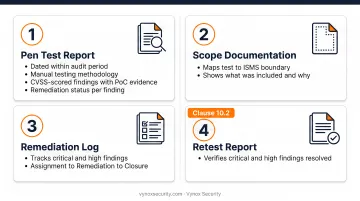
The retest report is non-negotiable for Clause 10.2. A test with no follow-up verification demonstrates that vulnerabilities were identified but their resolution was never confirmed. That's an open loop in the improvement cycle the standard requires.
Why Reports Get Rejected
Common reasons ISO 27001 auditors reject pen test reports:
- Report is dated outside the current audit period
- Methodology section describes only automated scanning tools
- No remediation evidence for critical findings
- Scope doesn't match the ISMS boundary documentation
- No retest confirming closure of high and critical findings
A PDF of scanner output with a cover page fails on multiple counts. The methodology has to demonstrate human judgment — logic testing, chained attack scenarios, and exploitation attempts that go beyond what a tool can automate.
That's the gap Vynox closes. Each engagement produces an evidence package with findings mapped directly to ISO 27001 Annex A control requirements, structured so organizations can hand it to their auditor without reformatting output or hunting for supporting documentation.
Pen Testing Frequency and Timing for ISO 27001
ISO 27001 does not prescribe a fixed testing frequency. Clause 9.1 requires the organization to determine when monitoring and measurement occur — the cadence is yours to define and justify, not the standard's to mandate.
CREST describes annual testing as typical and recommends additional testing around major business or technical changes. That's professional guidance, not a certification requirement.
The practical model auditors expect to see documented:
- Full-scope test covering the ISMS boundary on a yearly cycle (annual baseline)
- Additional testing after significant infrastructure changes, new application launches, cloud migrations, or major product releases
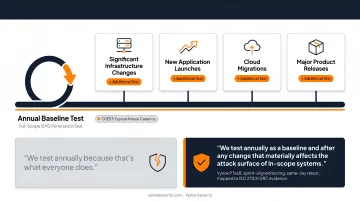
Document the cadence and its risk basis. "We test annually because that's what everyone does" is a weaker position than "we test annually as a baseline and after any change that materially affects the attack surface of in-scope systems."
For organizations running continuous development cycles or frequent AI model updates, that second trigger fires often. Vynox's PTaaS model is built for exactly this cadence: testing aligned with sprints and model releases, same-day retest turnaround, and findings mapped directly to ISO 27001 GRC evidence requirements.
Frequently Asked Questions
Is penetration testing mandatory for ISO 27001 certification?
Penetration testing is not explicitly mandated by ISO 27001. However, it is widely expected by auditors as the primary method of demonstrating technical control effectiveness under Clause 9.1. Controls like A.8.8 and A.8.29 are difficult to evidence credibly without it.
Which ISO 27001 Annex A controls does penetration testing satisfy?
The key controls are A.8.8 (technical vulnerability management), A.8.29 (security testing in development and acceptance), A.8.16 (monitoring activities), and A.5.36 (compliance with policies and standards). Whether each applies depends on your organization's Statement of Applicability.
How often should you conduct a penetration test for ISO 27001?
Annual testing is the widely accepted baseline, with additional change-triggered testing recommended after major infrastructure changes, new product releases, or cloud migrations. The cadence should be documented with risk-based justification.
Can a vulnerability scan replace a penetration test for ISO 27001?
No. Scans identify known vulnerability signatures but cannot demonstrate exploitability, find logic flaws, or produce the evidence of active control evaluation that auditors expect. Both serve complementary roles, but a scan alone is not sufficient.
What evidence does your ISO 27001 auditor need from a penetration test?
Auditors typically require four components:
- A dated report with manual methodology and CVSS-scored findings
- Scope documentation mapped to the ISMS boundary
- A remediation log for critical and high findings
- A retest report confirming closure
Should AI systems be included in the scope of an ISO 27001 penetration test?
If LLMs, RAG pipelines, or autonomous agents are within the organization's ISMS boundary, they must be included in the test scope. Many penetration testing firms lack a defined methodology for these surfaces, which leaves a gap in the ISMS evidence package that auditors are increasingly scrutinizing.