This guide is for security-conscious engineering teams, SaaS and AI companies, and enterprises working toward SOC 2 or ISO 27001 compliance. Your perimeter, meaning everything reachable from the public internet, is the first thing any attacker probes. If it fails, nothing else matters.
Here's the problem: external pentesting gets confused with vulnerability scanning constantly, or worse, treated as a once-a-year box to tick for an auditor. Neither view holds up.
Below, we cover what external pentesting actually is, why it matters more than most teams assume, how the process runs step-by-step, and what drives its scope and cost.
Key Takeaways
- External pentesting proves real exploitability against internet-facing assets, not theoretical risk
- It's distinct from internal testing (assumed breach) and vulnerability scanning (automated, passive)
- The process runs through planning, reconnaissance, validation, exploitation, and reporting phases
- Modern attack surfaces now include cloud storage, APIs, subdomains, and AI endpoints
- Cost and duration scale with scope size, asset complexity, and compliance demands
What Is External Penetration Testing?
External penetration testing is a security assessment where a tester, working with no prior access, attempts to breach your internet-facing assets the same way an outside attacker would. The goal is proof of exploitability, not a bare list of theoretical vulnerabilities.
Testers aim to answer one question: which weaknesses are actually reachable and exploitable, and how far could an attacker get? That means mapping realistic attack paths to business impact, such as customer data exposure or account takeover, rather than handing you a spreadsheet of possibilities.
Scope typically includes:
- Public domains and subdomains
- IP ranges and network perimeters
- Web applications
- APIs (REST and GraphQL)
- Cloud-facing infrastructure and storage
External vs Internal Penetration Testing
External testing assumes zero prior access. The tester is an outsider probing your perimeter cold, exactly the position a criminal group or opportunistic scanner would occupy on day one.
Internal testing flips that assumption. It starts from an existing foothold, either a compromised employee laptop or a malicious insider, and asks how much damage that access could cause once inside.
Most mature organizations run both. External testing typically comes first, since your perimeter is the most exposed layer and the one attackers hit most often before anything else.
External Pen Testing vs Vulnerability Scanning
These two get treated as interchangeable far too often, and that's a costly mistake.
| Vulnerability Scanning | Penetration Testing | |
|---|---|---|
| Method | Automated, signature-based | Manual, expert-led |
| Output | Prioritized list of CVEs/misconfigurations | Validated, exploitable attack paths |
| False positives | Common | Eliminated through manual verification |
| Business context | Minimal | Mapped to real impact |
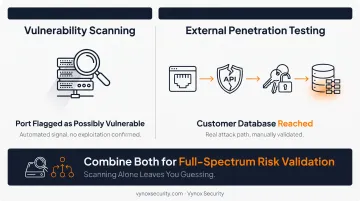
A scanner tells you a port might be vulnerable. A pentester chains that port with a misconfigured API and a weak credential to show you exactly how an attacker reaches your customer database. Smart security programs combine both approaches. Scanning alone leaves clients guessing at real-world risk without expert validation.
Why External Penetration Testing Is Critical
The numbers make the case better than any warning could. According to Verizon's 2025 Data Breach Investigations Report, vulnerability exploitation was present in 20% of breaches, a 34% year-over-year jump. Edge devices and VPNs alone accounted for 22% of exploitation targets, up from just 3% previously, nearly an eightfold increase in a single reporting cycle.
That's your perimeter. That's exactly what external pentesting is built to test.
What Compliance Frameworks Actually Require
- PCI DSS 4.0: Requirement 11.4.3 mandates external testing at least once every 12 months, plus after any significant infrastructure change, per the PCI Security Standards Council
- SOC 2: No fixed annual mandate, but auditors expect risk-driven, periodic testing as control evidence
- ISO 27001: Risk-based, tied to your Statement of Applicability rather than a universal cadence
What Goes Wrong Without It
Without regular external testing, common problems slip through unnoticed:
- Dev and staging environments left exposed to the public internet
- API keys leaked in GitHub repositories (median remediation time for leaked secrets sits around 94 days, per the same Verizon dataset)
- Unpatched internet-facing services running quietly until someone finds them
External pentesting works as both a regulatory necessity and an operational discipline for validating real perimeter resilience. Beyond compliance, it shows you exactly what's breakable before an attacker does.
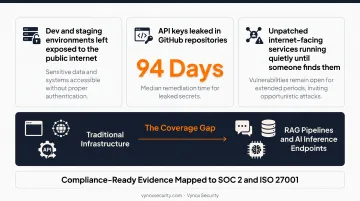
There's a newer wrinkle here too. Organizations shipping AI products alongside traditional infrastructure need testing that goes beyond web and network assets, extending into exposed APIs, RAG pipelines, and AI inference endpoints — a gap most traditional pentest firms weren't built to cover.
Vynox Security tests both AI-specific and traditional external attack surfaces in the same engagement, with compliance-ready evidence packs mapped directly to SOC 2 and ISO 27001 audit requirements.
How External Penetration Testing Is Carried Out
The process moves in one direction: from passive information gathering to active probing to controlled exploitation. Each phase narrows a long list of theoretical weaknesses down to a short list of real, provable risk.
Most engagements run black-box, meaning testers receive no credentials or internal documentation. This most closely mirrors how a genuine external attacker would begin.
Step 1: Planning and Scoping
Before any testing starts, the client and testing team define the rules of engagement. This covers which IPs, domains, subdomains, APIs, and cloud assets are in scope, what's off-limits, the testing timeline, and how findings get communicated as they surface. Skipping this step is how engagements go sideways.
Step 2: Reconnaissance (OSINT and Active Discovery)
Testers start passively, pulling information from LinkedIn, GitHub repositories, Certificate Transparency logs, and breach databases. Then they move to active discovery: port scanning, subdomain enumeration, and service fingerprinting.
The goal is a full map of your actual external attack surface, including the forgotten subdomain nobody remembers spinning up.
Step 3: Vulnerability Scanning and Manual Validation
Automated scanners flag potential weaknesses first. That's the easy part. The real work happens next, when testers manually validate each finding to strip out false positives and confirm which issues are genuinely exploitable.
Step 4: Exploitation and Post-Exploitation
Here, testers use the minimum foothold necessary to prove impact, whether that's gaining unauthorized access to a system or chaining two smaller misconfigurations into one serious breach path. Post-exploitation looks at how far an attacker could pivot once inside, which systems, which data, which privileges.
Step 5: Reporting, Debrief, and Retesting
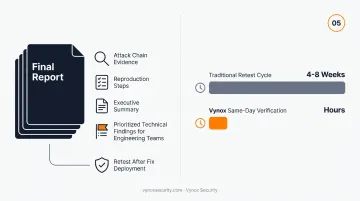
The final report documents each attack chain with evidence and reproduction steps, alongside an executive summary and prioritized technical findings for engineering teams. A retest follows once fixes deploy.
This is where turnaround time matters more than most teams expect. Traditional retest cycles often stretch four to eight weeks, since a new engagement has to be scoped and scheduled from scratch. Vynox verifies fixes the same day they're pushed to staging, cutting that multi-week wait down to hours.
Key Factors That Influence Scope, Duration, and Cost
Pricing and timelines aren't arbitrary. A handful of variables drive both:
- Asset count and complexity: More IPs, domains, APIs, and cloud services mean more testing hours and higher cost
- Testing depth: Black-box, gray-box, or white-box engagements change both effort and how deep testers can go
- Compliance requirements: PCI DSS, SOC 2, and ISO 27001 may dictate minimum testing frequency and reporting detail
- Add-ons: AI endpoint testing, source code review, or API security testing extend scope beyond a standard external test
Vynox structures this through two tiers:
| Tier | Timeline | Best For |
|---|---|---|
| Rapid Secure | 5-15 business days | Compliance-ready evidence for standard external tests |
| Deep Secure | 3-5 weeks | Comprehensive adversarial engagement with full AI red teaming |
Between formal engagements, PTaaS keeps the external attack surface under continuous review, testing aligned to every sprint and model update rather than waiting for next year's audit.
Common Misconceptions and When External Pen Testing Isn't Enough
A few assumptions cause real damage when left uncorrected.
"One annual test means continuous protection." Not even close. CREST's guidance on penetration testing is explicit that a test is a snapshot at a single point in time. Cloud configurations and AI endpoints can change within hours of a report landing in your inbox. That's exactly why Vynox's PTaaS model tests every sprint, not just once a year.
"A finding on a scan report equals a finding in a pentest report." A scan finding and a pentest finding aren't the same severity, and treating them as equivalent leads to misallocated remediation effort. A scanner flags a possibility; a pentester confirms exploitability.
External testing alone won't cover everything. It doesn't address insider threats or lateral movement risk inside your network. Pair it with internal testing and continuous attack surface monitoring between engagements, rather than treating one external report as a full security program.
Frequently Asked Questions
What is external penetration testing?
It's a simulated attack on your internet-facing assets, carried out by a tester with no prior access, aimed at proving real exploitability rather than just cataloging weaknesses.
What is the difference between internal and external penetration testing?
External testing assumes an outside attacker starting from zero access. Internal testing assumes an existing foothold, either a compromised device or an insider threat already inside the network.
How much does an external penetration test cost?
Cost depends on scope size, asset complexity, and testing depth. Vynox quotes pricing transparently based on estimated tester days rather than a flat rate, scaled to fit teams from startup to enterprise.
How long does an external penetration test take?
Most engagements run from a few days to a few weeks depending on the number of assets involved. Vynox's typical range for standard engagements is 5 to 15 business days.
How often should external penetration testing be performed?
Annual testing is a common regulatory minimum, particularly under PCI DSS. Additional retests are recommended after major infrastructure, API, or authentication changes.
Does external penetration testing cover cloud and AI systems?
It should. A modern external pentest needs to include cloud storage, APIs, and public-facing AI or LLM endpoints, not just traditional IPs and domains.