The stakes keep rising. 38% of breaches now trace back to software vulnerabilities, and the global average cost of a data breach has climbed to $4.99 million, with AI model inversion incidents running closer to $6 million. Business logic flaws, broken API authorization, and prompt injection against LLMs are exactly the kind of issues automated scanners routinely miss.
Here's the problem: many organizations think running a vulnerability scanner counts as a penetration test. It doesn't. That mix-up creates a false sense of security that shows up the hard way — during an actual incident, or a failed audit.
This guide breaks down what manual penetration testing actually involves, how the process works step by step, and where it fits into a modern security program, including one built around AI.
TL;DR
- Manual penetration testing uses ethical hackers to simulate real attacker behavior and exploit vulnerabilities
- It uncovers business logic flaws, chained exploits, and access-control gaps tools miss
- The process spans five phases: planning, reconnaissance, vulnerability analysis, exploitation, and reporting
- Engagements are scoped as black box, white box, or gray box based on tester access
- It's legal under signed authorization and essential for AI, API, and cloud deployments
What Is Manual Penetration Testing?
Manual penetration testing (MPT) is security testing performed by human experts (pentesters or ethical hackers) who simulate real attacker tactics, techniques, and procedures under a signed, authorized agreement. Instead of just flagging a vulnerability, a tester actively tries to exploit it, chain it with other weaknesses, and demonstrate what an attacker could do once inside.
That distinction matters. Manual testing exists to answer one question a scanner can't: is this vulnerability actually exploitable, and what happens if someone exploits it? A scan might flag a dozen "potential" issues. A manual tester tells you which three are real, how deep they go, and what data or systems they expose.
What manual pentesting is not:
- Goes beyond vulnerability scanning, which relies on automated pattern-matching against known signatures
- Isn't a one-time compliance checkbox with no follow-through
- Provides a snapshot of exploitability at a point in time, not a guarantee of zero risk
Automated tools are useful, but they generate plenty of false positives and can't tell you whether a flaw is actually reachable in production. Manual testing stays essential even as AI-assisted tools improve. Human creativity is still what's needed to spot logic flaws, chain low-severity bugs into a serious compromise, or catch genuinely novel issues in how an AI system handles inputs.
Types of Manual Penetration Testing (Black, White, and Gray Box)
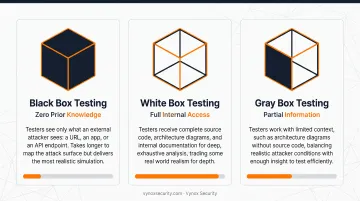
Every manual engagement starts with a decision about how much information the tester receives. That choice shapes what the test can realistically uncover.
- Black box: Testers start with zero internal knowledge, mirroring exactly what an external attacker would see: a URL, an app, or an API endpoint. This realistic simulation takes longer to map the attack surface.
- White box: Testers get full access to source code, architecture diagrams, and internal documentation. This enables deep, exhaustive analysis, trading some real-world realism for depth.
- Gray box: Testers receive partial information, such as architecture diagrams without source code. This middle ground balances realistic attacker conditions with enough context to test efficiently.
How Does Manual Penetration Testing Work?
Manual penetration testing follows a defined sequence, moving from initial scoping to a final report of validated, exploitable findings. Skipping steps here is usually where engagements go wrong.
Planning and Reconnaissance
Every engagement starts with scoping: which systems, APIs, or AI components are in bounds, and what's explicitly off-limits. This gets documented in rules of engagement (ROE), signed by both sides before any testing begins.
Reconnaissance follows in two stages. Passive recon gathers OSINT, public records, exposed subdomains, and leaked credentials without touching the target. Active recon then moves to port scanning, service enumeration, and mapping the live attack surface using tools like Nmap and OSINT frameworks.
Watch for this bottleneck: incomplete scoping. If an API integration or third-party service gets left out of the planning conversation, it often gets missed entirely during testing, and that's usually where attackers look first.
Vulnerability Analysis and Exploitation
This is where manual testing earns its name. Testers manually probe for weaknesses scanners routinely miss: broken access control, business logic flaws, injection vulnerabilities, and authorization gaps between user roles or tenants.
During exploitation, testers try to:
- Chain low-severity issues together into a high-impact compromise
- Escalate privileges from a standard account to admin-level access
- Extract data to prove real exposure, not just theoretical risk
All of this happens in a controlled "safe mode" agreed upon in the ROE, so testing doesn't knock production systems offline.
The quality of findings here depends heavily on tester skill and creativity, plus how much access the tester has been granted. A junior tester running a checklist finds different things than a senior tester thinking like an attacker with a specific goal.
Reporting and Remediation Guidance
The output of a manual pentest is a report, but a good one does more than list bugs. Expect reproduction steps, evidence, severity ratings, and a clear explanation of business impact for each finding.
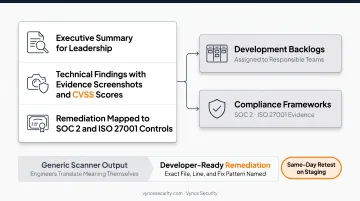
From there, findings typically flow into development backlogs, assigned to the teams responsible for the affected code, and compliance frameworks, mapped to controls like SOC 2 or ISO 27001 so the report doubles as audit evidence.
Report quality directly affects how fast issues get fixed. Generic, scanner-style output forces engineers to figure out what it means for their specific stack. Developer-ready, stack-specific remediation guidance (naming the exact file, line, and fix pattern) cuts that translation time out entirely.
This is the model Vynox Security builds its reports around: executive summaries for leadership, technical findings with evidence screenshots and CVSS scores for engineers, and remediation mapped directly to SOC 2 and ISO 27001 control requirements. Retests happen the same day a fix hits staging, instead of sitting in a queue for the next scheduled audit window.
Manual vs. Automated Penetration Testing
Automated testing and manual testing solve different problems. Automated tools scan large environments quickly and flag known issues at scale. Manual testing digs into whether those issues, and the ones no scanner can see, are actually exploitable.
| Automated Testing | Manual Testing | |
|---|---|---|
| Speed | Fast, continuous | Slower, deliberate |
| Coverage | Broad, known signatures | Deep, targeted |
| Finds | CVEs, misconfigurations | Logic flaws, chained exploits, auth bypass |
| False positives | Common | Rare — findings are proven exploitable |
Automated tools are also blind to zero-day and context-dependent vulnerabilities. A scanner can't tell that a discount code logic flaw lets a user apply a coupon infinitely, or that an API endpoint leaks another tenant's data because of a missing authorization check. That's manual testing territory.
AI systems make this gap impossible to ignore. Prompt injection, retrieval abuse in RAG pipelines, and agents that misuse the tools they're given aren't things a CVE scanner was ever built to catch.
Attackers are getting good at this fast: NIST's 2025 benchmarking found a 57% success rate hijacking AI agents on the first attempt, climbing to 80% after 25 attempts. No automated scanner catches that kind of adversarial behavior.
The most mature security programs combine both approaches. Automation handles continuous baseline coverage across the environment, while manual testing (or a hybrid PTaaS model) validates what actually matters: the logic, the access controls, the AI-specific attack surface.
Vynox Security's two-layer methodology reflects this approach:
- AI-specific surfaces: LLMs, RAG pipelines, autonomous agents, model inversion
- Traditional infrastructure: web apps, APIs, mobile, and cloud
Nothing in the stack goes unvalidated.
Who Needs Manual Penetration Testing (and Where It's Used)
Manual penetration testing fits at specific points in a product's lifecycle, not just once a year out of habit.
When it typically happens:
- Before a major launch, validating real-world exploitability before customers or attackers find it first
- After a significant release or architecture change
- As part of compliance-driven audits, including SOC 2 and ISO 27001
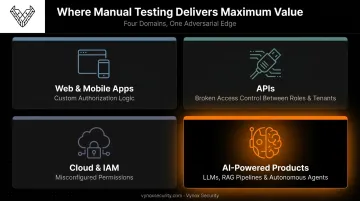
Where manual testing performs best:
- Complex web and mobile applications with custom authorization logic
- APIs where broken access control between user roles or tenants is the real risk
- Cloud and IAM environments, where one misconfigured permission can expose everything
- AI-powered products handling sensitive data, where LLMs, RAG pipelines, and agents introduce new attack surfaces
Industry context shapes cadence more than mechanics. Healthcare, fintech, and enterprise SaaS companies often need manual testing to satisfy compliance auditors and handle sensitive data responsibly. One G2 reviewer noted their tester's focus on "the real-world security risks of handling patient identifiable data" as a standout part of the engagement.
AI-native startups face a different pressure: they need testing that specifically covers LLM and agent attack surfaces before shipping. Vynox Security's AI-native testing methodology was built to address exactly that gap.
Conclusion
Manual penetration testing works because it's structured and human-led. Rather than listing theoretical risks, it proves what's actually exploitable and clarifies what that means for your business if someone finds it before you do.
Understanding the process (planning, reconnaissance, exploitation, reporting) makes it easier to decide on testing cadence, scope, and who you hire to do it. A once-a-year audit might satisfy a checkbox. It won't catch the vulnerability introduced in last week's sprint or last month's model update.
If you're figuring out what combination of manual, continuous, and AI-specific testing fits your environment, that's exactly what a scoping call is for. Vynox Security runs a free 30-minute discovery call to map your stack, identify the highest-risk areas, and recommend the right engagement. Book a free discovery call to get started.
Frequently Asked Questions
What is a manual penetration test?
A manual penetration test is a human-led, authorized simulated attack on your systems, designed to find real vulnerabilities and prove their business impact. Unlike a scan, a person actively tries to exploit what they find.
What is the difference between manual and automated penetration testing?
Automated tools scan quickly across large environments and flag known issues at scale. Manual testing goes deeper, validating whether those issues, and ones scanners miss entirely, are actually exploitable.
Is penetration testing illegal?
No — it's fully legal when performed under a signed agreement with a clearly defined scope and rules of engagement. Testing systems without authorization is illegal hacking, regardless of intent.
What are the three types of penetration testing?
Black box (zero prior knowledge), white box (full access to source code and architecture), and gray box (partial information). Each balances realism against depth differently.
How long does a manual penetration test take?
Timelines vary by scope and complexity, typically running one to a few weeks for most engagements. Specialized providers, including Vynox Security, offer faster turnaround of 5–15 business days for most engagement types.
How often should organizations run manual penetration tests?
At minimum, annually or after any major release, more frequently if you're bound by compliance frameworks like PCI DSS. Fast-moving teams shipping frequent updates, including AI model changes, benefit from continuous PTaaS-style testing instead.