?](https://file-host.link/website/vynoxsecurity-jps4q3/assets/refined-images/1786539825882000_c4db81cf2c504beca91fe7458068e5a5/360.webp)
Introduction
Basic web application attacks now account for 10% of all breach patterns tracked in Verizon's 2026 Data Breach Investigations Report. That's a meaningful slice of every confirmed breach in their dataset, and it doesn't even include the credential stuffing and API abuse that often gets logged elsewhere.
Yet ask five security leaders to define a "web application security audit," and you'll likely get five different answers.
Many teams use "audit," "assessment," and "penetration test" interchangeably. That confusion creates real gaps: a company thinks it ran a full audit when it actually ran an automated scan, then gets blindsided by a manual exploit an auditor should have caught.
This guide breaks down what a web application security audit actually is, what it should cover, how the process works step by step, and how to pick the right approach for your stack.
Key Takeaways
- Web application security audits examine code, config, and infrastructure to find exploitable weaknesses before attackers do
- Full coverage combines automated scanning, manual penetration testing, and source code review
- SOC 2, ISO 27001, and PCI DSS requirements drive much of today's audit demand
- AI features—chatbots, RAG search, agents—create attack surfaces most traditional audits still miss
What Is a Web Application Security Audit?
A web application security audit is a systematic process of examining an application's code, configurations, and runtime behavior to identify vulnerabilities, misconfigurations, and risky practices before someone exploits them.
The term covers several distinct testing methods, each with different strengths and blind spots.
Types of Web Application Security Audits
- Vulnerability scanning: Automated tools flag common weaknesses quickly but don't validate whether they're actually exploitable
- Penetration testing: Manual, expert-led simulated attacks confirm real-world exploitability and quantify business impact
- Source code review: Manual inspection catches insecure coding patterns and logic flaws that automated tools consistently miss
Most organizations need all three at different points in their release cycle. Relying on just one leaves gaps the others would have caught.
What a Comprehensive Audit Covers (Scope)
A comprehensive audit should extend across:
- Application code and business logic, including custom features and third-party integrations
- Authentication, session management, and access control mechanisms
- APIs and endpoints, covering data exposure and input validation
- Underlying infrastructure and cloud configuration that support the application
- AI-powered components such as chat widgets, RAG search, and embedded agents, which expand the attack surface beyond what legacy audits usually cover
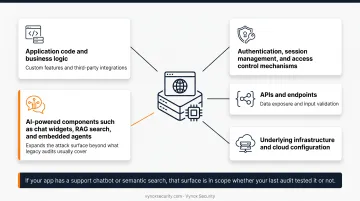
If your app has a support chatbot or semantic search, that surface is in scope whether your last audit tested it or not.
Why Web Application Security Audits Matter
Vulnerability exploitation was present in 20% of breaches in Verizon's 2025 DBIR, a 34% jump from the year before. Audits exist to find those exploitable paths on your team's schedule, not an attacker's.
The global average cost of a data breach reached $4.99 million in 2026, according to IBM's newsroom findings. A routine audit or pentest engagement costs a small fraction of that figure—the math rarely favors skipping the audit.
Compliance Pressure
Compliance is the loudest driver behind audit budgets today. Here's how the major frameworks treat testing requirements:
| Framework | Testing requirement |
|---|---|
| PCI DSS v4.0.1 | Vulnerability scans every 3 months; pentests every 12 months |
| SOC 2 | Risk-based; no universal mandatory pentest cadence |
| ISO 27001 | Testing driven by ISMS risk treatment plan |
| GDPR (Article 32) | Requires regular testing proportionate to risk |
| HIPAA | Periodic technical evaluation required; no fixed frequency in current rule |
Notice that only PCI DSS spells out hard numbers. The rest leave cadence to your risk assessment, which is exactly why audit evidence needs to be mapped to the specific controls an assessor expects—not handed over as a raw vulnerability list.
Vynox builds this mapping directly into its reports, so findings arrive already tied to SOC 2 and ISO 27001 control evidence requirements instead of leaving clients to translate a generic pentest report themselves.
Common Vulnerabilities a Security Audit Uncovers
Most findings fall into a handful of recurring categories, mapped in OWASP's Top 10:2025:
- SQL injection: Unsanitized input reaches the database layer and executes as a command
- Cross-site scripting (XSS): Unescaped user input renders in the browser, letting attackers hijack sessions or deface pages
- Broken authentication: Weak session management, short tokens, or missing MFA lets attackers impersonate legitimate users
- Broken access control (IDOR): Changing an ID in a request exposes another user's data without proper authorization checks
How to Conduct a Web Application Security Audit
A structured audit follows a defined sequence. Skipping steps, especially scoping, is where most engagements go sideways.
- Scope Definition & Asset Inventory: Catalog every application, API, subdomain, and data flow before testing starts. You can't secure what you haven't inventoried.
- Reconnaissance & Information Gathering: Identify frameworks, open ports, and outdated libraries that could signal known CVEs.
- Automated & Manual Testing: Pair vulnerability scanners with manual exploitation attempts. Scanners flag possibilities; manual testers confirm what is actually exploitable.
- Risk Analysis & Reporting: Rank findings by severity and exploitability. A strong report speaks to the engineer fixing the bug and the executive approving the budget.
- Remediation & Retesting: Verify each fix works in a staging or production-like environment before you close the finding.
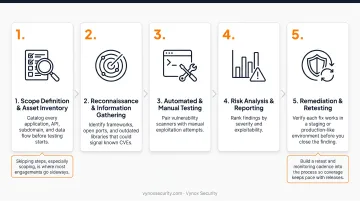
One-time audits age quickly once you ship new code. Build a retest and monitoring cadence into the process so coverage keeps pace with releases.
Web Application Security Audit Checklist & Best Practices
A few habits keep teams ahead of vulnerabilities instead of reacting after a breach.
- Shift security left: Run scanning in CI/CD instead of waiting for pre-release testing
- Keep a living checklist: Cover auth, encryption, dependencies, and logging—and revise it as the stack changes
- Pair tools with manual testing: Automation alone misses business logic flaws and floods teams with false positives
None of this replaces judgment. A checklist tells you what to look at; it doesn't replace the person who knows why a business logic flaw matters more than a low-severity CVE.
How Vynox Approaches Web Application Security Audits
Modern web apps increasingly embed LLM chat features, RAG search, and autonomous agents. Legacy pentest firms, built around CVE scanning and network misconfigurations, tend to overlook these entirely. Their tooling was never designed to test whether an attacker can extract a system prompt or manipulate a retrieval pipeline.
Vynox tests both layers in the same engagement:
- Traditional web application coverage: Full OWASP Top 10, business logic abuse, authentication and session flaws, and authorization testing across roles and tenants, scoped up to 20 endpoints
- AI-embedded attack surfaces: Prompt injection against chat widgets (using 40+ techniques), RAG retrieval-path testing for cross-tenant data leaks, and agent workflow testing for tool-call injection and privilege escalation
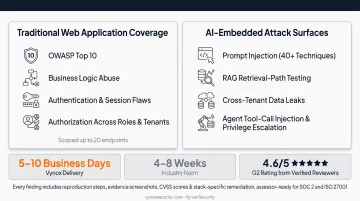
Every finding ships with reproduction steps, evidence screenshots, CVSS scores, and stack-specific remediation guidance. Fixes are written for the actual framework in use, not generic CVE advice. Reports are built assessor-ready for SOC 2 and ISO 27001 from the start.
Delivery typically runs 5–10 business days, against a 4–8 week industry norm for comparable scope.
For teams that need ongoing coverage rather than a one-time snapshot, Vynox's PTaaS model includes:
- Real-time dashboard tracking open vulnerabilities by severity
- Resolved-issue history and a 0–100 security posture score
- Same-day retesting when engineers push fixes to staging
Vynox holds a 4.6/5 rating on G2 from verified reviewers.
Frequently Asked Questions
How often should you conduct a web application security audit?
Cadence depends on release frequency and compliance needs. Run a full audit after major releases, and layer continuous automated scanning between those full assessments to catch issues sooner.
What's the difference between a web application security audit and a penetration test?
An audit is a broader evaluation covering code, configuration, and policy. A penetration test is one specific, hands-on technique often used as part of that broader audit.
How long does a web application security audit take?
Focused assessments often finish in a few days; full-scope engagements commonly take 1–3 weeks, depending on application complexity and endpoint count.
How much does a web application security audit cost?
Cost varies by scope, application size, and testing depth. Many providers use transparent, stage-appropriate pricing that scales from early-stage startups through enterprise clients.
Do web application security audits satisfy SOC 2 and ISO 27001 requirements?
Audits provide critical supporting evidence for both frameworks. Findings still need to be mapped to the specific control requirements auditors expect, not delivered as a raw vulnerability list.
What tools are used in a web application security audit?
Audits typically combine SAST, DAST, and dependency/SCA scanners with manual penetration testing frameworks. Tools alone can't replace expert manual validation of business logic flaws.