That gap gets wider as teams lean harder on AI-assisted development. Automated scanners flag known patterns. QA checks whether features work as intended. Neither is built to catch a logic flaw where a discount code applies twice, a session token is predictable, or an AI agent can be tricked into calling a tool it shouldn't. Penetration testing helps, but it tests the app from the outside — it can't see what's actually happening in the code.
This guide breaks down what secure code review is, how the process works step by step, the vulnerabilities it typically uncovers, how it compares to pentesting, and what it costs.
Key Takeaways
- Secure code review finds logic flaws and crypto weaknesses that scanners and pentests routinely miss
- Manual review stays essential: automated tools miss business-logic flaws without a clean signature
- AI-native code adds risks like unsafe prompts, insecure agent tool-calling, and unvalidated vector queries
- Code review and penetration testing are complementary; most compliance-conscious teams use both
- Modern reviews often finish in days, not the multi-week timelines traditional firms require
What Is Secure Code Review?
Secure code review is the manual or automated examination of source code to find vulnerabilities, logic flaws, and security weaknesses before an application reaches production. NIST defines it as a security-oriented investigation into an application's coding practices, with the explicit goal of surfacing weaknesses an attacker could exploit.
That's a different goal than a standard code review. A functional review asks: does this code work, is it readable, does it follow team conventions? A secure code review asks a narrower, sharper set of questions:
- Where does untrusted input enter the system, and is it validated?
- Are authentication and authorization enforced correctly, not just present?
- Is cryptography implemented properly, or just implemented?
- Can this logic be abused in a way the developer never intended?
A code reviewer can see things a black-box tester never will: validation logic, hard-coded secrets, permission checks, and the assumptions baked into the design.
Who Performs Secure Code Reviews?
Three roles typically get involved, and they're not interchangeable:
- Developers doing peer review: catch obvious issues early and reduce risk before merge, but usually lack dedicated security training
- Security engineers or dedicated reviewers: trace data flow, verify auth logic, and dig into vulnerability classes developers often overlook
- Security researchers or exploit writers: confirm a flaw is genuinely exploitable with proof-of-concept work, not just theoretically risky
Most mature programs use all three at different stages, with dedicated reviewers or specialist firms handling the higher-risk, higher-stakes codebases.
Types of Secure Code Review
Two approaches dominate, and they serve different purposes:
| Type | When it's used | What it covers |
|---|---|---|
| Baseline review | New applications, legacy onboarding, compliance audits | Full codebase, deep architectural context |
| Diff-based review | Daily development, pull requests, commits | Only changed code, fast turnaround |
Automated tools have a real place here. They're fast and repeatable. But OWASP notes that business-logic errors are notoriously hard for scanners to catch, because flawed logic often uses entirely legitimate application functions. A tool can't tell that skipping a payment-verification step is wrong if the code technically "works." A human reviewer still has to make that call.
The Secure Code Review Process: A Step-by-Step Methodology
Before anyone opens a file, a solid review starts with preparation. That means understanding the application's architecture, gathering any existing threat model, and identifying the highest-risk functions: authentication, payment flows, and admin panels, so review time gets spent where it matters most.
Core Review Steps
- Map entry points and validate input handling. Reviewers catalog REST endpoints, routes, and query parameters (anywhere untrusted data enters the app).
- Trace data flow end to end. Follow data from its source (user input, API calls, file uploads) through every transformation to its sink (database queries, file writes, rendered output).
- Verify security-critical logic. This covers authentication and authorization checks, cryptographic implementations, and configuration settings that could create a misconfiguration risk.
- Document findings in a structured format. Each issue gets a severity rating, reproduction steps, and remediation guidance developers can act on immediately.
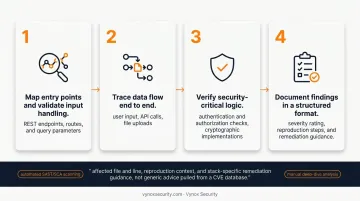
That last step matters more than it sounds. A finding without a clear file, line number, and fix recommendation just sits in a backlog. Vynox Security's source code review reports, for example, include the affected file and line, reproduction context, and stack-specific remediation guidance, not generic advice pulled from a CVE database.
Mature teams don't treat this as a one-time event. They blend automated SAST/SCA scanning for fast, repeatable coverage with manual deep-dive analysis for context-dependent risk, and they run diff-based reviews continuously inside CI/CD rather than saving everything for a major release.
Some providers lean on automation-first triage. Vynox and similar expert-led practices keep manual review primary, because automated tools still miss business-logic and AI-specific patterns that don't match a known signature.
Common Vulnerabilities Uncovered During Secure Code Review
Certain vulnerability classes show up in review after review. MITRE's 2024 CWE Top 25 ranks SQL injection third overall and missing authorization ninth, both squarely in secure code review territory.
Injection flaws
SQL injection, OS command injection, and Server-Side Request Forgery all stem from unsanitized input reaching a sensitive function. A classic example:
query = "SELECT * FROM users WHERE id = " + userInput
Swap that for parameterized queries, and the flaw disappears. Reviewers look for exactly this pattern across every query, shell call, and outbound request.
Authentication and session weaknesses
Predictable session ID generation, weak token entropy, and poor session expiration are all things a reviewer can spot in code that a pentest might only glimpse indirectly.
Access control issues
Insecure Direct Object References (IDOR) and privilege escalation usually trace back to one root cause: a missing server-side authorization check. The frontend might hide a button, but the backend still lets anyone through.
Cryptographic flaws
Weak or outdated algorithms, hardcoded encryption keys, and predictable randomness in security-sensitive operations are easy to miss in a black-box test but obvious once you're looking at the code.
AI-native risks
Traditional checklists were never built for LLM- and RAG-powered applications. These issues are already showing up in production code:
- Unsafe prompt construction
- Insecure agent tool-calling
- Unvalidated vector store queries
Reviewers should inspect how prompts are assembled, how agent tools are defined and invoked, and how retrieval logic enforces access control in RAG pipelines. Vynox Security maps this review work to the full OWASP LLM Top 10.
Secure Code Review vs. Penetration Testing: What's the Difference?
These two practices get lumped together constantly, and it's a mistake. They answer different questions.
| Dimension | Secure Code Review | Penetration Testing |
|---|---|---|
| Access | Direct source code, full visibility | Limited to what's externally observable |
| Best at | Logic flaws, cryptography, hidden code paths | Real-world exploitability, runtime behavior |
| Blind spot | Deployment-specific runtime issues | Code that's never reached or exercised |
Secure code review surfaces deep logic and cryptographic issues that a pentester can only infer from behavior. Penetration testing confirms whether those findings are actually exploitable in the running system. It also catches configuration and deployment issues that never show up in source.
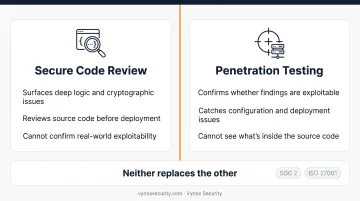
Neither replaces the other. SOC 2 and ISO 27001 auditors generally expect more than one testing method in a mature security program. Relying on only code review or only pentesting leaves a clear gap in the evidence trail.
Secure Code Review Best Practices for Development Teams
Reviewing every line of every service every sprint isn't realistic — and it's not the goal. A few practices separate teams that get real value from this process:
- Prioritize high-risk code first. Authentication, payment processing, and data-handling logic deserve review attention long before low-risk utility functions do.
- Filter with automation before going manual. Running SAST/SCA scans early clears obvious issues, freeing human reviewers to focus on logic and context.
- Standardize with a checklist. OWASP's Application Security Verification Standard (ASVS) 5.0 gives teams a testable, leveled framework rather than reinventing criteria each time.
- Keep a shared findings history. A knowledge base of past issues keeps review quality consistent across reviewers and prevents the same bug from reappearing six months later.
- Move to continuous, sprint-aligned reviews. AI model updates can open new attack surfaces overnight. Vynox's PTaaS aligns testing with sprints and model updates, with same-day retest once a fix hits staging.
How Much Does a Secure Code Review Cost?
Pricing isn't one-size-fits-all, and any vendor quoting a flat number without knowing your stack is guessing. Cost depends mainly on:
- Codebase size — lines of code and number of applications or services in scope
- Technology stack complexity — languages, frameworks, and third-party dependencies involved
- Compliance requirements — SOC 2 or ISO 27001 evidence needs add reporting depth
- Review approach — purely manual, purely automated, or a hybrid model
- Turnaround time — faster delivery windows typically carry a premium
Traditional consulting firms often stretch these engagements across many weeks, from initial scoping through final report delivery. That pace doesn't fit teams shipping weekly.
Vynox Security engagements typically complete in 3 to 15 business days depending on scope, with transparent, stage-appropriate pricing rather than a rigid rate card built only for enterprise budgets. For teams that need numbers before committing, book a discovery call or request a sample report to get an accurate quote.
Frequently Asked Questions
What is a secure code review?
A secure code review is a manual or automated examination of source code to find security vulnerabilities and weaknesses before an application reaches production. It focuses specifically on exploitable flaws rather than general code quality.
What is secure code?
Secure code is software written following secure coding practices that minimize exploitable weaknesses — things like injection flaws, weak authentication, or poor error handling. It's the goal a secure code review measures against.
What happens during a secure code review?
Reviewers analyze the application's architecture, trace how data flows through the system, and examine high-risk areas like authentication and cryptography. Findings are documented with severity ratings and remediation steps developers can act on.
How much does a secure code review cost?
Cost depends on codebase size, technology complexity, and how deep the review needs to go. Modern providers increasingly offer transparent, stage-based pricing instead of one-size-fits-all rate cards.
Is secure code review the same as penetration testing?
No — they're complementary, not identical. Code review works directly from source code, while penetration testing simulates external attacks against a running system with limited visibility inside.
How long does a secure code review typically take?
Timelines depend on codebase size and scope. Diff-based pull request reviews can take a few days; full baseline audits of large codebases often take several weeks with traditional firms, or about 3–15 business days with faster providers.