Introduction
Outsourced penetration testing used to mean one thing: a consultant shows up once a year, runs a scan, hands you a PDF, and disappears until next year's audit. That model is dead.
Between cloud sprawl, API-first architectures, and now AI systems sitting in production, your attack surface changes weekly, not annually. External security testing responsibility jumped from 33.4% to 44.9% of organizations between 2022 and 2023, according to Sonatype's 2023 DevSecOps Survey, and outsourced testing has become the default response to that pace of change.
Outsourcing sounds simple: hire a vendor, get a report, fix the bugs. In practice, outcomes vary wildly depending on scoping, vendor quality, methodology, and whether anyone actually acts on the findings.
This article covers exactly how to outsource correctly in 2026 — when it beats in-house testing, what separates a strong vendor from a shallow one, and the mistakes that sink most engagements without warning.
Key Takeaways
- Outsourcing brings certified, cross-industry expertise most in-house teams can't match
- Your risk profile and release speed determine the best testing model
- Vendor evaluation should weigh methodology and retesting policy over price
- A report without a documented retest cycle creates false confidence, not security
- Teams shipping LLMs or AI agents need AI-native testing skills, not just infrastructure scans
How to Outsource Penetration Testing the Right Way: Step-by-Step
Getting outsourced testing right isn't complicated, but it does require sequencing. Skip a step and the engagement, no matter how skilled the vendor, will underdeliver.
Step 1: Define Scope, Objectives, and Compliance Drivers
Before contacting a single vendor, document what's actually being tested:
- Assets in scope: web apps, APIs, mobile apps, internal networks, cloud infrastructure, or AI/LLM systems
- Business objective: compliance renewal, risk validation ahead of a funding round, M&A due diligence, or a customer security questionnaire
- Driving framework: SOC 2, ISO 27001, HIPAA, or PCI DSS, since each shapes testing depth differently
PCI DSS Requirement 11.4, for instance, mandates internal and external penetration testing at least every 12 months and after any significant infrastructure change. Exploitable findings must be corrected and retested before the requirement is satisfied. HIPAA doesn't name pentesting explicitly, but 45 CFR 164.308 requires a documented risk analysis covering vulnerabilities to electronic protected health information.
Vague scope produces vague results, so nail this down first.
Step 2: Choose the Right Testing Methodology and Engagement Model
Two decisions matter here:
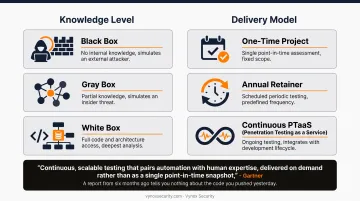
- Knowledge level: black box (no internal knowledge, simulates an external attacker), gray box (partial knowledge, simulates an insider threat), or white box (full code and architecture access, deepest analysis)
- Delivery model: one-time project, annual retainer, or continuous PTaaS (Penetration Testing as a Service)
Gartner describes PTaaS as continuous, scalable testing that pairs automation with human expertise, delivered on demand rather than as a single point-in-time snapshot. Teams shipping weekly or biweekly releases increasingly default to PTaaS because a report from six months ago tells you nothing about the code you pushed yesterday.
Step 3: Shortlist and Evaluate Vendors Rigorously
Certifications matter, but they're table stakes, not a full evaluation:
- Look for OSCP, CREST, CEH, or GPEN credentials on the actual testing team, not just marketing pages
- Ask whether the same testers stay engaged from scoping through delivery, or if you'll get a different team mid-engagement
- Request a sample report and check whether findings map to OWASP, and whether both a technical section and an executive summary are included
A vendor that hesitates to share a sample report before you sign anything is telling you something.
Step 4: Formalize Scope, Data Handling, and Legal Protections
Get this in writing before granting any system access:
- NDA terms, data encryption practices, data residency, and post-engagement data deletion policy
- Proof of cyber liability insurance
- Rules of engagement: testing windows, escalation protocol if a critical vulnerability surfaces mid-test, and who gets notified first
This step protects both sides. A vendor that can't answer these questions clearly probably hasn't thought them through internally either.
Step 5: Plan for Remediation, Retesting, and Ongoing Cadence
The test itself is only half the value. Build a remediation timeline with your internal team before testing starts, so findings don't sit in a backlog for three months.
Confirm upfront whether retesting is included, and whether it's same-day, same-week, or a separate billable event. Then decide on cadence: quarterly, per release, or continuous via a dashboard. Skipping this step is how organizations end up with documented vulnerabilities that never actually get fixed.
When Should You Outsource Penetration Testing vs Keep It In-House?
Outsourcing isn't the universal answer. The right call depends on internal resource depth, how sensitive your systems are, and what's driving the requirement.
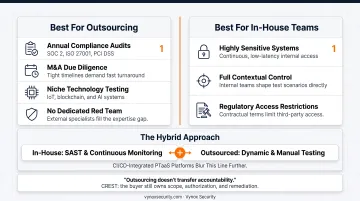
Outsourcing typically wins for:
- Annual compliance audits (SOC 2, ISO 27001, PCI DSS)
- M&A due diligence with tight timelines
- Niche technology testing — IoT, blockchain, or AI systems where in-house expertise is thin
- Organizations without a dedicated red team
In-house testing fits better when:
- Systems are highly sensitive and require continuous, low-latency internal access
- Full contextual control over test scenarios matters more than external objectivity
- Regulatory or contractual terms restrict third-party access to production environments
Regardless of which model you choose, ownership of risk doesn't shift with the contract. CREST notes that external providers bring specialist skills and independent assessment, but the buyer still owns scope, authorization, and remediation. Outsourcing doesn't transfer accountability.
For most growing engineering teams, the practical answer is a hybrid model: in-house SAST and continuous monitoring paired with outsourced dynamic and manual testing. CI/CD-integrated PTaaS platforms are blurring this line further, letting external testers plug directly into development pipelines without slowing down releases.
What to Look for in an Outsourced Penetration Testing Partner
The gap between a valuable pentest and a shallow one rarely shows up in the sales call. It shows up in methodology depth, tester quality, and whether findings are actually actionable.
Methodology: Manual Depth, Not Just Automated Scanning
Automated scanners find known CVEs fast. They don't find business logic flaws, chained privilege escalation, or authorization bypasses specific to your application's role model. Confirm the vendor blends both:
- Automated tooling for breadth and reconnaissance
- Manual, expert-driven testing for logic flaws scanners can't see
- Chained exploitation paths that link multiple low-severity issues into a critical compromise
Ask for a concrete walkthrough of how they test authorization flaws and privilege escalation paths on a stack similar to yours. If the answer is generic, that's a signal.
Reporting: Built for Both Engineers and Leadership
A report that only an engineer can parse — or only a board member can skim — isn't doing its job. Strong reports include:
- An executive summary in plain business language
- Technical findings with proof-of-concept evidence and reproduction steps
- Remediation guidance mapped to your actual stack, not generic advice
- Findings tied directly to your compliance framework's control requirements, not just severity labels
Compliance and Industry-Specific Experience
Each framework has different testing expectations, and auditors notice when a report doesn't match what they expect to see. Ask directly:
- Does the vendor have documented experience with your specific framework?
- Do findings translate into audit-ready evidence packs, or raw technical logs you'll need to reformat yourself?
- Can they produce a sample report from a similar compliance engagement?
Vynox Security, for example, structures reports as assessor-ready evidence mapped to SOC 2 and ISO 27001 control requirements, plus EU AI Act Article 15 adversarial testing, ISO 42001, and India's DPDP Act. The same engagement produces both the pentest and the compliance evidence, rather than requiring two separate workstreams.
AI-Native Testing Capabilities for Modern Attack Surfaces
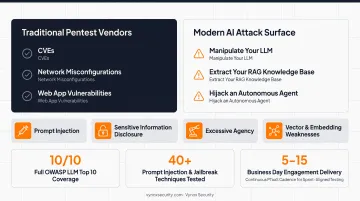
Here's the gap most buyers don't see coming. Traditional pentest vendors were built to scan for CVEs, network misconfigurations, and web app vulnerabilities. They were never designed to test whether an attacker can manipulate your LLM, extract your RAG knowledge base, or hijack an autonomous agent.
The OWASP LLM Top 10 lays out this exact risk category: prompt injection, sensitive information disclosure, excessive agency, and vector/embedding weaknesses among them. These aren't findings a traditional infrastructure scanner will ever surface.
This is precisely the gap platforms like Vynox Security are built for, offering full OWASP LLM Top 10 coverage and 40+ prompt injection and jailbreak techniques across both AI-specific and traditional infrastructure surfaces. Engagements run 5–15 business days, with continuous PTaaS cadence for teams shipping model updates every sprint.
Common Mistakes to Avoid When Outsourcing Penetration Testing
Most failed engagements share the same handful of root causes:
- Treating it as a one-time annual event. New code ships every week; a test from ten months ago doesn't cover it
- Scoping too vaguely — or too narrowly. Vague scope produces unfocused findings; narrow scope leaves critical systems untested entirely
- Choosing on price alone. CREST specifically warns against this, recommending buyers evaluate methodology, tester stability, and reporting quality instead
- Skipping the retest phase. PCI DSS requires exploitable findings to be corrected and retested; a test without verification doesn't satisfy that requirement
Exploitation of known vulnerabilities as an initial-access method jumped 180% year over year, according to Verizon's 2024 Data Breach Investigations Report. Unpatched, unverified findings are exactly what that trend feeds on.
Conclusion
Outsourcing penetration testing works when scope, vendor evaluation, and remediation planning are treated as an ongoing program rather than a one-off purchase. When engagements fail, the cause is rarely the decision to outsource. Vague scope, price-driven vendor selection, and skipped retests are the more common reasons.
For organizations building AI-powered products, the calculus has an added layer: your partner needs to test both traditional infrastructure and AI-specific attack surfaces, or you're only seeing half the risk. Vynox Security is built to close exactly that gap, testing AI systems alongside standard infrastructure in one engagement. If you want to see where that gap sits in your own stack, a free discovery call is a quick way to find out before your next engagement.
Frequently Asked Questions
What is outsourced penetration testing?
Outsourced penetration testing means hiring an external security provider to simulate real-world cyberattacks against your systems. The goal is finding and reporting exploitable vulnerabilities before actual attackers do.
What are the three types of penetration testing?
Black box testing simulates an external attacker with no prior knowledge. Gray box gives testers partial knowledge, simulating an insider threat. White box provides full code and architecture access for the deepest possible analysis.
Is pentesting being replaced by AI?
No. AI augments pentesting by speeding up discovery and evidence capture, but human expertise remains essential for business logic flaws and chained vulnerabilities. Gartner's own PTaaS definition requires both automation and human testers working together.
How much does it cost to outsource penetration testing?
Costs typically range from a few thousand dollars for a focused engagement to tens of thousands for comprehensive, multi-system testing, depending on scope and complexity. Transparent, stage-appropriate pricing is increasingly replacing flat enterprise rates among vendors.
How often should you outsource penetration testing?
Annual testing is the compliance floor for frameworks like PCI DSS. Fast-moving development teams get far more value from continuous or per-release testing through a PTaaS model.
What is PTaaS and how is it different from outsourced pentesting?
PTaaS is a subscription-based, continuous testing model with a real-time dashboard tracking vulnerabilities as they're found. Vynox, for instance, runs this cadence aligned to sprints and model updates. Traditional outsourced pentesting, by contrast, is project-based, ending with a single static report at delivery.