Here's the problem: pentesting shows up constantly in security questionnaires and funding checklists, but most founders have never scoped one, sat through one, or read a report from one. That knowledge gap costs time and money.
This guide covers what pentesting actually is, why startups can't skip it anymore, how the process works step-by-step, the different types you'll encounter, and when it does (or doesn't) make sense for your stage.
Key Takeaways
- Pentesting validates exploitable risk through human-led attacks that go beyond automated vulnerability scans.
- Enterprise buyers, auditors, and investors increasingly expect a recent, independent pentest report.
- Every engagement follows five stages: scoping, reconnaissance, exploitation, reporting, and retesting.
- AI-native startups face untested risks in LLMs, RAG pipelines, and autonomous agents that legacy pentesting misses.
- Cost, scope, and frequency should match your company's stage and risk profile.
What Is Penetration Testing?
Penetration testing is an authorized, human-led simulated attack against your systems, applications, or network, run to find and exploit vulnerabilities before someone with bad intentions does. NIST defines it as security testing in which evaluators mimic real-world attacks to identify ways around an application's or network's security controls.
The output is validated evidence, not theoretical findings: proof-of-concept exploitation, prioritized remediation guidance, and documentation you can hand to a customer, auditor, or investor as proof your security posture has actually been tested.
Penetration Testing vs. Vulnerability Scanning
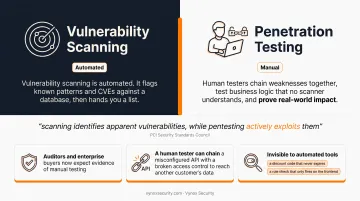
These two terms get used interchangeably, and that's a mistake. Vulnerability scanning is automated. It flags known patterns and CVEs against a database, then hands you a list.
Pentesting is manual. Human testers chain weaknesses together, test business logic that no scanner understands, and prove real-world impact. The PCI Security Standards Council draws this exact line: scanning identifies apparent vulnerabilities, while pentesting actively exploits them.
Here's why this matters for your compliance timeline:
- Auditors and enterprise buyers now expect evidence of manual testing, not a scan report with a different logo on it.
- A scan can't tell you whether an attacker can chain a misconfigured API with a broken access control to reach another customer's data. A human tester can.
- Business logic flaws (like a discount code that never expires, or a role check that only fires on the frontend) are invisible to automated tools entirely.
Why Startups Need Penetration Testing
Enterprise procurement has changed. Security reviews now sit between your sales team and a signed contract more often than not. In Vanta's 2023 survey of 2,500 IT and security leaders, 67% said customers, investors, and suppliers were increasingly demanding proof of security or compliance before moving forward.
Standardized vendor questionnaires reinforce this. Shared Assessments' SIG questionnaire, licensed by more than 500 organizations, directly asks whether independent penetration testing happens at least annually. That question is now baked into procurement, not a nice-to-have.
Auditors treat it the same way. SOC 2 and ISO 27001 don't universally mandate a pentest by name, but auditors routinely treat one as strong evidence of proactive security investment when relevant controls are in scope. Skipping it means you're explaining an absence instead of showing a report.
What Happens When Startups Skip It
The alternative to finding vulnerabilities yourself is having an attacker find them for you. That's an expensive alternative. IBM's 2023 data breach study found organizations with fewer than 500 employees averaged $3.31 million per breach, up 13.4% from the prior year.
That figure comes from a sample of companies that already got breached, so it's not a universal prediction. It also excludes softer costs: lost deals, investor hesitation, and the engineering hours spent on incident response instead of product work. For a seed-stage startup, that combination of direct and indirect costs can be harder to recover from than the breach itself, especially mid-fundraise.
The AI Attack Surface Nobody's Testing
If you're building on LLMs, RAG pipelines, or autonomous agents, you have an attack surface that traditional pentesting was never designed to touch. Prompt injection, jailbreaks, and data leakage through model outputs don't show up in a standard web app scope.
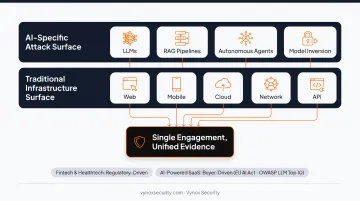
This is where specialized providers matter. Vynox Security, for example, runs a two-layer methodology that tests AI-specific surfaces (LLMs, RAG pipelines, autonomous agents, model inversion) alongside traditional infrastructure (web, mobile, cloud, network, API) within a single engagement.
For an AI-native startup, that means one workstream produces evidence covering both your model layer and your infrastructure, rather than needing two separate vendors.
Whether pentesting is best practice, regulatory-driven, or buyer-driven depends on your sector. Fintech and healthtech face closer regulatory scrutiny; AI-powered SaaS increasingly faces buyer-driven demands tied to the EU AI Act and OWASP's LLM framework.
How Penetration Testing Works: A Step-by-Step Breakdown
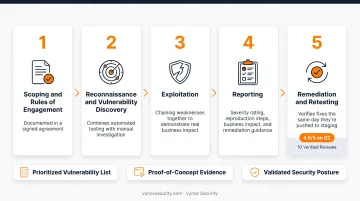
At a high level, testers define a scope, gather intelligence, attempt real exploitation, document everything, then validate your fixes after remediation. What comes out the other side: a prioritized vulnerability list, proof-of-concept evidence, and a security posture that's been validated instead of assumed.
Scoping and Rules of Engagement — Testers and stakeholders agree on target systems, testing boundaries, timing windows, and legal authorization before anyone touches a system, all documented in a signed agreement. Skipping this step crosses the line between authorized testing and unauthorized hacking under computer misuse laws in the US, UK, and India.
Reconnaissance and Vulnerability Discovery — Testers gather intelligence on the target, mapping technology stacks, exposed services, and potential entry points. This phase combines automated tooling with manual investigation to map where weaknesses are likely to exist before any exploitation begins.
Exploitation — Testers actively attempt to break in. Rather than stopping at "this looks vulnerable," they chain discovered weaknesses together to demonstrate real business impact, the same way an attacker would move through your environment.
Reporting — Every finding gets documented with a severity rating, reproduction steps, business impact, and remediation guidance. Good reports serve two audiences: engineers who need to fix the issue, and auditors who need evidence it was addressed.
Remediation and Retesting — Once your team ships fixes, the tester retests to confirm the vulnerability is actually resolved, not just patched over. Retest turnaround matters more than most founders expect: Vynox verifies fixes the same day an engineer pushes them to staging, backed by its 4.6/5 rating on G2 from 10 verified reviews.
Types of Penetration Tests Startups Should Know
Not every engagement covers the same ground. Here are the core scope categories you'll run into:
- Web application and API testing: covers OWASP Top 10 issues, broken access controls, and authentication flaws
- Internal and external network testing — checks how far an attacker could move once inside your perimeter
- Cloud configuration testing: reviews IAM privilege escalation, exposed storage, and misconfigurations across AWS, GCP, or Azure
- Mobile app testing — iOS and Android, including reverse engineering and certificate pinning bypass
- Social engineering: tests human processes, only when explicitly authorized
Timing usually follows a pattern: pre-launch, before compliance audits, after major architecture changes, before enterprise or regulated contracts, and then annually as a baseline.
AI and LLM Penetration Testing: The Newest Attack Surface
Startups building on LLMs, RAG pipelines, or autonomous agents face risks that standard web or network tests don't check for: prompt injection, jailbreaks, cross-tenant data leakage through retrieval systems, and agents that can be hijacked into taking unintended actions.
Comprehensive AI security testing should cover the OWASP Top 10 for LLM Applications, released in its current form in late 2024. Vynox runs 40+ prompt injection and jailbreak techniques per engagement, including direct injection, indirect injection via documents, role-play exploits, and multi-turn attack chains, and has extracted full system prompts in under 10 queries in some cases.
Full OWASP LLM Top 10 coverage is included in every AI engagement, so nothing in the model layer goes unchecked.
Key Factors, Misconceptions, and When a Pentest Isn't Enough
What Actually Affects Scope, Cost, and Timing
- Company stage and the size of your current attack surface
- Compliance requirements such as SOC 2, ISO 27001, HIPAA, or PCI DSS
- Whether you have an AI stack in production
- How often you ship new releases
Common Misconceptions
Two myths trip up almost every founder new to this.
First, an automated scan is not a substitute for a pentest, no matter how comprehensive the tool's marketing sounds.
Second, one annual pentest does not guarantee security between releases. Ship weekly and you've created new attack paths weekly, whether or not last year's report still looks clean.
When a One-Time Pentest Isn't Enough
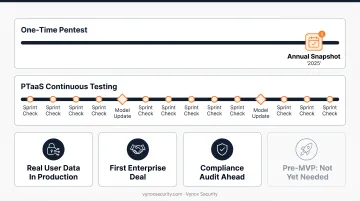
Startups shipping frequent releases, or continuously updating AI models, need continuous validation aligned with sprints rather than a single annual snapshot. This is exactly what PTaaS (Penetration Testing as a Service) models exist for, testing every sprint and every model update instead of waiting twelve months.
On the flip side: pre-MVP companies with no real attack surface yet, no user data, and nothing in production usually don't need a full engagement. Plan for it once you're handling real user data or pursuing your first enterprise deal or audit.
Frequently Asked Questions
Is penetration testing illegal?
No, as long as it's conducted with explicit written authorization and a defined scope. Testing systems without permission is unauthorized hacking, illegal under the US Computer Fraud and Abuse Act and equivalent statutes in the UK and India.
Is penetration testing still in demand?
Demand is rising, driven by enterprise procurement requirements, frameworks like SOC 2 and ISO 27001, and growing AI adoption creating attack surfaces that need validation.
Is penetration testing being replaced by AI?
Not really. AI tools are accelerating reconnaissance and scanning, but human testers remain essential for validating business logic flaws, chained exploits, and real-world impact automation alone can't reliably assess.
How much does penetration testing cost for a startup?
Costs vary by scope and depth: a focused Rapid Secure engagement on a single API or cloud environment costs less than a full Deep Secure assessment spanning web, mobile, and AI systems. Company stage, compliance needs, and whether AI systems are in scope all shape the final number.
How often should a startup run a penetration test?
At minimum, annually, with additional testing after major architecture changes, before compliance audits, and before signing enterprise contracts. Fast-shipping teams often move to PTaaS instead, aligning tests with every sprint rather than relying on a single yearly snapshot.
Do startups really need penetration testing before they have paying customers?
Pre-MVP or pre-launch startups can usually wait. Once you're handling real user data, or pursuing SOC 2 certification or an enterprise contract, it's time to plan an engagement rather than delay further.