
The stakes are higher in 2026 for a specific reason: AI systems are now part of the testable attack surface. LLMs, RAG pipelines, and autonomous agents introduce failure modes that traditional network scans were never built to catch. Security leaders need to know what's required for compliance. Job seekers need to know what skills actually get hired.
This guide covers both, starting with what a pentest actually is.
Key Takeaways
- PCI DSS mandates annual pentesting; HIPAA, SOC 2, and ISO 27001 treat it only as supporting evidence.
- AI systems now carry their own testing obligations under the EU AI Act and frameworks like ISO 42001.
- Entry-level pentesters typically need 1-4 years of IT experience plus a PenTest+ or CEH certification.
- Specializing in AI/LLM security testing is the clearest differentiator in a crowded 2026 job market.
- Average US pentester base salary sits at $103,782, according to PayScale.
What Is Penetration Testing?
Penetration testing is an authorized, simulated cyberattack designed to find exploitable vulnerabilities before a real attacker does. It differs from vulnerability scanning in one key way: a scanner flags potential weaknesses, while a pentest actively exploits them to prove real-world impact.
Testing generally falls into a few categories, based on the tester's knowledge level or the target being assessed:
- Black-box testing - the tester has no prior knowledge of the environment, mimicking an outside attacker
- White-box testing - full access to source code and architecture, useful for deep technical review
- Gray-box testing - partial knowledge, simulating an attacker with some insider access
- Network, application, and personnel testing - scoped by target type rather than knowledge level, covering infrastructure, software, or human vulnerabilities like phishing susceptibility
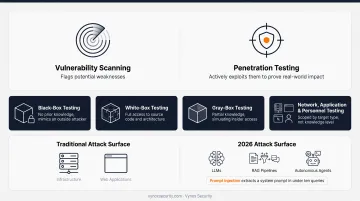
The scope has expanded fast. In 2026, the "attack surface" isn't just servers and web apps anymore. It now includes LLMs, RAG pipelines, and autonomous agents that make decisions and call tools on their own.
A traditional CVE scanner won't catch a prompt injection that extracts a system prompt in under ten queries. That gap is exactly why AI-native testing has become its own discipline.
Penetration Testing Requirements for Compliance in 2026
Regulatory and industry frameworks increasingly push organizations toward regular pentesting, even when the language stops short of an outright mandate. According to a 2024 survey by Core Security, 72% of respondents use penetration testing specifically for external compliance purposes.
Here's how that plays out across the frameworks security teams ask about most.
PCI DSS
If your organization touches cardholder data, this is the one framework with a genuinely explicit requirement. Under PCI DSS v4.0.1, Requirement 11.4 mandates:
- Conduct internal and external penetration tests at least once every 12 months
- Perform additional testing after any significant infrastructure or application change
- Test segmentation controls to confirm the cardholder data environment stays isolated from out-of-scope systems
- Require service providers to test segmentation controls every six months, not annually
Testing independence matters here too. Internal resources can perform the test, but they must be organizationally separate from the team managing the systems being tested.
HIPAA
HIPAA's current Security Rule requires an "accurate and thorough assessment" of risks to electronic protected health information, but it stops short of naming penetration testing directly. The Security Rule doesn't prescribe a specific methodology, which leaves room for interpretation.
That's changing. HHS proposed a rule in December 2024 that would require penetration testing at least every 12 months for regulated entities.
The proposal remains just that, a proposal, while the current rule stays in effect. Healthcare organizations handling patient data would be smart to treat annual testing as inevitable rather than optional.
SOC 2 and ISO 27001
Neither framework names penetration testing as a required control. SOC 2's Common Criteria 7.1 calls for identifying and evaluating vulnerabilities, without specifying a cadence. ISO 27001:2022's Annex A Control 8.8 covers management of technical vulnerabilities in similarly broad terms.
In practice, auditors and enterprise customers expect a pentest report anyway. It's become the de facto evidence that satisfies these vulnerability management controls, even though the standards themselves leave the method open.
Emerging AI and LLM Compliance Requirements
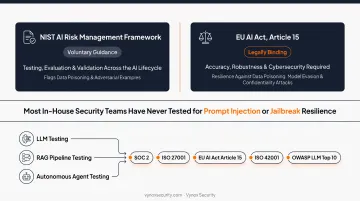
This is where most compliance guides stop, and where the real gaps are showing up. The NIST AI Risk Management Framework offers voluntary guidance on testing, evaluation, and validation across an AI system's lifecycle, flagging risks like data poisoning and adversarial examples. It's not law.
The EU AI Act is. Article 15 requires high-risk AI systems to demonstrate accuracy, robustness, and cybersecurity, explicitly including resilience against data poisoning, model evasion, and confidentiality attacks.
Most in-house security teams have never tested for prompt injection or jailbreak resilience. Vynox Security was built to close that gap, mapping findings from LLM, RAG pipeline, and autonomous agent testing directly to SOC 2 and ISO 27001 AI-specific controls.
The same findings extend to EU AI Act Article 15 adversarial testing, ISO 42001, and the OWASP LLM Top 10.
Technical and Skill Requirements to Conduct a Penetration Test
Becoming a competent pentester starts with a technical foundation that hasn't changed much in a decade, even as the targets have.
Core foundations include:
- Networking fundamentals (TCP/IP, routing, firewalls)
- Scripting in Python, Bash, and PowerShell
- Comfort across Linux, Windows, and macOS environments
- Working knowledge of cryptography
- Cloud architecture familiarity across AWS, GCP, and Azure
Tools of the Trade
No tester gets far without a working toolkit, and the same handful of tools shows up in job postings and daily workflows alike. The standards include:
- Kali Linux - the go-to penetration testing distribution, pre-loaded with security tools
- Nmap - network scanning and host discovery
- Burp Suite - web application testing and traffic interception
- Metasploit - exploit development and delivery framework
- Wireshark - packet capture and traffic analysis
- Nessus - vulnerability scanning and assessment
Certifications by Career Stage
Which certification makes sense depends on where you are in your career:
| Certification | Best For | Format |
|---|---|---|
| CompTIA PenTest+ | Early-career testers | Multiple-choice and performance-based, ~165 minutes |
| CEH | Early-career, knowledge-focused roles | Knowledge exam plus optional practical component |
| OSCP | Intermediate to advanced | 24-hour hands-on practical exam |
| GPEN | Intermediate to advanced | Proctored exam, 82 questions |
The 2026 Differentiator: AI-Native Testing
Certifications validate baseline knowledge, but prompt injection testing, jailbreak assessment, and agentic AI vulnerability work are becoming the skills that separate candidates in a saturated job market. Testers who can only run Nmap and Burp Suite are competing with thousands of others. Testers who understand RAG pipeline exfiltration or agent goal-hijacking are competing with far fewer. It's the skill set companies like Vynox Security build their AI security testing practices around.
Don't overlook soft skills either. Report writing is as valuable as technical chops. A finding that an engineer can't reproduce and an executive can't understand doesn't get fixed.
2026 Career Guide: How to Become a Penetration Tester
Breaking into pentesting follows a fairly consistent path, even as the specific tools shift year to year.
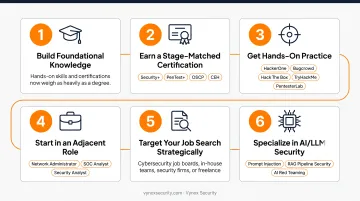
- Build foundational knowledge. A four-year degree helps but isn't universally required. Many hiring managers weigh hands-on skills and certifications just as heavily as a diploma.
- Earn a stage-matched certification. Start with Security+ or PenTest+, then progress toward OSCP or CEH as experience grows.
- Get hands-on practice. Bug bounty platforms like HackerOne and Bugcrowd offer real-world exposure. Hack The Box, TryHackMe, and PentesterLab provide structured labs for building repeatable skills.
- Start in an adjacent role. Network administrator, SOC analyst, or general security analyst positions build the operational context pentesting requires.
- Target your job search strategically. Use dedicated cybersecurity job boards alongside general listings, and decide early whether you want in-house teams, security firms, or freelance engagements.
- Specialize in AI/LLM security. As more products ship with LLMs and agents built into, testers who can assess prompt injection resilience and RAG pipeline security stand out immediately.
Penetration Tester Salary, Job Outlook, and Career Path
Compensation data backs up the demand security teams are already feeling.
- Average base salary: $103,782 per year in the US, according to PayScale, with a range of roughly $68,000 to $152,000 depending on experience and specialization
- Job growth: the U.S. Bureau of Labor Statistics projects 29% growth for information security analysts between 2024 and 2034, far outpacing the average for all occupations
- Specialization premium: testers with hands-on AI security experience, such as LLM and RAG pipeline testing, can command pay above the standard range
Career progression typically follows three stages:
- Junior penetration tester – runs scoped tests under supervision
- Senior or lead tester – owns engagements and often specializes in a niche like AI security testing
- Security manager or consultant – leads a team or builds an independent practice
Meeting 2026 Penetration Testing Requirements: In-House Team vs. Specialized Partner
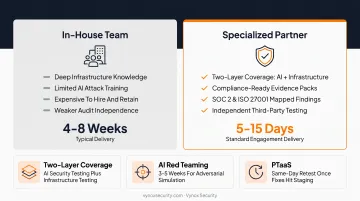
Building an internal pentesting function sounds appealing until you account for what it actually takes to keep the team current. Most in-house teams have deep infrastructure knowledge but little to no training in AI-specific attack techniques like prompt injection or RAG exfiltration testing. Hiring and retaining that specialized skill set is expensive, and the talent pool is thin.
There's also an audit reality : compliance evidence for SOC 2 and ISO 27001 increasingly favors independent, third-party testing. Auditors trust findings more when the tester has no stake in the outcome.
This is the gap specialized partners fill. Vynox Security, for example, delivers compliance-ready evidence packs, mapped findings, reproduction steps, CVSS scores, and executive summaries within 5-15 business days for standard engagements. Traditional firms typically take 4-8 weeks for the same deliverables.
Here's how the model works in practice:
- Two-layer coverage: AI Security Testing (LLMs, RAG pipelines, agents, model inversion) sits alongside Infrastructure Testing (web, mobile, cloud, network, API), so nothing in the stack goes untested
- AI Red Teaming runs 3-5 weeks for deeper, scenario-driven adversarial simulation
- Pentest-as-a-Service (PTaaS) aligns testing to development sprints and model updates rather than an annual calendar, with same-day retest verification once fixes hit staging
For teams shipping AI features every sprint, this continuous cadence matters more than a once-a-year snapshot ever could.
Frequently Asked Questions
What is required for penetration testing?
A defined scope, a tester with the right tools and skills, and often a compliance driver like PCI DSS, HIPAA, or ISO 27001 depending on your industry. The specifics shift based on what you're testing and why.
Do you need a degree to become a penetration tester?
A degree helps but isn't mandatory. Certifications like PenTest+ or OSCP, combined with hands-on experience, often carry equal or greater weight with hiring managers.
How long does it take to become a penetration tester?
Most professionals spend 1-4 years in an adjacent IT or security role, such as SOC analyst or network administrator, before transitioning into a dedicated pentesting position.
Is penetration testing required for SOC 2 or ISO 27001 compliance?
Neither framework explicitly mandates it. Both expect vulnerability management evidence, and a pentest report is typically the clearest way to satisfy that expectation.
How much do penetration testers earn in 2026?
The US average base salary sits around $103,782, according to PayScale, with a range of roughly $68,000 to $152,000 depending on certification level and specialization, particularly in AI security testing.
What certifications are best for a penetration testing career?
CompTIA PenTest+ and CEH suit entry-level testers. OSCP and GPEN are better fits once you have a few years of hands-on experience under your belt.