Introduction
Cloud adoption outpaced security teams years ago, and the gap keeps widening. By late 2023, 89% of organizations were running multi-cloud environments, up from 87% the year before, according to Flexera's 2024 State of the Cloud Report.
That growth didn't come with matching security headcount.
Security teams now juggle SOC 2, ISO 27001, HIPAA, and GDPR at the same time, often manually, while cloud resources change by the minute. AI-powered and SaaS companies feel this pressure most acutely, since new models, agents, and data pipelines ship every sprint.
This article covers what cloud security compliance actually means, the frameworks that matter most, common pitfalls, and the best practices (including continuous validation) that keep organizations audit-ready year-round.
Key Takeaways
- Cloud security compliance maps controls to regulatory, industry, and contractual rules, separate from security alone
- ISO 27017/27018, NIST, CSA CCM, and SOC 2 each address different slices of cloud risk
- Configuration drift and shared responsibility confusion cause most compliance gaps
- Continuous monitoring and independent testing keep you compliant better than annual audits alone
What Is Cloud Security Compliance?
Cloud security compliance is the set of controls, policies, and audits an organization implements to meet regulatory and industry standards while protecting data hosted in cloud environments. It's the evidence layer that proves your security program actually works, not just that it exists on paper.
Compliance vs. Security: Two Different Jobs
Cloud security compliance and cloud security aren't interchangeable, even though people use the terms loosely.
- Cloud security = the technical controls (encryption, IAM, network segmentation) that actually stop attacks
- Cloud compliance = the regulatory and contractual proof that those controls exist and function correctly
Treating them as one thing creates blind spots. A team can pass every technical control and still fail an audit because they never documented access reviews. The reverse happens too: organizations chase paperwork while real misconfigurations sit exposed.
The Shared Responsibility Model
Every major cloud provider splits security duties with customers:
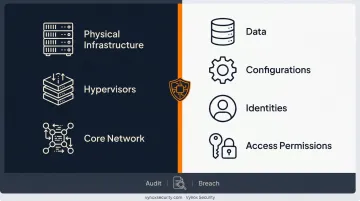
- Providers secure the physical infrastructure, hypervisors, and core network
- Customers secure data, configurations, identities, and access permissions
Misunderstanding this split is one of the most common reasons compliance gaps go unnoticed until an audit or a breach surfaces them.
Who Needs This Most
Cloud compliance isn't optional for certain sectors:
- Healthcare and fintech handling regulated data under HIPAA or PCI DSS
- B2B SaaS and AI companies pursuing enterprise deals that require SOC 2 or ISO 27001 evidence before a contract gets signed
- Healthcare and fintech handling regulated data under HIPAA or PCI DSS
- B2B SaaS and AI companies pursuing enterprise deals that require SOC 2 or ISO 27001 evidence before a contract gets signed
- Any team under enterprise security questionnaires where contractual proof of cloud controls is a condition of the deal
According to Vanta's 2024 State of Trust Report, which surveyed 2,500 business and IT leaders across the US, UK, and Australia, 65% of organizations said customers, investors, and suppliers are increasingly demanding proof of compliance before doing business. Enterprise procurement teams simply won't sign without it.
Key Cloud Compliance Standards and Frameworks
These are the frameworks auditors, cloud providers, and enterprise procurement teams reference most often when they evaluate whether your cloud environment is trustworthy.
ISO/IEC Standards for Cloud Security
ISO/IEC 27001 is the backbone. It defines requirements for building and maintaining an information security management system (ISMS), applicable to organizations of any size or sector.
Two cloud-specific extensions build on it:
- ISO/IEC 27017 adds cloud-specific controls, such as VM hardening and shared responsibility clauses in SLAs, for both providers and customers
- ISO/IEC 27018 governs how public cloud providers handle personally identifiable information (PII) they process on a customer's behalf
NIST Frameworks
The NIST Cybersecurity Framework 2.0 organizes security activity around six core functions: Govern, Identify, Protect, Detect, Respond, and Recover. Govern was added in the 2.0 update, making it the current standard rather than the older five-function version some teams still reference.
NIST SP 800-53 provides a detailed catalog of security and privacy controls. It's mandatory for federal systems, but plenty of private companies adopt it voluntarily as a rigorous baseline, especially those selling into government-adjacent industries.
CSA STAR Program and Cloud Controls Matrix (CCM)
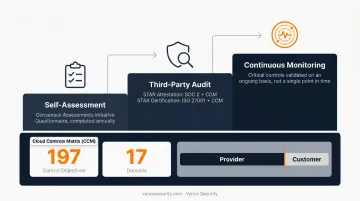
The Cloud Security Alliance (CSA) runs the STAR program, which certifies cloud security posture across three levels:
- Self-assessment: organizations complete the Consensus Assessments Initiative Questionnaire annually
- Third-party audit: includes STAR Attestation (SOC 2 plus CCM) and STAR Certification (ISO 27001 plus CCM)
- Continuous monitoring: CSA's most rigorous tier, with critical controls validated on an ongoing basis rather than at a single point in time
The Cloud Controls Matrix (CCM) underpins all three levels. It contains 197 control objectives spread across 17 domains, mapping which party in the cloud supply chain — provider or customer — should implement each one.
SOC 2 in Cloud Environments
SOC 2 isn't exclusive to cloud companies. It applies to any service organization handling customer data, evaluated against the AICPA's Trust Services Criteria covering security, availability, processing integrity, confidentiality, and privacy. It has become closely associated with SaaS and cloud vendors because buyers ask those vendors for it most often.
Generating audit-ready SOC 2 evidence (access logs, penetration test reports, remediation records) is often the slowest part of the process. Vynox Security addresses this directly: its compliance-ready evidence packs map penetration test findings to SOC 2 and ISO 27001 control requirements. Evidence collection becomes a byproduct of testing instead of a separate scramble before an audit deadline.
Industry-Specific and Regulatory Standards
| Standard | Covers | Cloud-Specific Requirement |
|---|---|---|
| HIPAA | Healthcare/PHI | Cloud providers holding ePHI qualify as business associates and need a signed BAA |
| PCI DSS | Payment card data | Baseline technical requirements apply across merchants, processors, and cloud service providers |
| GDPR | EU personal data | Article 32 requires risk-appropriate security measures; Article 33 requires 72-hour breach notification |
| FedRAMP | US federal cloud services | Standardizes assessment and authorization for IaaS, PaaS, and SaaS handling federal data |
Cloud Service Provider (CSP) Frameworks
AWS splits responsibility clearly: AWS secures the infrastructure "of" the cloud (hardware, networking, facilities), while customers secure everything "in" the cloud, including operating systems, IAM permissions, and data encryption. The AWS Well-Architected Framework's security pillar builds practical guidance on top of that split.
Azure and Google Cloud publish equivalent frameworks. Both organize guidance around a similar security pillar covering confidentiality, integrity, and ongoing posture improvement. The logic is consistent even if the terminology varies slightly between providers.
Common Cloud Compliance Challenges
Most compliance failures trace back to the same handful of root causes.
- Configuration drift: Resources change constantly, so point-in-time audits go stale almost as soon as evidence is collected
- Shared responsibility confusion: Teams assume the provider covers security and stop monitoring data, access, and app-layer controls
- Multi-framework complexity: AI and SaaS companies juggle SOC 2, ISO 27001, and customer questionnaires with teams of two or three
These aren't hypothetical risks. A CSA survey of 2,037 IT and security professionals found only 23% had full visibility into their cloud environments, meaning 77% operated with meaningful blind spots—often from container and serverless complexity.
Those blind spots show up in real incidents. A Thales study of 3,000 respondents across 18 countries found 31% of cloud breaches traced back to misconfiguration or human error, not sophisticated attacks. The vulnerabilities were already there. Nobody caught them in time.
Cloud Security Compliance Best Practices
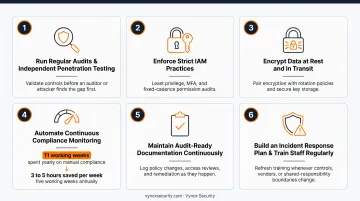
These six practices consistently separate organizations that pass audits smoothly from those scrambling every cycle.
Run regular audits and independent penetration testing. Validate controls before an external auditor or an attacker finds the gap first. Manual testing catches logic flaws and chained exploits that automated scanners miss entirely.
Enforce strict IAM practices. Apply least privilege, require multi-factor authentication (MFA), and audit permissions on a fixed cadence rather than reactively.
Encrypt data at rest and in transit. Pair encryption with sound key management: rotation policies, access restrictions, and secure storage for the keys themselves.
Automate continuous compliance monitoring. Manual reviews can't keep pace with cloud change velocity. Vanta's 2024 State of Trust Report found organizations spend 11 working weeks per year on compliance tasks, but automation could save an estimated 3 to 5 hours per week, or roughly five working weeks annually.
Maintain audit-ready documentation continuously. Log policy changes, access reviews, and remediation as they happen. This turns audits into validation exercises instead of fire drills.
Build an incident response plan and train staff regularly. Cloud-specific obligations shift often, so refresh training whenever controls, vendors, or shared-responsibility boundaries change.
Organizations that treat compliance as a continuous habit spend far less time preparing for audits and far more time reducing risk.
How Continuous Security Validation Strengthens Cloud Compliance
Auditors increasingly expect proof of active testing, not just policy binders. SOC 2 and ISO 27001 controls both reference vulnerability management and independent security validation as part of demonstrating that controls actually function. A documented policy alone no longer meets that bar, which is why continuous validation belongs in the compliance program.
Assessments of AWS, Azure, and GCP environments surface the misconfigurations that most often slip past standard reviews:
- IAM privilege paths that let a low-privilege credential chain into admin access
- Public exposure of S3 buckets, storage snapshots, and machine images
- Security group and network rules that leave internal services reachable from the internet
- Secrets management gaps, including missing key rotation
- Weak AI workload isolation, where one open bucket can expose model weights, training data, and source code
When findings map to SOC 2 and ISO 27001 control requirements, the report doubles as compliance evidence. Vynox Security cloud assessments typically turn around in 3 to 5 business days, with developer-ready fix guidance (reproduction steps, stack-specific remediation, and severity scoring) so teams can close gaps before an audit deadline.
Organizations that run continuous testing through a PTaaS model accumulate that evidence sprint over sprint. Cloud environments stay audit-ready year-round, not only in the weeks before a formal review.
Frequently Asked Questions
What is cloud security compliance?
Cloud security compliance is adherence to the security controls and regulatory standards that protect cloud-hosted data, typically demonstrated through frameworks like SOC 2 and ISO 27001. It proves your security controls work, not just that they exist.
Is SOC 2 for cloud only?
No. SOC 2 applies to any service organization handling customer data, whether hosted in the cloud or on-premises. It's just become closely associated with SaaS and cloud vendors because that's who buyers ask for it most.
What is CSA and CCM?
The Cloud Security Alliance (CSA) is an industry body that publishes the Cloud Controls Matrix (CCM). CCM is a framework of 197 control objectives across 17 domains used to assess cloud provider and organizational security posture.
What is security and compliance in AWS?
AWS security and compliance rests on the shared responsibility model: AWS secures the infrastructure, and customers secure what runs on it. The AWS Well-Architected Framework's security pillar provides practical implementation guidance.
What is the shared responsibility model in cloud compliance?
It's the division of security duties between cloud provider and customer: providers secure underlying infrastructure, customers secure data, configurations, and access. Misunderstanding this split causes most unmonitored compliance gaps.
How often should cloud compliance be audited or tested?
Continuous monitoring should run year-round, supplemented by periodic third-party audits and independent penetration tests. Increase testing after major infrastructure changes, new product launches, or model updates.