Introduction
Nearly 50,000 new vulnerabilities were published to the National Vulnerability Database in 2025 alone, based on NVD's own publication-date records. That's roughly 137 new weaknesses disclosed every single day.
Meanwhile, the average data breach now costs organizations $4.99 million globally, according to IBM's 2026 Cost of a Data Breach Report. That same report found a 56% jump in AI-driven attacks.
Here's the real problem: your attack surface is growing faster than your team can track it. Cloud services, APIs, mobile apps, and now LLMs and AI agents all add new entry points daily. Manual tracking simply doesn't scale.
This guide covers what a vulnerability assessment actually is, the five steps involved, how it differs from penetration testing and vulnerability management, and why AI systems now require an entirely new layer of testing.
Key Takeaways
- Vulnerability assessments identify, classify, and prioritize security weaknesses across IT and AI systems
- The process follows five steps: scoping, testing, analysis, prioritization, and remediation
- Assessments differ from ongoing vulnerability management and from active-exploit penetration testing
- LLMs, RAG pipelines, and AI agents create attack surfaces traditional scanners cannot see
- Compliance frameworks like SOC 2 and ISO 27001 require documented, regular testing evidence
What Is a Vulnerability Assessment (and Why It Matters)?
A vulnerability assessment is a systematic review that identifies, classifies, and reports on security weaknesses across an organization's systems. Each finding gets a severity rating and remediation guidance, giving security teams a clear roadmap instead of a raw list of problems.
It's a point-in-time snapshot, not an ongoing activity. Run it today, and you get an accurate picture of today's weaknesses. Run it again in three months, and the picture will have changed.
Vulnerability vs. Threat vs. Risk
These three terms get mixed up constantly, and the confusion causes real problems in prioritization meetings.
- Vulnerability — a weakness in a system, process, or control that could be exploited
- Threat — a circumstance or actor with the potential to exploit that weakness
- Risk — the combination of likelihood and impact if the threat actually exploits the vulnerability
An unpatched server (vulnerability) plus an attacker actively scanning for it (threat) equals a genuine risk that needs prioritizing above a theoretical weakness nobody is targeting.
The Compliance Angle
Frameworks like SOC 2, ISO 27001, PCI DSS, and GDPR don't just recommend testing; they build it into their control structures:
- SOC 2 CC7.1 calls for periodic vulnerability scans plus scans after significant environmental changes
- ISO/IEC 27001 Annex A control 8.8 covers management of technical vulnerabilities directly
- PCI DSS v4.0.1 requires internal scans on a recurring basis and external ASV scans at least every three months
- GDPR Article 32 requires a process for regularly testing and evaluating security measures
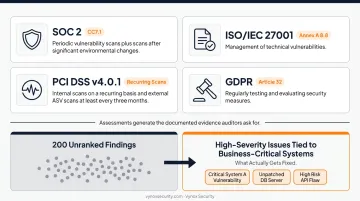
Assessments generate the documented evidence auditors ask for. Without them, you're describing your security posture instead of proving it.
Beyond compliance, assessments give dev and security teams visibility into which weaknesses actually matter. Instead of a backlog of 200 unranked findings, teams get a short list of high-severity issues tied to business-critical systems — which is what actually gets fixed.
Types of Vulnerability Assessments
Not every assessment looks the same. The right type depends on what you're trying to protect.
Network-Based Assessments
These scans identify exploitable weaknesses across wired and wireless infrastructure: open ports, insecure protocols, and unpatched network devices. Internal scans tend to surface far more issues than external ones, since they see what an insider (or an attacker who's already in) would see.
Host-Based Assessments
Host-based scans dig into individual servers, workstations, and containers. They reveal patch history and configuration issues that a network scan simply can't see because they require deeper, authenticated access to the machine itself.
Application and Database Assessments
This is where SQL injection, cross-site scripting (XSS), broken authentication, and database misconfigurations surface. Web apps and data stores are frequent breach entry points, and OWASP's Web Security Testing Guide remains the standard reference for this category.
Wireless Network Assessments
These focus on Wi-Fi environments, hunting for rogue access points, weak encryption standards, and misconfigured wireless controllers that could let an attacker walk onto your network without ever touching a cable.
AI and LLM Vulnerability Assessments (The New Attack Surface)
Here's the gap most security teams haven't closed yet: traditional scanners were built to find CVEs and network misconfigurations. They have no mechanism to detect prompt injection, jailbreaks, insecure RAG pipeline data leakage, or autonomous agent misuse, because none of these live at the CVE or network layer.
The OWASP Top 10 for LLM Applications formalizes these risks, including:
- Prompt injection and system prompt leakage
- Sensitive information disclosure
- Supply chain issues and data poisoning
- Excessive agency
- Vector and embedding weaknesses
AI-native security testing extends traditional methodology into that layer. Vynox Security, for example, runs full OWASP LLM Top 10 coverage plus 40+ prompt injection and jailbreak techniques in every AI engagement:
- Direct and indirect injection (documents, tool outputs)
- Role-play exploits and token manipulation
- Multi-turn attack chains
Testers have extracted a full system prompt in under 10 queries—a finding no CVE scanner can surface.
The Vulnerability Assessment Process: 5 Key Steps
A proper assessment follows a repeatable structure, whether you're testing a network or a RAG pipeline.
- Scoping and preparation — Define which assets, applications, and systems (including AI models and pipelines) are in scope, and estimate the business impact if each were compromised.
- Vulnerability identification and testing — Run automated scans and/or manual testing against the defined scope, referencing vulnerability databases and threat intelligence feeds.
- Vulnerability analysis — Determine root cause for each finding: an outdated library, a misconfiguration, unvalidated input. Root-cause analysis shapes real remediation, not just surface patches.
- Risk assessment and prioritization — Rank findings by severity, exploitability, and business impact. CVSS scores (0.0 to 10.0, with bands from Low to Critical) are the industry standard for this.
- Remediation and reporting — Patch, reconfigure, or mitigate each finding, then document results with reproduction steps and evidence for stakeholders and auditors.
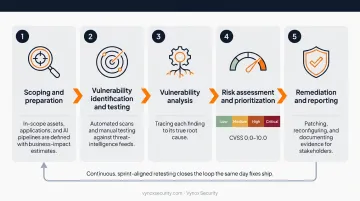
None of this is a one-time exercise. Software and AI models change weekly, sometimes daily, so a scan from six months ago tells you very little about today's risk. Continuous, CI/CD-integrated testing is now the baseline for teams that ship frequently.
Vynox Security's PTaaS model matches that cadence: testing aligns with every sprint and every model update. A real-time dashboard tracks open vulnerabilities by severity alongside an overall security posture score.
When engineers push a fix to staging, retests happen the same day, closing a feedback loop that annual pentests leave open for months.
Vulnerability Assessment vs. Vulnerability Management vs. Penetration Testing
These three terms get used interchangeably, but they describe different things.
| Concept | What It Is | When It's Used |
|---|---|---|
| Vulnerability Assessment | A point-in-time evaluation that identifies and catalogs weaknesses | Regular hygiene checks, compliance evidence |
| Vulnerability Management | The ongoing program that assessments feed into | Continuously, as a broader security capability |
| Penetration Testing | Active exploitation to simulate a real attacker | Before major launches, after significant changes |
An assessment tells you a door is unlocked. A penetration test walks through it, checks what's inside, and confirms how far an attacker could actually get. Vulnerability management is the entire ongoing operation of finding, tracking, and closing those doors, quarter after quarter.
Most mature security programs need all three, on staggered timelines: assessments running regularly, management tying it all together, and pentests validating defenses at critical moments.
Vulnerability Assessment Tools, Best Practices, and Choosing the Right Partner
Tool Categories
Three broad categories cover most assessment work:
- Network and protocol scanners — discover live hosts, open ports, and exposed services
- Application scanners — test for known weakness patterns in code and web apps (though signature-based tools can generate false positives)
- Threat intelligence platforms — provide context on which vulnerabilities are being actively exploited in the wild
Best Practices
- Schedule automated scans on a recurring basis, not just once a year
- Integrate testing directly into CI/CD pipelines so issues surface before deployment
- Reassess after every major system, application, or AI model update
- Rescan after remediation to confirm the fix actually worked
Choosing a Testing Partner
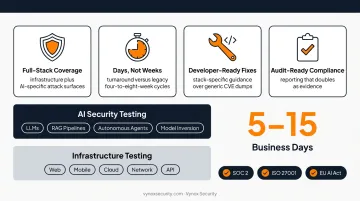
Traditional infrastructure coverage isn't enough anymore. When evaluating a partner, look for:
- Coverage across both traditional infrastructure and AI-specific attack surfaces
- Turnaround measured in days, not the 4-8 weeks common at legacy firms
- Developer-ready remediation guidance, not generic CVE recommendations
- Compliance-mapped reporting that doubles as audit evidence
Vynox Security covers that mix in one engagement. Its two-layer methodology pairs AI Security Testing (LLMs, RAG pipelines, autonomous agents, model inversion) with supporting Infrastructure Testing (web, mobile, cloud, network, API), typically delivered in 5–15 business days depending on scope.
Findings map directly to SOC 2, ISO 27001, and EU AI Act evidence requirements. Reports are written for both engineers and leadership, with developer-ready fixes instead of generic CVE dumps.
Frequently Asked Questions
What is a cyber vulnerability assessment?
It's the process of identifying, classifying, and reporting security weaknesses across an organization's IT and AI systems. The goal is to reduce breach risk through documented, prioritized findings.
What is the difference between CVE and CVSS?
A CVE is a unique identifier and catalog entry for a known vulnerability. CVSS is the scoring framework (0.0 to 10.0) used to rate how severe that vulnerability actually is.
What is the difference between a vulnerability assessment and a penetration test?
Assessments identify and catalog weaknesses without exploiting them. Penetration tests actively exploit those weaknesses to confirm whether real-world defenses would hold up.
How often should a vulnerability assessment be performed?
Continuous or quarterly testing is the current baseline, with additional scans after any major infrastructure, application, or AI model change. PCI DSS, for example, requires external scans at least every three months.
What is the difference between vulnerability assessment and vulnerability management?
An assessment is the discovery step, a single scan producing a set of findings. Vulnerability management is the broader, ongoing program that uses those findings to drive continuous remediation.
How long does a vulnerability assessment typically take?
Timelines vary by scope. Automated scans can finish in hours; comprehensive assessments covering AI systems, RAG pipelines, or agents often take one to two weeks.