Introduction
APIs now carry the majority of web traffic, not just a slice of it. According to Imperva's 2024 State of API Security report, API calls account for 71% of all web traffic. Every one of those endpoints is a potential entry point for an attacker.
The security incident data backs this up. Akamai's 2024 API Security Impact Study found that 84% of security professionals experienced an API security incident in the past year.
Many security teams still struggle with coverage. They stitch together scanners, gateways, and periodic manual reviews—yet that patchwork misses business logic flaws, shadow APIs, and risks from AI and LLM-powered features.
This guide breaks down what API security testing tools are, the main categories on the market, the features worth paying for, and why tools alone can't replace expert-led penetration testing.
Key Takeaways
- Automate detection of injection flaws, broken authentication, and misconfigurations across REST, GraphQL, and SOAP APIs
- Layer SAST/DAST scanners, discovery tools, and gateways: no single category covers the full lifecycle
- Pair automation with manual and AI-native pentesting to catch business logic abuse scanners miss
- Match tools to API type, deployment environment, and compliance needs such as SOC 2 or ISO 27001
What Are API Security Testing Tools?
API security testing tools are software (and the methods behind them) built to find vulnerabilities, misconfigurations, and logic flaws in APIs, both before deployment and after. They differ from general application security tools because APIs expose data structures and business logic directly, with no UI layer to hide weak spots.
That same exposure is what separates them from API management tools and gateways. Gateways handle routing, authentication, and traffic control. They keep APIs running smoothly. They do not hunt for vulnerabilities; that is the job of a dedicated testing tool or tester.
What These Tools Actually Test For
Most reputable tools benchmark against the OWASP API Security Top 10 (2023 edition). A few of the most common risks:
- Broken Object Level Authorization (BOLA): API never checks that the caller owns the object; change an ID in the URL and pull someone else's data
- Broken Authentication: Weak token validation, unsigned JWTs, or expiration checks that never run
- Broken Object Property Level Authorization: Formerly "excessive data exposure": the API returns or accepts fields the user should never see or change
Effective testing has to span the entire API lifecycle:
- Design-time: Review the OpenAPI/Swagger schema before a line of code ships
- Pre-production: Scan inside CI/CD pipelines before deployment
- Runtime: Monitor live behavior for abuse patterns
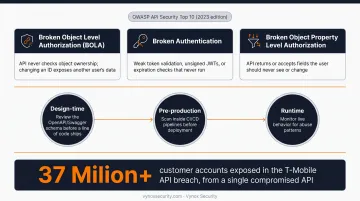
The stakes are concrete. When T-Mobile disclosed a breach tied to a single compromised API, it exposed personal data from more than 37 million prepaid and postpaid customer accounts. One API. Tens of millions of records.
Types of API Security Testing Tools
API security testing tools generally fall into five overlapping categories. Each one covers a different stage or angle of the attack surface. None of them cover everything on their own.
Static Analysis (SAST) & API Spec Scanners
SAST tools analyze source code and OpenAPI/Swagger definitions to catch design-time flaws before anything reaches production: missing authentication requirements, insecure schema definitions, and overly permissive data types.
Strength: cheap and early. Catching a flaw in a spec review costs far less than catching it after launch.
Limitation: these tools can't see runtime behavior or how a business process might be abused. A schema can look perfectly secure and still allow logic exploitation once live.
Dynamic Analysis (DAST) & Fuzzing Tools
DAST tools send crafted requests to a live or staging API to surface injection flaws, authentication bypasses, and error-handling issues. Fuzzing tools go a step further, feeding invalid or random inputs to see what breaks.
Strength: finds runtime issues static analysis can't see, including injection flaws and auth bypasses.
Limitation: needs a running API and skilled interpretation. False positives are common and costly to chase.
API Discovery & Inventory Tools
You can't test what you don't know exists. Discovery tools continuously scan network traffic, cloud environments, and code repositories to surface documented APIs, undocumented "shadow" APIs, and deprecated "zombie" endpoints still quietly running in production.
This gap is bigger than most teams assume. Akamai's 2024 research found that only 27% of organizations had both a complete API inventory and knew which APIs handled sensitive data — down from 40% the year before. That's not a shadow-API prevalence number, but it's a clear signal that visibility is slipping in the wrong direction.
API Gateways, WAFs & WAAP Platforms
Gateways, web application firewalls, and WAAP platforms enforce authentication, rate limiting, and schema validation at runtime. They're genuinely useful, but they're perimeter-focused.
Internal, east-west API traffic between microservices often flows right past them. These are protection tools, not testing tools, even though vendors and buyers frequently lump the two together.
Penetration Testing & Manual/AI-Assisted Assessment
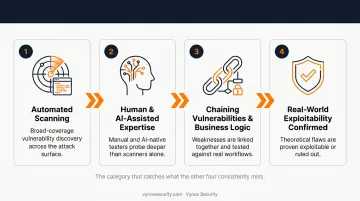
This category combines automated scanning with human (or AI-native) expertise to chain vulnerabilities together, probe business logic, and confirm whether a theoretical flaw is actually exploitable in the real world. It's the category that catches what the other four consistently miss.
Key Features to Look for in API Security Testing Tools
Not every tool on the market delivers equal value. Before you buy or build an in-house stack, prioritize these capabilities:
- Continuous discovery with full OWASP API Top 10 coverage, so new endpoints and shadow APIs don't sit untested for weeks
- CI/CD and SDLC integration that catches issues in the pipeline without slowing developers
- Developer-ready reporting with reproduction steps and specific remediation guidance, not a raw dump of vulnerability IDs nobody has time to decode
- Compliance mapping that ties findings directly to SOC 2 and ISO 27001, so audit prep isn't a separate scramble
A tool that checks all four boxes will save far more engineering time than one that only scans fast and reports loosely.
Why Automated Tools Alone Aren't Enough
Automated scanners are strong at what they're built for: missing security headers, weak TLS configurations, known CVEs. Pattern-based flaws. Where they consistently fall short is business logic abuse and authorization flaws — the exact issues that cause the biggest breaches.
OWASP's own testing guide says it plainly: automation of business logic abuse cases isn't possible, and it "remains a manual art" dependent on the tester's understanding of the full business process. BOLA is the textbook example — a scanner can confirm an endpoint responds, but it has no idea whether the specific user making the request should be allowed to see that specific object. That judgment call requires a human.
The AI Layer Adds a New Problem
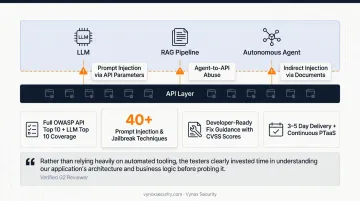
APIs increasingly sit behind AI agents, RAG pipelines, and LLM-powered features. That introduces attack surfaces traditional scanners were never built to test — prompt injection delivered through API parameters, agent-to-API abuse, indirect injection via documents that flow through an API into a model's context window.
Closing that gap means treating AI testing and API testing as one engagement, not two workstreams. Vynox Security, for example, layers traditional API penetration testing with AI-native testing across LLMs, RAG pipelines, and autonomous agents.
Expert-led testing in this model typically delivers:
- Full OWASP API Top 10 and OWASP LLM Top 10 coverage in every relevant engagement, hand-tested rather than scanner-generated
- 40+ prompt injection and jailbreak techniques against systems where APIs feed AI models
- Developer-ready fix guidance with HTTP-level evidence, reproduction steps, and CVSS scores — not generic "sanitize your inputs" advice
- 3–5 business day delivery for API engagements, plus continuous PTaaS options that verify fixes the same day they're pushed to staging
One verified G2 reviewer put it directly: "Rather than relying heavily on automated tooling, the testers clearly invested time in understanding our application's architecture and business logic before probing it." That's the manual reasoning automated scanners simply can't replicate.
The practical answer isn't choosing tools or pentesting — it's layering both. Use automated tools for continuous baseline coverage across your known API surface, then schedule expert-led testing to validate business logic, chain exploits together, and produce audit-ready evidence for SOC 2 or ISO 27001 reviews.
API Security Testing Best Practices
A few habits separate teams with strong API security from teams reacting to breaches after the fact:
- Test early and continuously: Embed API scanning into CI/CD pipelines instead of saving it for pre-release crunch time.
- Maintain a live API inventory: Untracked shadow and zombie endpoints are often the first entry point attackers find.
- Combine tool categories: SAST, DAST, discovery, and periodic pentesting each cover a different blind spot; no single tool does it all.
- Revisit your strategy when adding AI features: A RAG pipeline or agentic workflow can change your API risk profile overnight, and your testing plan needs to change with it.
Teams that treat this as an ongoing program rather than a one-time checklist face far fewer surprises in audits and in actual attacks.
Frequently Asked Questions
What are API security tools?
They're software and testing approaches that identify and help remediate vulnerabilities across API authentication, business logic, and data exposure. Most benchmark against the OWASP API Security Top 10.
What are the best practices for API security?
A full list spans authentication, rate limiting, discovery, encryption, monitoring, and testing. The most critical: maintain a live inventory, enforce strong authorization checks, encrypt data in transit, and test continuously rather than once a year.
Are API gateways enough for API security?
No. Gateways handle routing, authentication, and rate limiting at the perimeter, but they lack deep behavioral and business logic testing. Dedicated testing tools or expert-led pentesting are still necessary.
What's the difference between API security testing tools and API management tools?
Management tools focus on publishing, routing, and traffic control for your APIs. Security testing tools actively hunt for exploitable vulnerabilities. They're built for different jobs entirely.
Can automated API security tools replace manual penetration testing?
No. Automated tools scale well for known vulnerability classes, but they can't replicate the reasoning needed to chain exploits or test business logic like BOLA. Periodic expert-led testing remains necessary.
How often should APIs be tested for security vulnerabilities?
Run automated scanning continuously in CI/CD, and schedule expert-led penetration testing quarterly or with each major release. AI-powered or high-risk APIs warrant more frequent testing because those attack surfaces change quickly.