Introduction
Three years ago, most companies were experimenting with chatbots. Today, LLMs write production code, power customer support agents, and sit inside internal copilots that touch payroll data, source code, and customer records.
That speed created a gap. Traditional pentesting tools were built to catch SQL injection and broken authentication, not a model that can be tricked into treating a malicious PDF as a command.
Prompt injection, data leakage through model outputs, and over-privileged AI agents don't show up on a standard vulnerability scan.
This guide breaks down what LLM security actually means, the risks that matter most right now, the best practices security teams are adopting, and how to find out whether your defenses would survive a real attack.
Key Takeaways
- LLM security spans the model, prompts, training data, RAG pipelines, and cloud infrastructure, not just the model alone
- The OWASP Top 10 for LLM Applications is the industry baseline, with prompt injection as the highest-ranked risk
- Best practices span input/output validation, access control, secure deployment, and continuous adversarial testing
- Guardrails need regular validation; ongoing LLM penetration testing confirms they hold under real attack conditions
What Is LLM Security?
LLM security is the discipline of protecting large language models and their supporting systems from unauthorized access, manipulation, data leakage, and misuse — across development, deployment, and daily operation.
Here's the mental shift that trips up most security teams: traditional application security assumes untrusted inputs need validation before they reach trusted logic. LLM security has to go one step further.
The model itself can be manipulated into treating untrusted input as a legitimate instruction. A user prompt, a retrieved document, or even a tool's API response can all become an attack vector.
What Makes LLM Security Different From Traditional AppSec
Two things break the old playbook:
- Probabilistic behavior. LLM outputs aren't rule-based. The same input can produce different outputs across runs, which makes traditional deterministic testing far less reliable.
- Shifting trust boundaries. User prompts, plugin responses, training data, and RAG retrieval sources are all potential entry points, and a firewall can't tell a legitimate document from one carrying hidden instructions.
The Full Stack You're Actually Securing
Most teams think "LLM security" means testing the chatbot. It actually spans four layers:
- Model endpoint : the LLM itself, where prompt injection and jailbreak attempts land
- Prompt/tool layer : orchestration logic, tool calls, and agentic workflows sitting between the model and external systems
- Data layer : training data, RAG retrieval pipelines, chat history, and logs
- Cloud/identity layer : the IAM configurations, storage, and CI/CD pipelines the whole stack runs on
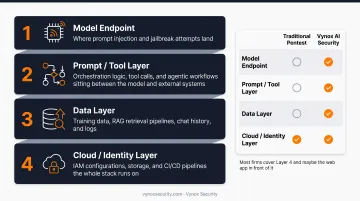
This is exactly why most traditional pentest firms miss AI risk entirely. They cover layer four and maybe the web app in front of it, but leave the model, the prompt layer, and the data layer completely untested.
Why LLM Security Matters Right Now
The scale of exposure isn't theoretical anymore. Organizational use of generative AI in at least one business function jumped from 33% in 2023 to 71% in late 2024, according to McKinsey's State of AI survey. It's a lot of new production surface area in under two years.
Security teams aren't keeping pace. More than one-third of cybersecurity professionals name AI as their team's biggest skills shortfall, per ISC2's 2024 workforce study. That gap shows up in production.
Consider what happened at Samsung. According to Reuters, the company banned staff globally from using ChatGPT and similar tools after an employee uploaded sensitive source code to the platform. There was no breach, no hack. Just an employee doing their job with a tool nobody had secured properly.
This pattern repeats across industries:
- Rapid adoption outpacing security review
- Teams lacking AI-specific expertise to catch the new risk classes
- Sensitive data leaving the organization through ordinary, well-intentioned use
Top LLM Security Risks You Need to Know
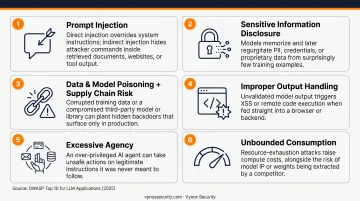
The OWASP Top 10 for LLM Applications is the framework most security teams use to categorize these risks. The current 2025 list looks like this:
| ID | Risk Category |
|---|---|
| LLM01 | Prompt Injection |
| LLM02 | Sensitive Information Disclosure |
| LLM03 | Supply Chain |
| LLM04 | Data and Model Poisoning |
| LLM05 | Improper Output Handling |
| LLM06 | Excessive Agency |
| LLM07 | System Prompt Leakage |
| LLM08 | Vector and Embedding Weaknesses |
| LLM09 | Misinformation |
| LLM10 | Unbounded Consumption |
A few of these risks deserve a closer look:
- Prompt injection takes two forms. Direct injection happens when a user's own prompt overrides the system's instructions, while indirect injection hides attacker-controlled instructions inside a document, website, or tool output the model retrieves.
- Sensitive information disclosure happens when models memorize and later regurgitate PII, credentials, or proprietary data from their training set, sometimes from surprisingly few training examples.
- Data and model poisoning paired with supply chain risk: corrupted training data or a compromised third-party model or library can introduce hidden backdoors that don't surface until production.
- Improper output handling lets unvalidated model output trigger XSS or remote code execution when fed straight into a browser or backend.
- Excessive agency turns an over-privileged AI agent connected to real tools (email, payments, databases) into a serious risk, capable of taking unsafe actions on legitimate instructions it was never meant to follow.
- Unbounded consumption covers resource-exhaustion attacks that rack up compute costs or degrade service, plus the ongoing risk of a model's IP or weights being extracted by a competitor.
LLM Security Best Practices
Input, Output & Guardrail Controls
Your first line of defense is controlling what goes in and what comes out.
- Validate and sanitize user input, external content, and encoded data before it reaches the model
- Define expected output formats and use structured schemas (like JSON Schema) so downstream systems only accept output in the shape they expect
- Redact PII from logs and sanitize sensitive content before it touches training pipelines
Worth being honest here: OWASP itself notes it's unclear whether fool-proof prompt-injection prevention exists, given how stochastic model behavior is. Layered controls reduce risk — they don't eliminate it.
Access Control & Data Protection
Treat the model like any other privileged system component:
- Implement RBAC and MFA, with managed identities scoped to minimum required access
- Encrypt data in transit (TLS 1.2/1.3) and at rest, including embeddings and vector chunks
- Apply data minimization: restrict what training and RAG data the model can access, and enforce retrieval-time permission checks so users stay within their access tier
Secure Development & Deployment
Before anything ships:
- Verify model and supply chain integrity: know where every fine-tuned model and third-party library came from
- Sandbox untrusted evaluation, fine-tuning, and conversion jobs with restricted network egress
- Isolate LLM workloads through containerization to limit the blast radius if something does go wrong
Continuous Testing & Monitoring
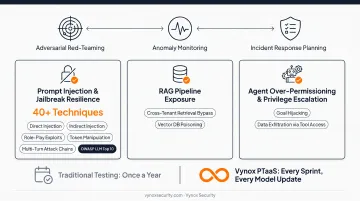
Controls only matter if they hold up under real pressure. That's where adversarial red-teaming, anomaly monitoring, and incident response planning come in, catching issues before and after production, not just at launch.
This is also where LLM penetration testing earns its place as the practice that validates whether all the above actually works. A proper assessment should test:
- Prompt injection and jailbreak resilience across dozens of distinct attack techniques
- RAG pipeline exposure, including cross-tenant retrieval and access-control bypass
- Agent over-permissioning, tool-call injection, and privilege escalation through agent chaining
Vynox Security runs this testing with 40+ prompt injection and jailbreak techniques, including direct injection, indirect injection via documents and tool outputs, role-play exploits, token manipulation, and multi-turn attack chains, all mapped against the full OWASP LLM Top 10.
This coverage extends to RAG pipelines, tested for cross-tenant retrieval bypass and vector DB poisoning, and to autonomous agents, tested for goal hijacking and data exfiltration through their own legitimate tool access. Through a PTaaS model, this testing runs on every model update and every sprint, not once a year.
How to Validate Your LLM Security Posture
A checklist tells you what you meant to do. It doesn't tell you whether an attacker can still get around it. Self-assessed guardrails are necessary, but they're not sufficient on their own.
NIST's own guidance backs this up: pre-deployment tests are frequently limited to lab conditions or benchmark datasets that don't extrapolate to real-world use. NIST specifically recommends adversarial role-playing, red-teaming, chaos testing, and independent evaluation — not developers marking their own homework.
A comprehensive LLM security assessment should include:
- Full OWASP LLM Top 10 coverage: not just prompt injection, but sensitive disclosure, supply chain, and agentic risk too
- Dozens of prompt injection and jailbreak techniques, tested systematically rather than a handful of quick tries
- RAG pipeline and autonomous agent testing, including query manipulation, cross-tenant bypass, and privilege escalation through tool chaining
- Developer-ready remediation guidance your engineers can actually act on, not a generic CVE list
Vynox Security's approach reflects this end to end, with engagement details built for speed and audit-readiness:
- 5–15 business days for most assessments, or 3–5 weeks for AI red teaming's deeper adversarial simulation
- Findings mapped directly to SOC 2 and ISO 27001 evidence requirements, so the same engagement that finds your vulnerabilities also builds your audit evidence pack
- Continuous testing cadence aligned to sprints and model updates through PTaaS, with same-day retests once a fix hits staging
If you're shipping an LLM, RAG pipeline, or AI agent into production and haven't tested it against real attack techniques, a 30-minute discovery call is the fastest way to start. It'll help scope exactly what an assessment would cover for your stack.
Frequently Asked Questions
What is an LLM in security?
In a security context, an LLM is both an application component and an attack surface. It must be secured against manipulation, data leakage, and misuse, not just evaluated for output accuracy.
How is LLM security different from traditional cybersecurity?
Traditional security assumes structured, predictable inputs. LLM security has to account for freeform natural-language inputs and probabilistic outputs that attackers can manipulate through crafted prompts.
What is the OWASP Top 10 for LLM Applications?
It's the industry-standard framework categorizing the most critical LLM risks, including prompt injection, sensitive information disclosure, and excessive agency, as detailed in OWASP's LLM Top 10 project. Security teams use it as a shared baseline for testing and remediation.
How often should organizations test their LLM security?
Test after major model or prompt changes and continuously as new attack techniques emerge, keeping the cadence aligned with development sprints. Annual point-in-time testing leaves too large a gap for AI systems that change weekly.
Can prompt injection attacks be fully prevented?
Not entirely — OWASP notes it's unclear whether foolproof prevention exists given models' stochastic behavior. Layered input/output controls, least-privilege tool access, and continuous testing reduce the risk.
What compliance frameworks apply to LLM security?
SOC 2, ISO 27001, GDPR, ISO 42001, and the EU AI Act (Article 15's adversarial testing requirement for high-risk systems) all touch LLM security. Findings from a proper AI security assessment can map directly to each framework's evidence requirements.