Introduction
Small businesses have become a favorite target for attackers, and the reasons aren't complicated: thin security budgets and sprawling digital footprints, compounded by AI tools most teams haven't stress-tested. In fact, 43% of cyberattacks now target small businesses, according to Verizon's Data Breach Investigations Report.
Yet many owners still treat penetration testing as a compliance checkbox, filed away after an audit instead of a practice that prevents breaches, downtime, and lost customer trust.
This article breaks down why that mindset falls short, covering the financial risk penetration testing reduces, the compliance requirements it satisfies, the growth opportunities it unlocks, and the AI-driven attack surface most traditional testing still ignores.
Key Takeaways
- 31% of SMBs experienced a cyberattack last year, per Microsoft's 2024 SMB survey
- Pentesting confirms which vulnerabilities attackers can exploit, unlike scanning alone
- Regular testing cuts breach costs and strengthens PCI DSS compliance
- Chatbots and autonomous agents create AI attack surfaces conventional tools miss
- Ongoing testing tied to release cycles beats a once-a-year exercise
What Is Penetration Testing?
Penetration testing is an authorized, simulated cyberattack designed to find and prove exploitable weaknesses before real attackers do. Ethical hackers use the same techniques as criminals, but with explicit permission and a defined scope. NIST's SP 800-115 guidelines describe the practice as an attempt to circumvent a system's security features, not simply list them.
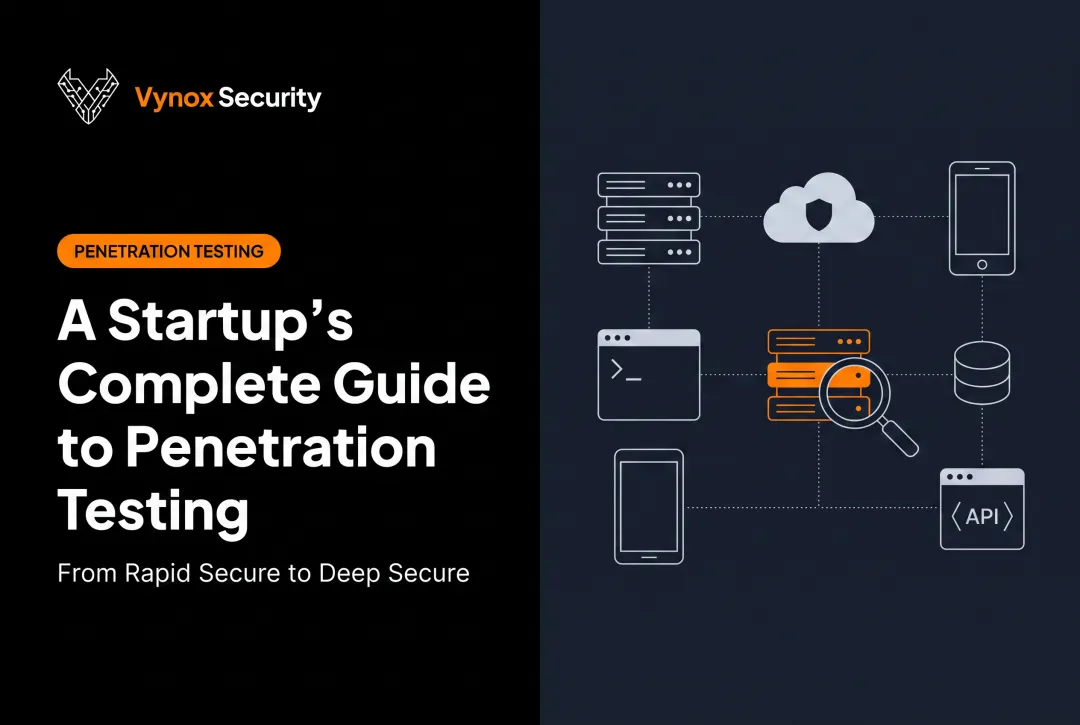
It typically applies to:
- Websites and web applications
- Mobile apps (iOS and Android)
- Networks and cloud infrastructure (AWS, GCP, Azure)
- APIs
- AI-powered features, including chatbots, RAG pipelines, and autonomous agents
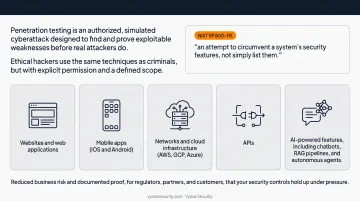
The real value is reduced business risk and documented proof, for regulators, partners, and customers, that your security controls hold up under pressure.
Key Advantages of Penetration Testing for Small Businesses
The advantages below focus on outcomes small business owners actually track: cost, trust, compliance, and growth. Each one ties directly to decisions you're already making, like where to spend limited IT budget, which vendors to sign, and how ready you are for your next audit.
Reduces Financial and Operational Risk from Cyberattacks
Penetration testing surfaces the exploitable weaknesses (unpatched software, weak credentials, misconfigured cloud storage) before attackers can turn them into ransomware or a data breach. Ethical hackers simulate real attacks and rank findings by severity, so a limited IT budget goes toward the highest-risk gaps first instead of being spread thin.
The cost of skipping this step is steep. Microsoft's 2024 survey of 2,000 US and UK SMB decision-makers found an average attack cost of $254,445, with some incidents topping $7 million. Recovery time ranged from a single day to more than a month, a window most small businesses can't afford to absorb.
KPIs this affects:
- Downtime hours
- Incident response cost
- Ransomware payout avoidance
- Mean time to recovery
This matters most for businesses with limited in-house security staff, legacy systems still in production, or rapid product expansion that outpaces internal security reviews. Traditional firms often run four-to-eight week engagements, meaning a vulnerability introduced mid-cycle can sit exposed for weeks before anyone catches it. Faster, more frequent testing closes that window.
Builds Customer Trust and Satisfies Compliance Requirements
Reducing breach risk is only half the equation. Penetration testing also gives you documented evidence of due diligence, which matters when you're handling payment data, health records, or personal information. PCI DSS v4.0.1 is explicit about this: Requirements 11.4.2 and 11.4.3 mandate internal and external penetration tests at least once every 12 months and after any significant infrastructure or application change.
HIPAA and GDPR take a broader, risk-based approach to security evaluation rather than naming pentesting outright, but auditors and partners still expect to see it.
In practice, testers validate the controls protecting customer and payment data, then produce a report you can hand to regulators, auditors, or enterprise procurement teams without translation.
For example, a Vynox client handling patient-identifiable data needed an assessment that balanced thoroughness with real-world risk, not just a checklist. The engagement gave their team audit-ready evidence while staying focused on the risks that actually mattered to their patient data environment.
KPIs this affects:
- Audit pass rate
- Post-incident customer churn
- Compliance fine exposure
This advantage matters most for businesses handling payment data, PII, or health records, or those preparing for a SOC 2 or ISO 27001 audit for the first time.
Strengthens Competitive Position by Covering Modern, AI-Driven Attack Surfaces
Compliance is table stakes, but the bar doesn't stop there. Enterprise clients, investors, and government contracts increasingly ask for proof of security testing before they'll sign. That bar keeps rising as small businesses adopt AI features (chatbots, RAG-based search, autonomous agents) that expand their attack surface well past what conventional pentesting tools were built to check.
Traditional pentest scopes don't test for prompt injection, jailbreaks, or data leakage in LLM-powered features, leaving a blind spot in an otherwise well-tested business. A full system prompt, for instance, can be extracted in under ten queries, a gap that's completely invisible to CVE scanners.
IBM's 2025 research found that 13% of organizations reported breaches involving AI models or applications, and 97% of that group lacked proper AI access controls in the first place.
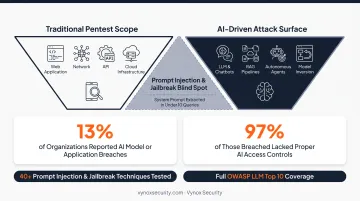
This is where specialized providers matter. Vynox Security tests both traditional infrastructure and AI-specific surfaces (LLMs, RAG pipelines, autonomous agents, model inversion) in a single engagement, using 40+ prompt injection and jailbreak techniques and full OWASP LLM Top 10 coverage. AI-powered small businesses and startups don't get left with an untested AI layer while their infrastructure looks secure on paper.
KPIs this affects:
- Contract win rate
- Investor due-diligence pass rate
- Number of unresolved AI-feature vulnerabilities
This matters most for startups and small businesses building or embedding AI features, or pursuing enterprise and investor deals that now require security proof as a condition of the deal.
What Happens When Penetration Testing Is Missing or Ignored
Skipping regular testing doesn't remove risk. It just hides it until the risk shows up as a costly incident.
- Inconsistent security posture: vulnerabilities sit unnoticed until an attacker finds them first
- Higher breach likelihood: risks tied to newer AI features go completely untested
- Reactive firefighting: incident response costs more time and money than scheduled remediation
- Difficulty winning enterprise contracts: investor and vendor reviews now expect a current pentest report
- Rising long-term costs: repeated incidents erode customer trust with each occurrence
Businesses that treat testing as optional end up paying for it later, usually at a higher price than the test itself would have cost.
How to Get the Most Value from Penetration Testing
Penetration testing pays off when it's applied consistently, findings get reviewed on a schedule, and remediation gets prioritized instead of filed away in a backlog.
A few things to look for in a provider:
- Compliance mapping: maps findings to frameworks like SOC 2 or ISO 27001, with developer-ready fix guidance instead of a raw vulnerability dump
- Continuous retesting: scheduled around major releases or new features, including AI updates, rather than a single annual test
- Fast retest turnaround: verifies fixes quickly instead of letting them sit in limbo between sprints
Vynox Security, for example, offers same-day retest turnaround and a continuous PTaaS cadence aligned to development sprints and model updates. Resource-constrained small teams can act on findings quickly without slowing down what they're shipping. Instead of a dense PDF built for auditors, reports include reproduction steps, CVSS scores, and stack-specific remediation guidance engineers can act on right away.
Conclusion
The real value of penetration testing is simple: it catches what an attacker would find first, across both your traditional infrastructure and any AI-powered features you've shipped. Its benefits compound over time: reduced risk, stronger compliance, and better growth opportunities all build on each other with consistent testing.
To capture those compounding gains, treat penetration testing as an ongoing practice tied to each release cycle, not a once-a-year checkbox exercise. The businesses that do this consistently are the ones that catch problems in a sprint instead of a headline.
Frequently Asked Questions
How much does a typical penetration test cost?
Costs for small businesses typically range from $3,000 to over $10,000, depending on scope and depth. AI-focused engagements, such as LLM or RAG pipeline testing, often carry different pricing based on the systems involved.
Is pentesting illegal?
No. Penetration testing is fully legal when authorized by the business being tested. It follows the same methods attackers use, but with explicit permission and defined rules of engagement signed before testing begins.
What are the three types of penetration tests?
Black box testing assumes no prior knowledge of the system, white box testing uses full access, and gray box testing uses limited knowledge. Gray box often balances realism and cost well for small businesses.
How often should a small business conduct penetration testing?
At least annually, or after any major system or feature change. Businesses shipping updates rapidly, including AI features, should test more frequently.
Do we need a pentest if we already use vulnerability scanners?
Yes. Scanners only flag potential issues, while pentesting validates what's actually exploitable. The two are complementary, not interchangeable.
Does penetration testing cover AI features and chatbots?
Traditional pentesting often misses AI-specific risks like prompt injection or RAG data leakage. Specialized providers, including Vynox Security, test LLMs, RAG pipelines, and agents alongside standard infrastructure in the same engagement.