
Introduction
Most organizations deploy AI systems — chatbots, decision engines, RAG-powered assistants — without ever testing how they hold up under adversarial conditions. That gap is exactly where attackers operate.
AI red teaming is the practice of simulating real-world attacks against AI systems before deployment, surfacing vulnerabilities that traditional security tools were never designed to find. Prompt injections that bypass every CVE scanner. Retrieval exploits exposing documents across tenants. Tool-access hijacks that turn legitimate agent permissions into attack vectors.
This guide covers what AI red teaming is, how it differs from conventional penetration testing, which vulnerabilities it uncovers, and how to run a structured program — with practical steps any security or AI team can follow.
Key Takeaways
- Security risks (model theft, data exfiltration) and safety risks (harmful outputs, policy bypass) both need coverage — neither is optional
- AI systems are probabilistic; a single test pass cannot confirm safety — run multiple rounds
- Test the full stack: model behavior, prompts, RAG pipelines, agent tool calls, and APIs
- Effective teams combine ML engineers, security researchers, and domain experts
- EU AI Act Article 15 and NIST AI RMF are turning adversarial testing into a compliance requirement
What Is AI Red Teaming?
NIST defines AI red teaming as "a structured testing effort to find flaws and vulnerabilities in an AI system, often in a controlled environment and in collaboration with developers of AI."
The concept traces back to military red vs. blue team exercises — adversarial simulations designed to stress-test defenses before real conflict. Cybersecurity adopted the model for network and infrastructure testing. AI systems introduced an entirely different threat model, requiring the practice to evolve again. That evolution matters — because the attack surface, the failure modes, and the stakes are fundamentally different from anything traditional security testing was built to handle.
What AI Red Teaming Actually Covers
AI red teaming covers far more than prompt hacking or jailbreaking.
It spans two distinct but equally important dimensions:
- AI Security — model theft, data exfiltration, training data poisoning, system prompt extraction, model extraction via inference queries
- AI Safety — harmful outputs, policy bypass, hallucinations, bias, failures caused by ordinary users with no malicious intent
Microsoft's AI Red Team, established in 2018, treats both dimensions as inseparable — and explicitly notes that safety failures can be triggered by benign users, not just deliberate attackers.
Systems in Scope
AI red teaming applies across the full AI stack:
- Large language models (LLMs) and generative AI applications
- RAG pipelines and vector databases
- Agentic and multi-agent systems with tool access
- Multimodal models
- APIs and integrations connecting these components
What an Engagement Produces
A proper AI red teaming engagement produces structured, developer-ready output — not just a catalog of failures. Deliverables typically include:
- Documented vulnerabilities with proof-of-concept reproduction steps
- CVSS severity classifications for prioritization
- Remediation guidance scoped to your stack, ready for engineering teams to act on immediately
How AI Red Teaming Differs From Traditional Penetration Testing
The fundamental difference is determinism. Traditional penetration testing targets systems where security controls either hold or fail — networks, authentication flows, and server configurations produce predictable outputs. AI systems are probabilistic: identical inputs can produce different outputs across runs, so standard pass/fail logic doesn't hold. As Microsoft notes, one failed attack attempt does not establish safety — testing requires multiple rounds because generative AI output varies by design.
The Attack Surface Has Shifted
Traditional pen testing focuses on infrastructure access and code-level exploits. AI red teaming targets model behavior, training data, prompt inputs, API responses, and agent tool calls: attack vectors that conventional security tools cannot detect.
Team composition follows the same logic. Traditional red teams are typically security engineers. AI red teaming requires a multidisciplinary group — OpenAI's Red Teaming Network sought experts in cognitive science, biology, chemistry, law, linguistics, cybersecurity, and economics, because the risks span technical, ethical, and contextual dimensions simultaneously.
Comparison at a Glance
| Aspect | Traditional Pen Testing | AI Red Teaming |
|---|---|---|
| Focus | Infrastructure, access paths, code exploits | Model behavior, prompts, data, guardrails, agent actions |
| Attack Surface | Servers, networks, auth systems | LLMs, RAG pipelines, APIs, embeddings, tool calls |
| Techniques | Network scanning, exploit frameworks, injection | Prompt injection, jailbreaks, model extraction, RAG poisoning |
| Nature of Testing | Deterministic — exploits reproduce reliably | Probabilistic — multiple runs required to confirm findings |
| Goals | Prevent unauthorized system access | Prevent harmful outputs, data leakage, model abuse, and safety failures |
Key Vulnerabilities AI Red Teaming Uncovers
The OWASP Top 10 for LLM Applications 2025 provides the most widely-used attack taxonomy. Here are the vulnerability categories that AI red teaming surfaces most directly.
Prompt Injection and Jailbreaking
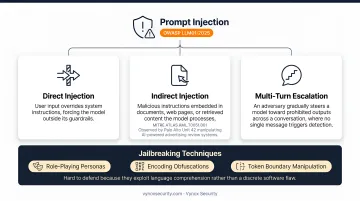
Prompt injection is the anchor category — OWASP LLM01:2025. It takes three main forms:
- Direct injection — User input overrides system instructions, forcing the model outside its guardrails
- Indirect injection — Malicious instructions embedded in documents, web pages, or retrieved content the model processes. MITRE ATLAS catalogs this as AML.T0051.001. Palo Alto Unit 42 has observed this in the wild, including hidden instructions manipulating AI-powered advertising review systems
- Multi-turn escalation — An adversary gradually steers a model toward prohibited outputs across a conversation, where no single message triggers detection
Jailbreaking techniques — role-playing personas, encoding obfuscations, token boundary manipulation — are particularly hard to defend against because they exploit language comprehension rather than a discrete software flaw.
Data Leakage and Model Extraction
Adversarial prompts can force models to expose system prompts, reveal sensitive training data, or surface confidential information never intended for end users. System prompt extraction in particular can be achieved in under 10 queries, and CVE scanners won't flag any of it.
Model extraction takes this further: attackers query a proprietary model extensively to build a functional copy, undermining intellectual property protections and enabling offline abuse without the original guardrails. MITRE ATLAS catalogs this as AML.T0024 — Exfiltration via ML Inference API.
RAG Pipeline and Agentic AI Attacks
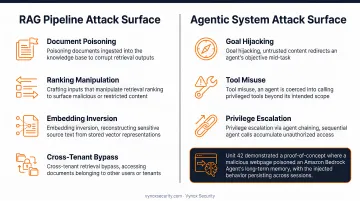
RAG pipelines and agentic systems extend the threat surface well beyond the model itself — introducing risks in the data retrieval layer, external tool integrations, and persistent memory. RAG-specific attack patterns include:
- Poisoning documents ingested into the knowledge base to corrupt retrieval outputs
- Crafting inputs that manipulate retrieval ranking to surface malicious or restricted content
- Embedding inversion — reconstructing sensitive source text from stored vector representations
- Cross-tenant retrieval bypass — accessing documents belonging to other users or tenants
Agentic systems introduce a different threat surface entirely. Unit 42 demonstrated a proof-of-concept where a malicious webpage poisoned an Amazon Bedrock Agent's long-term memory, with the injected behavior persisting across sessions. The specific threats:
- Goal hijacking — Untrusted content redirects an agent's objective mid-task
- Tool misuse — An agent is coerced into calling privileged tools beyond its intended scope
- Privilege escalation via agent chaining — Sequential agent calls accumulate unauthorized access
How to Implement AI Red Teaming: Step by Step
Step 1: Define Scope and Objectives
Before any testing begins, clarify three things:
- Scope the system under test: LLM only, full application stack, APIs, agentic workflows, or end-to-end RAG pipeline
- Define adversary profiles: external attacker, insider threat, or a low-sophistication user manipulating the system through normal interaction
- Set risk thresholds: what constitutes an acceptable vs. unacceptable finding given the deployment context
Start narrow. Testing one scenario thoroughly produces more actionable results than testing everything superficially.
Step 2: Build the Right Team
The ideal composition:
- ML engineers who understand model internals, fine-tuning behavior, and embedding systems
- Security professionals familiar with adversarial tactics and offensive tooling
- Domain specialists who understand use-case-specific risks — healthcare data, financial decisions, legal content
- Behavioral or social scientists who can probe alignment and fairness failures
Many organizations supplement internal capabilities with external specialists. Vynox Security's AI red teaming engagements cover LLMs, RAG pipelines, and autonomous agents with full OWASP LLM Top 10 coverage and 40+ prompt injection techniques. Developer-ready findings are delivered in 3–5 weeks.
Step 3: Choose Testing Methods and Set Up a Safe Environment
Use a hybrid approach:
- Automated scanning for broad coverage: tools like PyRIT (Microsoft), Garak (NVIDIA), and promptfoo generate adversarial inputs at scale across known attack patterns
- Manual testing for depth: novel attack chains, multi-turn escalations, and business-context harms that automation misses
For destructive tests — particularly agent-related scenarios where an exploit could send emails, delete records, or exfiltrate files — scope testing to staging or sandbox environments with agreed guardrails for production systems.
Step 4: Execute Testing and Document Findings
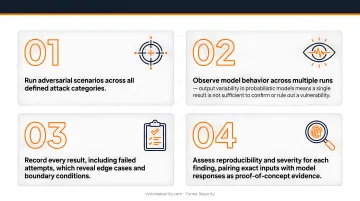
During execution:
- Run adversarial scenarios across all defined attack categories
- Observe model behavior across multiple runs — output variability in probabilistic models means a single result is not sufficient to confirm or rule out a vulnerability
- Record every result, including failed attempts, which reveal edge cases and boundary conditions
- Assess reproducibility and severity for each finding, pairing exact inputs with model responses as proof-of-concept evidence
Step 5: Analyze, Remediate, and Retest
Prioritize findings by severity and business impact. Developer-ready remediation means:
- Specific fix instructions tied to the actual tech stack, not generic advice
- Updated guardrails, prompt restructuring, fine-tuning adjustments, or access control changes as appropriate
- Retest scheduled once fixes are deployed to confirm they hold
AI red teaming is not a one-time exercise. It should be embedded into the SDLC and triggered at each significant model update or development sprint. Vynox's PTaaS model is designed around this cadence — continuous testing aligned to model updates and sprints, with same-day retest turnaround when fixes hit staging.
Common Challenges and Limitations
Probabilistic Output Makes Confirmation Harder
A red team cannot declare an input "safe" after a single run. Output variance is inherent to generative AI : the same prompt can produce different responses depending on temperature, context, and model state. Teams must run multiple rounds and document confidence levels alongside findings, not just binary pass/fail results.
Scope Creep Is Real
AI systems are embedded in complex stacks — LLM, APIs, agents, infrastructure, retrieval layers. Without clear boundaries, red teaming efforts expand indefinitely or miss high-risk components entirely. Mismatched expectations between red teams and development teams are a consistent friction point. Common scope pitfalls include:
- Testing the LLM in isolation while skipping the retrieval layer and API boundaries
- Expanding attack surface mid-engagement without adjusting timeline or resources
- No agreed-upon threat model, leaving high-risk components untested
Define scope before testing starts, not during.
Cross-Disciplinary Talent Is Scarce
AI red teaming requires professionals with rare, overlapping skills spanning ML, security, and domain knowledge. The gap is real: few security firms have native AI testing capability, and the shortage shows in engagement quality. As Anthropic notes, red teaming can reveal failures but cannot prove the absence of untested risks — results depend entirely on tester expertise, access, and the quality of the threat model.
That dependency on expertise points to a broader reality: because AI models evolve continuously, a one-time engagement before launch is a starting point, not a complete answer. Ongoing investment is required to keep pace with model updates and emerging attack techniques.
Frameworks and Regulations That Support AI Red Teaming
NIST AI RMF and OWASP LLM Top 10
NIST AI 600-1 places adversarial testing under the MEASURE function. Specific actions include conducting adversarial testing at a regular cadence (MS-4.2-001) and red-teaming for abuse, prompt injection, data poisoning, membership inference, and model extraction (MS-2.7-007).
The OWASP LLM Top 10 (2025 edition) adds a direct attack taxonomy for LLM applications — including system prompt leakage (LLM07) and vector/embedding weaknesses (LLM08) relevant to RAG deployments. Not a compliance standard, but the most practical reference for structuring what to test.
EU AI Act
Two articles carry direct adversarial testing obligations:
- Article 15 requires operators of high-risk AI systems to demonstrate accuracy, robustness, and cybersecurity throughout the system lifecycle — including resistance to adversarial examples, poisoning attacks, and confidentiality attacks.
- Article 55(1) requires providers of GPAI models with systemic risk to conduct and document adversarial testing, assess and mitigate systemic risks, and report serious incidents.
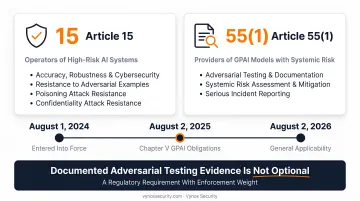
The Act entered into force August 1, 2024, with Chapter V GPAI obligations applying from August 2, 2025, and general applicability from August 2, 2026.
For organizations deploying high-risk AI systems, documented adversarial testing evidence is not optional — it is a regulatory requirement with enforcement weight.
Frequently Asked Questions
What is red teaming in AI?
AI red teaming is a structured security practice where experts simulate adversarial attacks on AI systems — covering LLMs, RAG pipelines, and agents — to discover vulnerabilities, unsafe outputs, and misuse risks. Unlike traditional security testing, it covers both deliberate attacks and failures triggered by ordinary users.
What is an example of red teaming in AI?
A red team testing an enterprise AI chatbot might embed malicious instructions inside a document the model retrieves via its RAG pipeline. When the model processes that document, it overrides its system instructions and reveals confidential data, a real attack pattern observed in production AI deployments.
How is AI red teaming different from traditional penetration testing?
Traditional pen testing targets fixed, deterministic infrastructure: networks, servers, authentication controls. AI red teaming probes probabilistic model behavior— prompt responses, training data integrity, agent actions, and retrieval outputs. It requires different techniques, different tools, and a team that spans ML, security, and domain expertise.
When should an organization implement AI red teaming?
Any organization deploying an LLM, RAG system, or AI agent should conduct red teaming before launch and after each significant model or data update. This is especially critical when processing sensitive data or operating under frameworks like SOC 2, ISO 27001, or the EU AI Act.
Does AI red teaming replace traditional security testing?
No, it complements it. AI systems still run on infrastructure and APIs that require conventional penetration testing. Both disciplines are necessary for full-stack coverage. Addressing AI-layer vulnerabilities while leaving infrastructure untested leaves significant exposure.
What should an AI red teaming report include?
A complete report should cover:
- Documented vulnerabilities with proof-of-concept reproduction steps
- CVSS severity classifications tied to business impact
- Developer-ready remediation guidance specific to your tech stack
- Retest recommendations to validate each fix
Where regulatory requirements apply, compliance-mapped evidence packs for SOC 2, ISO 27001, or EU AI Act Article 15 should also be included.