That definition sounds simple. In practice, most teams confuse it with something else entirely — a config scanner report labeled a "pentest" that never actually tries to break anything.
This guide is written for engineering leads, DevOps and cloud teams, and security-conscious founders running production workloads on AWS. No vendor jargon, no filler — just a clear walkthrough of how a real AWS pentest works, what it requires from your team, and when you actually need one versus when a lighter review will do.
Key Takeaways
- AWS pentesting simulates an attacker who already has a foothold (leaked keys, a compromised EC2 instance, or insider access) and tries to escalate privileges.
- It's not the same as a ScoutSuite or Prowler scan; those check configuration but don't exploit anything.
- AWS's Customer Support Policy defines exactly what's fair game to test and what's off-limits.
- A quality report includes reproduction steps and compliance-mapped fixes, not just a severity list.
TL;DR
- Simulates an attacker with an existing foothold (a leaked access key, compromised EC2/Lambda function, or insider-level credentials) who then escalates privileges or reaches sensitive data.
- Differs from a cloud configuration review, a read-only audit against best practices that involves no exploitation.
- Follows five stages: scoping, reconnaissance, automated scanning, exploitation/privilege escalation, and reporting/remediation.
- Governed by two AWS policies: the Shared Responsibility Model (what AWS secures vs. what you secure) and the Customer Support Policy for Penetration Testing (what can be tested without prior approval).
What Is AWS Penetration Testing?
AWS penetration testing is an authorized, goal-oriented assessment that simulates how an attacker with initial access (leaked credentials, a compromised EC2 instance, or a hijacked Lambda function) could move laterally and escalate privileges inside your AWS account.
The goal is to prove whether a specific misconfiguration is actually exploitable, and quantify what happens if it is: data exposure, lateral movement, full account takeover.
This differs from two things people often lump into the same bucket:
- A cloud configuration review/audit: read-only, benchmarked against CIS or AWS best practices, with no active exploitation attempted.
- A general external network pentest: tests your internet-facing perimeter but doesn't necessarily touch IAM roles, cross-account trust, or internal cloud architecture.
The AWS Shared Responsibility Model and What It Means for Testing
AWS splits security into two halves. "Security of the cloud" is AWS's job: physical data centers, the hypervisor, and patching for fully managed services. "Security in the cloud" is yours: IAM policies, network configuration, application code, and how you handle data.
A pentest focuses almost entirely on your side of that line. Nobody is testing AWS's data center door locks. They're testing the attack surface you actually control.
Types of AWS Assessments
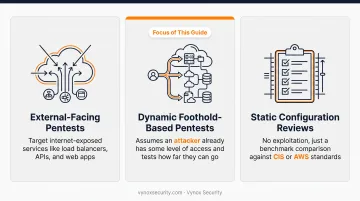
Three distinct assessment types get confused constantly, and each serves a different budget and purpose:
- External-facing pentests: target internet-exposed services like load balancers, APIs, and web apps.
- Dynamic foothold-based pentests: the focus of this guide, assuming an attacker already has some level of access and testing how far they can go.
- Static configuration reviews: no exploitation, just a benchmark comparison against CIS or AWS standards.
Why AWS Penetration Testing Matters for Modern Businesses
AWS runs over 200 services, and the shared-responsibility split means most incidents trace back to customer-side mistakes, not AWS platform failures. Gartner's own forecast, cited by IBM, projected that through 2025, 99% of cloud security failures would be the customer's fault. That's a forward-looking estimate, not a measured breach rate, but it's directionally hard to argue with.
The posture data backs it up. Palo Alto Networks' Unit 42 team analyzed 210,000 cloud accounts. It found that 76% weren't enforcing MFA for console users, 83% had hard-coded credentials in source control, and 60% took over four days to fix known issues.
Without active testing, this is what typically slips through:
- Overly permissive IAM roles granting far more access than the workload actually needs
- Exposed metadata endpoints that hand out temporary credentials to anything that asks
- Publicly shared snapshots left open long after a debugging session ended
- Long-lived access keys that never got rotated, sometimes for years
Compliance frameworks are catching up too. SOC 2 and ISO 27001 auditors increasingly expect evidence of actual penetration testing, not just an automated scan, as part of technical control assurance.
This is where a lot of teams get stuck choosing between a slow, generic scanner report and something that's actually useful to engineers.
Vynox Security's cloud assessments, for instance, focus on developer-ready findings and compliance-mapped evidence rather than a 40-page PDF nobody reads. This matters even more for AI-powered businesses whose AWS environment also hosts LLM or RAG workloads, where a single exposed S3 bucket can leak model weights and training data alongside customer information.
AWS Penetration Testing Methodology: A Step-by-Step Walkthrough
This methodology assumes the tester starts with an initial foothold: a leaked key, a compromised compute resource, or insider-level access. It's the most realistic attack scenario in cloud environments.
This scenario is exactly what AWS's Customer Support Policy for Penetration Testing is built around. Most services can be tested this way without prior approval, though DoS testing and direct attacks on AWS-managed infrastructure like Route 53 remain strictly prohibited.
Each step builds on the last. What you find during enumeration directly determines which exploitation paths are even worth attempting later.
Step 1: Scoping and Prerequisites
Before anything technical happens, gather:
- A signed authorization or statement of work
- An architecture diagram showing account structure and trust relationships
- A scoped access key, ideally the SecurityAudit managed policy or a role mirroring a real developer or application's permissions, never full admin
Step 2: Reconnaissance and Attack Surface Mapping
The tester enumerates the principal's identity and permissions using tools like the AWS CLI's get-caller-identity, Pacu, CloudFox, or enumerate-iam. This builds a mental map of attached IAM policies, groups, roles, and trust relationships across the account.
Step 3: Automated Configuration Scanning
Tools like ScoutSuite and Prowler run against the scoped key, flagging misconfigurations against CIS AWS Benchmarks. These tools are useful, but they generate false positives and miss plenty of services entirely. Manual validation isn't optional here.
Step 4: Exploitation and Privilege Escalation
A realistic example: extracting temporary credentials from the EC2 instance metadata service, then running enumerate-iam to brute-force what permissions those credentials actually grant. From there, an overly permissive execution role might allow chaining a low-privilege key into full administrative access.
Step 5: Validating Impact (Cross-Service and Data Access)
Escalated access gets tested against real targets: an exposed RDS instance, a misconfigured S3 bucket, a cross-account trust relationship. This step proves actual business impact instead of theoretical risk.
Step 6: Reporting and Remediation Guidance
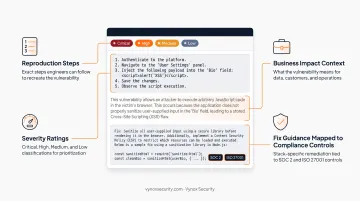
A quality report includes reproduction steps, severity ratings, business impact context, and stack-specific fix guidance mapped to compliance controls like SOC 2 or ISO 27001, so engineers can remediate quickly instead of guessing.
Tools & Rules of Engagement for AWS Penetration Testing
Most AWS pentests lean on the same open-source toolkit, with each tool covering a different phase:
| Tool | Primary Role |
|---|---|
| AWS CLI | Identity checks, service interaction, baseline enumeration |
| ScoutSuite | Configuration auditing against CIS benchmarks |
| Prowler | Automated compliance and security checks |
| Pacu | Active exploitation framework for AWS environments |
| CloudFox | Situational awareness and enumeration |
| enumerate-iam | Brute-forcing permission discovery on a credential set |
A few rules of engagement matter regardless of which tools get used:
- Request temporary or role-based credentials over long-lived IAM user keys wherever possible.
- Scope access to mirror real permissions — a developer role or application role, not full admin.
- Written authorization (SOW/PSA) and proof of account ownership are mandatory before testing starts, no matter what AWS's policy technically allows.
AWS's Customer Support Policy permits testing of most customer-controlled services without prior approval. Denial of Service testing and attacks against Route 53 or other AWS-managed infrastructure remain strictly off-limits.
Common Mistakes, Misconceptions & When a Config Review Is Enough
The biggest misconception: a ScoutSuite or Prowler scan alone is a configuration benchmark, not a full penetration test. Nobody actually tried to exploit anything.
A close second: assuming automated scanners cover the entire environment. They don't. Many AWS services still have no automated checks at all, which means manual, service-specific research is required to get real coverage.
A cloud configuration review is genuinely sufficient when:
- Your environment is small or relatively simple
- Budget is limited and you need a baseline first
- You're doing early-stage due diligence, not defending production data
It's time for a real pentest when:
- A compliance requirement (SOC 2, ISO 27001) explicitly demands penetration testing, not just a scan
- Your threat model includes credential exposure or insider risk
- You've had a recent security incident
Even after you hit these triggers, cadence matters as much as scope. Continuous testing aligned to sprints is increasingly replacing the old annual-pentest model, especially for teams shipping code and AI features every week. Vynox's PTaaS engagements retest AWS environments after every deployment, not just once a year.
Frequently Asked Questions
Does AWS allow penetration testing?
Yes. AWS permits testing of most customer-controlled services under its published Customer Support Policy without prior approval. DoS testing and attacks on DNS/Route 53 remain prohibited.
What are the 5 stages of penetration testing?
Reconnaissance, scanning/enumeration, exploitation, post-exploitation/privilege escalation, and reporting. This maps directly onto the AWS-specific methodology covered above.
What's the difference between an AWS penetration test and a cloud configuration review?
A configuration review is a read-only audit against best practices. A penetration test actively attempts privilege escalation and data access from a simulated foothold.
Which AWS services can and can't be tested?
Compute, storage, database, and application-layer services are generally testable. AWS-managed infrastructure like Route 53 is off-limits, along with DoS-style attacks.
How much does an AWS penetration test cost, and how long does it take?
Cost and timeline depend on account complexity and services in scope. Vynox typically delivers cloud engagements in 3–15 business days, compared to the 4–8 weeks common at traditional firms.
How often should an AWS environment be pentested?
Best practice is testing after major architecture or IAM changes, plus at least annually for compliance. Continuous testing aligned with sprints is becoming the preferred cadence for fast-moving teams.