That shift creates a problem. Many teams ship RAG pipelines after a handful of manual spot checks — "it looked good in the demo" — and call it done. That approach misses silent failures: hallucinated citations, retrieval that pulls irrelevant chunks, and security gaps that no one tested for until a customer found them first.
This guide covers the metrics that actually catch these failures, a step-by-step testing framework you can run today, and the security dimension most evaluation stacks completely ignore.
Key Takeaways
- RAG evaluation needs two separate lenses: retrieval quality and generation quality, each with its own metrics
- Five baseline metrics — faithfulness, answer relevancy, contextual precision, contextual recall, and contextual relevancy — cover most failure modes
- Testing belongs in three places: offline datasets, CI/CD gates, and live production monitoring
- Functional metrics don't catch prompt injection or PII leakage; that requires dedicated adversarial testing
- Frameworks like Ragas and DeepEval operationalize metrics but aren't a substitute for security testing
What Is RAG Evaluation & Why It Matters in 2026
RAG evaluation measures whether a retriever finds the right context and whether a generator turns that context into an accurate, grounded answer. Teams typically score both pieces independently and then test the whole pipeline end-to-end.
This differs from general LLM benchmarking. A benchmark like MMLU tells you how smart a model is in the abstract.
RAG evaluation tells you how well this specific retriever, paired with this specific generator, performs against your specific knowledge base and your users' actual questions. A model that aces every public benchmark can still fail badly on your internal wiki if your chunking strategy is broken.
Three Places RAG Pipelines Break
Most RAG failures trace back to one of three stages:
- Ingestion and chunking: documents split awkwardly, losing context or splitting mid-sentence
- Retrieval: the wrong chunks get pulled, or the right ones rank too low to matter
- Generation: the model receives good context but still contradicts, invents, or ignores it
A common assumption is that bigger context windows solve retrieval problems. They don't. Liu et al.'s "Lost in the Middle" study tested GPT-3.5-Turbo, GPT-4, and Claude-1.3 on multi-document QA. The researchers found a U-shaped performance curve: models use information at the beginning or end of context far better than information buried in the middle.
GPT-3.5-Turbo's accuracy dropped by more than 20% when the answer-bearing document moved to the middle of the context. Expanding retrieval from 20 to 50 documents only improved performance by 1 to 1.5 percentage points.
The lesson: more retrieved context isn't a fix. You need metrics that check placement and utilization, not just volume.
Top RAG Evaluation Metrics for 2026
These six metrics were chosen because they're industry-adopted, cover the retriever and generator independently, and support both reference-based scoring (against a ground-truth answer) and reference-free scoring (no labeled dataset required).
Faithfulness (Hallucination Detection)
Faithfulness checks whether every claim in the generated answer is actually supported by the retrieved context, with no contradictions or fabrications.
This is the most important trust metric in the whole stack. A system can retrieve flawless context and still hallucinate at generation time.
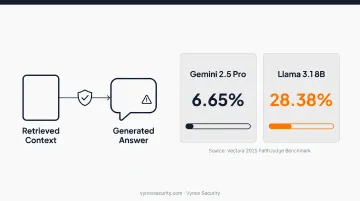
Vectara's 2025 FaithJudge benchmark found hallucination rates ranging from 6.65% for Gemini 2.5 Pro to 28.38% for Llama 3.1 8B across controlled RAG test sets. Model choice materially affects grounding, even with identical retrieved context.
| What It Measures | Whether output claims are grounded in retrieved context |
| How It's Scored | LLM-as-a-judge comparing claims against retrieved context, or NLI-based entailment checks |
| Best Used For | Generation debugging and continuous production monitoring |
Answer Relevancy
This metric checks whether the response actually addresses what the user asked — independent of whether the facts are correct.
It catches a different failure than faithfulness: off-topic or evasive answers where the model technically doesn't hallucinate but also doesn't answer the question. This often exposes a weak prompt template rather than a retrieval problem.
| What It Measures | Alignment between the input query and the generated output |
| How It's Scored | LLM-as-a-judge or semantic similarity scoring against the input |
| Best Used For | Prompt template tuning and model comparison |
Contextual Precision
Contextual precision checks whether the most relevant retrieved chunks are ranked ahead of less relevant ones.
This is the clearest signal you have for reranker quality. A retriever can pull the right document, but if it lands at position 8 out of 10, the generator may never use it meaningfully.
| What It Measures | Ranking quality of retrieved chunks |
| How It's Scored | Reference-based, comparing chunk order against an ideal output |
| Best Used For | Evaluating rerankers and tuning the retrieval pipeline |
Contextual Recall
Contextual recall assesses whether the retrieved context contains everything needed to produce the ideal answer.
Precision alone can be gamed by retrieving very little: a system that returns one perfect chunk scores well on precision but may be missing supporting details. Recall keeps that honest.
| What It Measures | Completeness of retrieved information versus the ideal answer |
| How It's Scored | Reference-based LLM-as-a-judge comparison against ground-truth answers |
| Best Used For | Diagnosing under-retrieval and embedding model gaps |
Contextual Relevancy
This measures what proportion of retrieved chunks are actually relevant to the query, regardless of order.
Unlike the metrics above, this one is reference-free — no labeled dataset required. That makes it fast to run whenever you tweak chunk size, top-K, or swap embedding models.
| What It Measures | Proportion of relevant chunks among all retrieved chunks |
| How It's Scored | Reference-free LLM-as-a-judge scoring per chunk |
| Best Used For | Tuning chunk size, top-K, and embedding model choice |
Answer Correctness / Semantic Similarity
This end-to-end metric blends factual correctness against a ground truth with embedding-based similarity scoring.
This is your release-tracking metric: a single comparable score you can watch across model versions and deployments, without needing to dig into which component regressed.
| What It Measures | Overall agreement between the generated answer and a ground-truth reference |
| How It's Scored | Combination of F1-style factual correctness and cosine similarity |
| Best Used For | Release-to-release regression tracking and model comparisons |
How to Test Your RAG System: A Step-by-Step Testing Framework
Step 1: Build a Golden Test Dataset
Start with question–answer–context triples pulled from real sources:
- Actual user queries and support logs
- Search history from your existing product
- Synthetic questions generated by an LLM from your source documents
Include varied query complexity: simple lookups, multi-part questions, ambiguous phrasing, and even misspellings. Loop in domain experts to validate edge cases your synthetic data generator might miss entirely.
Step 2: Choose an Evaluation Mode (End-to-End vs. Component-Level)
With a dataset ready, decide how granularly to score results. End-to-end evaluation treats the pipeline as a black box, scoring only the final input, output, and retrieved context together. Component-level evaluation isolates the retriever and generator separately, which pinpoints exactly where a failure originates.
A simple rule of thumb: use component-level testing while actively developing or debugging, and switch to end-to-end for pre-release validation.
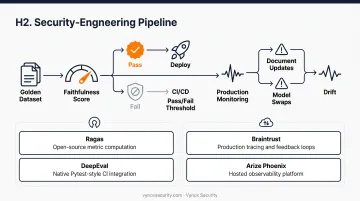
Step 3: Automate Testing in CI/CD and Production
Once you've chosen an evaluation mode, the next step is running these checks continuously. Wire your metrics into CI/CD with pass/fail thresholds, blocking deployment if faithfulness drops below a set score on your golden dataset. Then extend monitoring into production using reference-free metrics on live traffic, since document updates and model swaps introduce drift that offline datasets won't catch.
Common frameworks that operationalize this:
- Ragas and DeepEval: open-source libraries for computing metrics, with DeepEval offering native Pytest-style CI integration
- Braintrust and Arize Phoenix: platforms built around production tracing, feedback loops, and hosted observability
Each has different strengths: open-source flexibility versus a managed production feedback loop. Neither replaces the security testing covered next.
RAG Security Testing: The Metric Most Teams Overlook
Here's what functional metrics don't tell you: because the generator consumes whatever content the retriever pulls in, that content can carry hidden instructions.
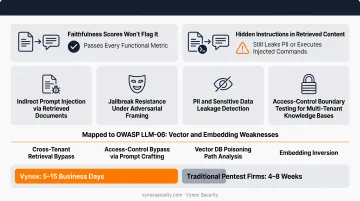
A poisoned document, a manipulated PDF, or a compromised knowledge base entry can inject commands the model then follows. Faithfulness scores won't flag it, because the answer might look perfectly grounded.
A system can pass every functional metric in this guide with high marks and still leak PII from a retrieved file, or execute an injected instruction buried inside an internal wiki page. That's a different category of failure entirely.
Core security test categories every RAG pipeline needs:
- Indirect prompt injection via retrieved documents
- Jailbreak resistance under adversarial framing
- PII and sensitive data leakage detection
- Access-control boundary testing for multi-tenant knowledge bases
OWASP's Gen AI Security Project ranks prompt injection as the number-one LLM risk and separately calls out vector and embedding weaknesses as a distinct category worth testing on its own. Structuring adversarial tests against the OWASP LLM Top 10 gives teams a repeatable framework rather than an ad hoc checklist.
This is exactly the gap Vynox Security was built to close. Its RAG Pipeline Security Testing service covers the full retrieval path, from user query to retrieved content.
Techniques include cross-tenant retrieval bypass, access-control bypass via prompt crafting, vector DB poisoning path analysis, and embedding inversion, all mapped to OWASP LLM-06.
The engagement runs as part of a broader methodology testing 40+ prompt injection and jailbreak techniques across LLM, RAG, and agent surfaces. This includes direct injection, indirect injection via documents, role-play exploits, and multi-turn attack chains. Findings arrive with:
- Reproduction steps engineers can run themselves
- CVSS severity scores
- Developer-ready, stack-specific remediation guidance
- Evidence mapped to SOC 2 and ISO 27001 controls, ready for auditors
Delivery typically runs 5–15 business days, available as Rapid Secure (fast, compliance-ready) or Deep Secure (comprehensive adversarial coverage including full AI red teaming). For teams that need this validated independently rather than built in-house, that's a meaningfully faster turnaround than the 4-8 weeks traditional pentest firms quote.
Conclusion
No single metric tells the whole story. A reliable RAG system needs retrieval metrics, generation metrics, and adversarial security testing running side by side — not swapped in for one another. Faithfulness catches hallucinations. Contextual precision catches ranking problems. Neither catches a prompt injection hidden in a retrieved PDF.
Treat evaluation as ongoing, tied to every sprint and every model update, not a checklist you run once before launch. Documents change, models get swapped, and drift happens in between releases.
That same drift can open new attack surfaces just as easily as it causes hallucinations. If your functional evaluation stack is solid but your RAG pipeline hasn't had dedicated adversarial testing, book a discovery call with Vynox Security's team to scope a security assessment that runs alongside it.
Frequently Asked Questions
What does RAG assessment mean?
RAG assessment refers to systematically measuring how well a retrieval-augmented generation system retrieves relevant context and generates accurate, grounded responses. Teams typically score the retriever and generator separately, then validate the combined pipeline.
Is ChatGPT a RAG model?
ChatGPT is a standalone LLM, not inherently a RAG model. Its browsing, plugin, and file-upload features (including enterprise "custom GPTs") turn it into a RAG-style system whenever it retrieves external context before answering.
What are the 7 types of RAG?
Commonly referenced patterns include naive/standard RAG, retrieve-and-rerank, multi-hop RAG, agentic RAG, graph RAG, hybrid search RAG, and modular RAG. These are practical architecture patterns, not a single agreed-upon academic taxonomy.
What is a good faithfulness score for a RAG system?
There's no universal threshold. Many production teams target a faithfulness score above 0.8–0.9 on a 0-1 scale and investigate anything lower, though the right cutoff depends on your specific use case and risk tolerance.
How is RAG evaluation different from standard LLM evaluation?
Standard LLM evaluation benchmarks a model's general capabilities across broad tasks. RAG evaluation measures how a specific retriever and generator combination performs against your specific knowledge base and real user queries.
Does RAG evaluation cover security risks like prompt injection?
No. Standard functional metrics like faithfulness and relevancy aren't designed to catch security risks. Teams need dedicated adversarial testing, such as the assessments Vynox Security offers, to catch prompt injection, jailbreaks, and data leakage in RAG pipelines.