Introduction
Most damaging breaches don't start at the perimeter. They start after an attacker is already inside — through a phished employee, a compromised vendor account, or a malicious insider moving laterally toward your most sensitive systems.
The numbers make this concrete. According to IBM's 2024 Cost of a Data Breach Report, malicious insider incidents averaged 287 days from occurrence through containment, and stolen-credential incidents averaged 292 days. That's nearly a year of undetected access.
This guide breaks down what internal penetration testing is, how it works through each stage, what it commonly uncovers, and how it differs from external testing — giving your organization a clear picture of internal security posture and what to do about it.
Key Takeaways
- Internal pen testing simulates an attacker already inside your network — not one trying to break in
- Uncovers lateral movement paths, credential weaknesses, and Active Directory misconfigurations that external tests never reach
- Four structured stages guide every engagement: scoping, reconnaissance, exploitation, and reporting
- Black box, grey box, and white box models each reflect a different attacker scenario — choose based on what threat you're preparing for
- Findings map directly to compliance controls under SOC 2, ISO 27001, and PCI DSS
What Is Internal Penetration Testing?
Internal penetration testing is a controlled, authorized security assessment where a tester simulates an attacker who has already gained a foothold inside your network. The core question it answers: once someone is in, how far can they go?
Perimeter defenses — firewalls, intrusion detection, external monitoring — are built on the assumption that threats originate outside. They offer almost no protection against an attacker already operating inside the network. Internal pen testing is designed to close that gap.
What It Is Not
This distinction matters:
- Vulnerability scanners identify suspected weaknesses automatically — they don't exploit or chain findings into real attack paths
- External tests probe what's visible from the internet — internal tests start from inside the network perimeter
- It's an active simulation of real attacker behavior, not a compliance checkbox to tick
The Three Testing Models
The scope and starting position vary significantly depending on which model is used:
| Model | What the Tester Receives | Threat Scenario Simulated |
|---|---|---|
| Black Box | Network access only, no credentials | Attacker plugged in physically or via Wi-Fi with zero organizational knowledge |
| Grey Box | Low-privilege domain account | Compromised employee account — the most common real-world scenario |
| White Box | Full documentation, network maps, admin credentials | Maximum coverage within a fixed window; common for compliance-driven engagements |
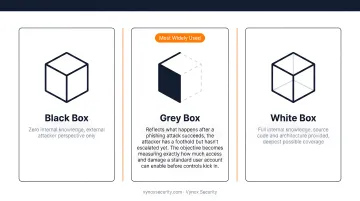
Grey box is the most widely used model. It reflects what happens after a phishing attack succeeds — the attacker has a foothold, but hasn't escalated yet. The objective becomes measuring exactly how much access and damage a standard user account can enable before controls kick in.
How Internal Penetration Testing Works
Internal pen testing follows a structured sequence. Testers replicate how real attackers operate, pursuing the lowest-effort, highest-impact paths first and escalating to more sophisticated techniques from there.
Scoping and Planning
Before any testing activity begins, the following must be defined in writing:
- In-scope assets — target network ranges, specific systems, and defined testing scenarios
- Out-of-scope assets — production databases, critical infrastructure where disruption is unacceptable
- Starting position and access level — which box model applies and what credentials (if any) the tester receives
- Objectives — reaching the domain controller, accessing a sensitive file share, or compromising a specific target system
- Rules of engagement — communication protocols, incident procedures, and testing hours
Written authorization is mandatory before any activity begins. No reputable tester starts without it.
At Vynox Security, scoping starts with a free 30-minute discovery call — Karan Singh maps your infrastructure stack and recommends the right engagement model so nothing gets tested out of context.
Reconnaissance and Discovery
This phase is largely non-intrusive. The tester maps the internal environment by:
- Identifying live hosts and exposed services
- Discovering software versions and patch levels
- Passively listening to network traffic
- Locating sensitive servers, VLANs, and authentication protocols in use
- Identifying communication protocols that lack signing or encryption
The output is an exploitation roadmap — a prioritized list of weaknesses ranked by real-world impact and exploitability.
Exploitation and Lateral Movement
This is the core technical phase. Testers actively attempt to exploit discovered weaknesses, typically starting with the lowest-effort, highest-impact techniques:
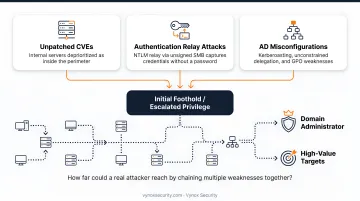
- Unpatched CVEs on internal servers that haven't been prioritized because they're "inside the perimeter"
- Authentication relay attacks — such as NTLM relay via unsigned SMB — that allow credential capture without a password
- Active Directory misconfigurations — Kerberoasting, unconstrained delegation, and GPO weaknesses that let a standard user escalate to domain administrator
Once an initial foothold or escalated privilege is achieved, the tester attempts lateral movement — pivoting across the network toward high-value targets. The objective is to determine how far a real attacker could reach by chaining multiple weaknesses together — not just confirming that a single flaw exists in isolation.
Post-Exploitation and Reporting
Every step gets documented: each vulnerability exploited, each lateral movement path taken, the full chain from starting position to final objective. This creates a reproducible record for remediation teams.
Strong deliverables serve two audiences simultaneously:
- Executive summary — a risk narrative for leadership covering business impact and overall posture
- Technical report — step-by-step findings with reproduction steps, evidence screenshots, CVSS scores, and developer-ready, stack-specific remediation guidance
Vynox's internal pen test engagements deliver exactly this format. Findings map directly to SOC 2 and ISO 27001 control requirements as a built-in part of every engagement.
The result is an assessor-ready evidence pack — one your auditor can use without additional translation.
What Internal Pen Tests Typically Uncover
Certain categories of findings appear consistently across internal assessments — not because organizations are careless, but because internal environments carry years of accumulated decisions, legacy systems, and implicit trust assumptions. Four categories account for the majority of what testers find:
Unpatched Systems and Known CVEs
Internal hosts running outdated operating systems or software with publicly known vulnerabilities are a frequent target. Because these systems sit inside the trusted network, patching gets deprioritized. The logic is that they're not "exposed to the internet," so urgency drops. Once an attacker clears the perimeter, that logic collapses immediately.
Authentication and Protocol Weaknesses
Three issues tend to cluster in environments that haven't undergone a focused internal review:
- SMB signing not enforced — enables NTLM relay attacks where an attacker intercepts and relays authentication without ever cracking a password
- LLMNR/NBT-NS/mDNS broadcast protocols enabled — these legacy name-resolution protocols can be poisoned to capture credential hashes from any machine on the network
- Weak or default credentials on internal services — printers, management interfaces, and internal tools frequently run with default passwords
Note: Microsoft enabled SMB signing by default beginning with Windows 11 24H2 and Windows Server 2025 — but mixed and legacy estates remain exposed until fully upgraded.
Active Directory Misconfigurations
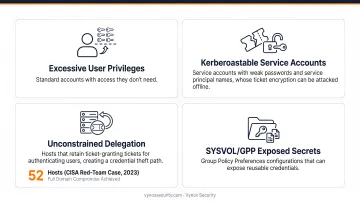
Active Directory is where most privilege escalation chains end up. Common issues include:
- Excessive user privileges — standard accounts with access they don't need
- Kerberoastable service accounts — service accounts with weak passwords and service principal names, whose ticket encryption can be attacked offline
- Unconstrained delegation — hosts that retain ticket-granting tickets for authenticating users, creating a credential theft path (a 2023 CISA red-team case found 52 hosts with unconstrained delegation and ultimately achieved full domain compromise)
- SYSVOL/GPP exposed secrets — Group Policy Preferences configurations that can expose reusable credentials
Lateral Movement Paths and Excessive Internal Access
Flat network architecture is what turns a single compromised workstation into full domain compromise. Two conditions create this exposure:
- No segmentation — an attacker who lands on a low-value endpoint can pivot directly to sensitive servers without crossing any access boundary
- Overly permissive file shares — sensitive data frequently sits in internal shares accessible to all authenticated domain users, requiring no exploitation at all
These aren't edge cases. In flat environments, they're the default state.
Internal vs. External Penetration Testing
The distinction comes down to starting position and attack surface.
External penetration testing simulates an attacker trying to break in from the internet — probing public-facing applications, exposed services, and ingress points. It answers: can someone get in?
Internal penetration testing assumes they already have — and asks: what happens next?
Neither test can substitute for the other:
- External testing cannot replicate the risk profile of a compromised insider, a phished employee, or an attacker who's already bypassed the perimeter
- Internal testing cannot assess how attackers gain entry in the first place
CIS Controls v8.1 makes this explicit — Safeguard 18.2 calls for periodic external penetration tests, while 18.5 calls for periodic internal tests, each at least annually. Defense-in-depth requires both.
When to Run Each
| Test Type | Recommended Timing |
|---|---|
| External | Before major product launches; annual cadence |
| Internal | After significant infrastructure changes; post-incident; pre-compliance audit; when onboarding new network segments |
| Both | Annual baseline; before SOC 2 or ISO 27001 audit cycles |
Conclusion
Internal networks operate on implicit trust. That trust becomes an attacker's greatest tool once they gain a foothold — and the average time to discover that foothold is measured in months, not days.
Internal pen testing makes that advantage visible before a real attacker can use it. It closes lateral movement paths, surfaces authentication weaknesses, and gives engineering teams actionable findings grounded in what's actually exploitable — not theoretical risk assessments.
That's the difference between knowing your exposure and waiting for a breach to reveal it. Book a discovery call with Vynox Security to scope an internal pen test around your environment, stack, and compliance requirements.
Frequently Asked Questions
How long does an internal penetration test typically take?
Scope determines duration. At Vynox Security, the network pen test — which covers internal testing — typically runs 5–10 business days in total, with reporting delivered alongside and after active testing. Larger environments with multiple network segments or complex Active Directory domains may require extended timelines.
What is the difference between internal and external penetration testing?
External testing targets the perimeter from the internet — public-facing systems and ingress points. Internal testing simulates an attacker who already has a foothold inside the network, testing what damage they can do from there. Both test fundamentally different attack surfaces and both are required for a complete security posture.
How often should organizations conduct internal penetration tests?
At minimum annually, per CIS Controls v8.1. Additional tests are warranted after significant infrastructure changes, post-incident, or when approaching compliance deadlines under SOC 2, ISO 27001, or PCI DSS. Organizations with active development cycles benefit from Vynox's PTaaS model, which provides continuous testing aligned to each sprint.
What access does a tester need to perform an internal pen test?
It depends on the model. Black box requires only network access with no credentials. Grey box requires a standard low-privilege domain account. White box requires full documentation and admin-level access. All three require a signed authorization and agreed rules of engagement before testing begins.
What deliverables should I expect from an internal penetration test?
Vynox delivers two reports with every engagement:
- Executive summary: risk narrative and business impact for leadership
- Technical report: findings with evidence screenshots, CVSS scores, reproduction steps, and stack-specific remediation guidance for engineering teams
Assessor-ready compliance evidence mapping for SOC 2, ISO 27001, and PCI DSS is included where applicable.
Does internal penetration testing help with SOC 2 or ISO 27001 compliance?
Yes. Internal pen testing provides direct evidence for controls related to vulnerability management, access control, and risk assessment under both frameworks. Vynox maps findings directly to control requirements and delivers assessor-ready evidence packs, so compliance documentation comes out of the same engagement rather than a separate exercise.