Introduction
AI agents don't just answer questions anymore. They call APIs, write to databases, send emails, and approve transactions, often with real credentials and no human checking the output first. AI agents don't just answer questions anymore. They call APIs, write to databases, send emails, and approve transactions, often with real credentials and no human checking the output first.
A single manipulated reasoning step doesn't just produce a bad sentence; it triggers a real action on a live system.
This shift is happening fast. Gartner predicts that 40% of enterprise applications will include task-specific AI agents by the end of 2026, up from less than 5% in 2025. That's an eightfold jump in under two years, and most security programs haven't caught up.
This article covers what AI agent security actually means, the risk categories worth worrying about, the practices that hold up under pressure, and how adversarial testing proves whether your defenses actually work.
Key Takeaways
- Agents act, not just answer, so a compromised reasoning step becomes a real action backed by live credentials
- Prompt injection, direct and indirect, remains the most exploitable vector in agentic deployments
- Excessive permissions and unmanaged shadow agents cause more damage than any single exotic attack
- Identity-first controls, runtime monitoring, and continuous adversarial testing beat one-time reviews
- OWASP, ISO 42001, NIST AI RMF, and SOC 2 increasingly expect documented agent risk assessments
What Is AI Agent Security?
AI agent security is the practice of keeping autonomous AI systems safe, predictable, and controlled once they're operating on real systems. Those agents reason, plan, call tools and APIs, and take action—so securing them is not the same discipline as securing a chatbot.
The core question has changed. With a standard LLM, security teams asked: can someone influence what the model says? With an agent, the question becomes: if someone influences the model, what can it actually reach or change? That's the difference between text generation risk and execution-with-access risk, and it reshapes how you defend the system.
Here's the part that trips up most security teams: every AI agent functions as a non-human identity (NHI). It holds API keys, service account credentials, or cloud IAM roles, just like a piece of infrastructure would.
That makes identity, not the model itself, the primary control point. You can have a perfectly aligned model and still get breached because the agent was handed a permission set nobody reviewed.
Why AI Agents Create a Different Attack Surface Than Chatbots or Traditional Apps
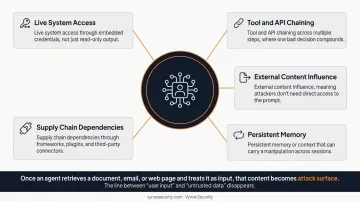
Several structural properties push agent risk past what standard AppSec controls anticipate:
- Live system access through embedded credentials, not just read-only output
- Tool and API chaining across multiple steps, where one bad decision compounds
- External content influence, meaning attackers don't need direct access to the prompt
- Persistent memory or context that can carry a manipulation across sessions
- Supply chain dependencies through frameworks, plugins, and third-party connectors
The most underappreciated point here: agents can be steered by the data they read, not just what a user types. Once an agent retrieves a document, email, or web page and treats it as input, that content becomes attack surface.
The line between "user input" and "untrusted data" disappears. Most legacy security tooling was never built to watch for that.
Top AI Agent Security Risks to Address
Most agent security incidents follow the same repeatable pattern: something influences the model's reasoning, the agent holds real access, and a tool executes the result. These six categories cover the vast majority of real-world exposure.
Prompt Injection (Direct and Indirect)
Direct injection manipulates the system prompt or user input directly. Indirect injection hides malicious instructions inside documents, emails, web pages, or retrieved data the agent processes later. Agents struggle to tell trusted instructions apart from attacker-controlled content, because both often arrive in the same text stream.
Invariant Labs demonstrated this clearly. They planted an indirect prompt injection inside a public GitHub issue, and when Claude Opus read that issue through the GitHub MCP integration, it used its connected tools to pull private-repository data and publish it in a pull request to a public repo. No human approval was required at any step.
It was a controlled demonstration, not a live breach. Still, exfiltration and downstream tool calls can happen without anyone noticing until it's too late.
Excessive Agency and Unauthorized Actions
Small input manipulations can push an agent past its intended scope: triggering a workflow early, chaining tools in a sequence nobody designed, or completing a task in a way that's technically "successful" but never authorized. This is a business logic failure, and standard AppSec scanners simply don't check for it.
Shadow AI agents make this worse. Agents spun up by individual teams outside security's visibility carry whatever default permissions their platform assigns, usually more than they need, with nobody tracking them.
Identity Misuse and Privilege Escalation
Agents get treated as convenience, not risk. Teams hand them broad, long-lived permissions so they don't break mid-task. When an attacker influences that agent's decisions, they inherit whatever privileges it was given, which can mean assuming roles or moving laterally across cloud environments.
A Cloud Security Alliance and Zenity survey found that 53% of surveyed organizations reported AI agents exceeding their intended permissions occasionally or sometimes, with only 8% saying their agents never did. Permission creep isn't the exception in agentic deployments. It's closer to the default.
Data Exposure Through Unbounded Retrieval
Agents and RAG pipelines abstract data access behind tool calls. A manipulated agent can quietly aggregate or export sensitive records through a channel that looks like normal activity in traditional security logs, so nothing trips an alarm.
This gets dangerous fast when agents pull from internal knowledge bases containing PII, financial records, or health data. The exposure doesn't require a dramatic breach; it just requires the agent doing exactly what it was designed to do, for the wrong requester.
Memory Poisoning and Persistent Context Manipulation
Attacker-planted instructions stored in an agent's memory or context can shape its behavior across future sessions, long after the original injection point is gone. The agent keeps acting on a compromised instruction it "remembers," even after the document or message that planted it has been deleted.
Supply Chain Risk Through Tools, Plugins, and MCP Servers
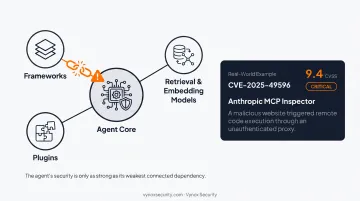
Agents depend on frameworks, plugins, and retrieval or embedding models built by someone else. If any dependency is compromised, the agent trusts tampered output or malicious context by default, because it has no reason not to.
One real example: CVE-2025-49596 in the Anthropic MCP Inspector let a malicious website trigger remote code execution through an unauthenticated proxy, rated critical at CVSS 9.4. The agent's security is only as strong as its weakest connected dependency.
Best Practices for Securing AI Agents
Security for agentic workflows spans CloudSec, AppSec, and SecOps at once. The practices below map directly to the risk categories above, functioning as fixes for specific failure modes rather than a generic checklist.
Establish Dedicated Agent Identities With Least Privilege
Every agent needs its own scoped role or service account. Never share API keys across agents or environments.
- Use short-lived credentials with automatic rotation instead of static keys
- Store secrets in a dedicated secrets manager, never in prompts or environment variables
- Scope permissions to the specific tools and data the agent actually needs, nothing broader
Build a Complete Agent Inventory
You can't secure what you can't see. For every deployed agent, capture:
- Owner and business purpose
- Accessible tools and APIs
- Permissions granted and reachable data stores
- Deployment environment (staging, production, or third-party platform)
Treat any agent you can't fully account for as high-risk by default, regardless of what it's supposed to do.
Validate and Sanitize Inputs and Retrieval Sources
Treat every piece of external content as untrusted before it enters the agent's reasoning loop. That includes documents, emails, web pages, and API responses.
Use clear delimiters that separate instructions from data, so the model has a structural signal for what to follow versus what it's only reading.
Enforce Human-in-the-Loop for High-Impact Actions
Not every action needs a human checkpoint, but irreversible or consequential ones do. Require explicit, action-bound approval for:
- Financial transactions or fund transfers
- Data deletions
- Production deployments
Reserve autonomous execution for low-risk, reversible tasks only.
Monitor Runtime Behavior Continuously
Establish behavioral baselines for tool call patterns, data access volume, and retrieval frequency, then watch for deviation. At minimum, log:
- Agent identity for every action taken
- Tool calls made and their parameters
- Prompts received
- Retrieval sources queried
- Policy decisions (approved, blocked, escalated)
Without this telemetry, investigating an incident becomes guesswork.
Test Agents Adversarially Before and After Every Change
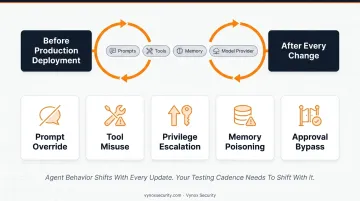
Run structured abuse-case testing before production deployment, and again after any change to prompts, tools, memory, or model provider. Cover cases such as:
- Prompt override
- Tool misuse
- Privilege escalation
- Memory poisoning
- Approval bypass
Agent behavior shifts with every update. Your testing cadence needs to shift with it.
AI Agent Security Testing: Validating Your Defenses Before Attackers Do
Guardrails and best practices look solid on a whiteboard. They only prove effective under real adversarial pressure. Misconfigurations, injection vulnerabilities, and permission gaps tend to surface during simulated attacks, not during a static configuration review that just checks boxes.
Most traditional penetration testing firms don't test AI-specific attack surfaces. Prompt injection, RAG pipeline exploitation, and agent tool-chaining rarely appear in a standard pentest scope, leaving a blind spot in programs that assume "we got pentested" means "we're covered."
Vynox Security runs dedicated autonomous agent assessments as part of an AI-native testing practice, alongside LLM penetration testing and RAG pipeline security testing. Every agent engagement targets the failure modes that actually cause incidents:
- Tool-call injection via crafted inputs
- Indirect prompt injection through the agent's environment
- Privilege escalation through agent chaining
- Goal hijacking and task redirection
- Data exfiltration through legitimate tool channels
- MCP and tool-use abuse across multi-agent systems
Testing covers full OWASP LLM Top 10 exposure and applies 40+ prompt injection and jailbreak techniques. Agent-specific findings map to OWASP LLM-08 (Excessive Agency). Framework-specific coverage extends to LangChain agents and OpenAI Assistants API implementations.
Destructive tests stay scoped to staging or sandbox environments, with guardrails agreed upfront before anything touches production.
A standard agent assessment runs 10 to 15 business days, well under the 4 to 8 weeks typical of traditional firms. Engagements are available as Rapid Secure (fast, compliance-ready) or Deep Secure (comprehensive adversarial coverage, including full AI red teaming).
Findings arrive ready for engineers and auditors:
- Reproduction steps and evidence screenshots
- CVSS scores with stack-specific fix guidance
- Evidence mapped to SOC 2 and ISO 27001 AI-specific controls
Since agent behavior shifts with every prompt change, tool update, or model provider release, one-time testing has a short shelf life. A PTaaS cadence aligned to development sprints and model updates catches vulnerabilities in the same sprint they appear, not six months later at the next scheduled audit.
Teams evaluating whether their agent stack needs this can book a free discovery call to get a scoped assessment plan.
Who Owns AI Agent Security in Your Organization?
Agentic workflows cross CloudSec, AppSec, and SecOps simultaneously, which in practice means nobody fully owns them. Undefined boundaries between these teams create exactly the control gaps attackers exploit, because each team assumes agent risk belongs to someone else.
The fix is unglamorous but effective:
- Assign a named human owner to every deployed agent, no exceptions
- Integrate agent registration into the standard deployment workflow, not as an afterthought
- Require sign-off before an agent gets production credentials, the same way you'd require it for a new production database
Governance frameworks are starting to formalize this expectation:
- ISO 42001 — define responsibilities for AI use, assess AI-related risks, and monitor systems across the lifecycle
- NIST AI RMF — document AI-risk roles, maintain an inventory of AI systems, and assign ongoing review responsibility
Neither framework names which team should own agent security day-to-day, but both expect that someone, by name, does.
Frequently Asked Questions
How is AI agent security different from traditional application security?
Traditional AppSec protects static code and predefined workflows. AI agent security must also cover autonomous decision-making, real non-human credentials, and tool execution across the entire stack.
What is the most common security risk in AI agent deployments?
Prompt injection combined with excessive or unmanaged permissions is the most frequently exploited combination. It converts a manipulated model response into a real, unauthorized action on a live system.
What telemetry do security teams need to investigate an AI agent incident?
At minimum: agent identity, tool calls made, prompts received, retrieval sources queried, and policy decisions logged. Without these, investigating an incident is mostly guesswork.
How often should AI agents be security tested?
Before production deployment, and again after any material change to prompts, tools, memory, retrieval, or model provider. A continuous cadence aligned to development sprints catches issues faster than periodic reviews.
What compliance frameworks apply to AI agent security?
OWASP LLM Top 10, ISO 42001, NIST AI RMF, MITRE ATLAS, and SOC 2/ISO 27001 AI-specific controls are the frameworks most organizations map their findings against.
Can traditional penetration testing tools detect AI agent vulnerabilities?
Generally, no. Traditional tools miss AI-specific attack surfaces like prompt injection, memory poisoning, and tool or agent chaining, which require purpose-built AI-native testing methodologies.