Here's the uncomfortable truth: there's no single answer to "how much will this cost me." A small coffee shop using a hosted checkout might spend a few hundred dollars a year. A global payment processor might spend a quarter of a million. Both are "PCI compliant."
This article breaks down 2026 pricing by business size, the cost components that make up your bill, what pushes prices up or down, and how to budget without wildly over- or underestimating.
Key Takeaways
- SAQ-eligible small businesses pay a fraction of what Level 1 merchants pay for a full Report on Compliance (RoC)
- Merchant level, transaction volume, CDE complexity, and security maturity drive most cost variance
- Recurring costs (scans, pen tests, training) typically outpace one-time setup over 3–5 years
- Scope reduction via tokenization, segmentation, or a Level 1 processor can cut your bill significantly
- Underbudgeting remediation and internal staff time is the most common costly mistake
How Much Does PCI Compliance Cost in 2026? (Pricing Overview)
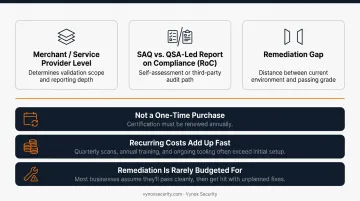
PCI compliance cost depends on three things: your merchant or service provider level, whether you validate via Self-Assessment Questionnaire (SAQ) or a QSA-led Report on Compliance (RoC), and how much remediation work sits between your current environment and a passing grade.
A few misconceptions trip businesses up every year:
- It's not a one-time purchase. Certification must be renewed annually.
- Recurring costs add up fast. Quarterly scans, annual training, and ongoing tooling often exceed the initial setup.
- Remediation is rarely budgeted for. Most businesses assume they'll pass cleanly, then get hit with unplanned fixes.
| Tier | Typical annual cost | Validation path |
|---|---|---|
| Small business (SAQ) | $300–$3,200 | Self-assessment (Level 3/4) |
| Midsize business | $2,500–$52,000 | SAQ A through A-EP (Level 2) |
| Large enterprise (RoC) | $70,000–$260,000+ | QSA-led RoC (Level 1) |
Small Business / Self-Assessment Questionnaire (SAQ) Tier
A small, SAQ-eligible business can expect to spend roughly $300 to $3,200 annually, depending on payment flow.
SecurityMetrics' 2026 benchmark puts a basic program near $300/year: SAQ ($50–$200), ASV scanning ($100–$200 per IP), and employee training (about $70/head), according to SecurityMetrics' 2026 cost analysis.
That range covers self-assessment, quarterly scanning, and basic training. It does not cover major remediation or new hardware if your environment has gaps. This tier fits Level 3/4 merchants processing under 1 million transactions annually.
Midsize Business Tier
Midsize businesses hit a much wider range, largely based on how card data flows through their systems. A midsize business using a simple hosted checkout (SAQ A) might spend $2,500-$8,000/year, while one with a more exposed environment (SAQ A-EP) can land at $20,000-$52,000/year.
Network segmentation projects are usually what push a company toward the top of this range. Untangling flat networks into properly isolated zones isn't cheap, but it pays off in lower ongoing assessment scope. This tier suits growing merchants and Level 2 merchants nearing 1-6 million transactions.
Large Enterprise / Report on Compliance (RoC) Tier
Level 1 merchants and service providers requiring a QSA-led RoC typically spend $70,000 to $260,000+ annually. That includes the QSA engagement itself (often $55,000-$200,000), penetration testing, file-integrity monitoring, SIEM/log management, and dedicated compliance staff.
Remediation is often the single largest line item here — legacy environments with outdated software or hardware can require anywhere from $10,000 to $500,000+ to bring current, based on figures reported by SecurityMetrics. This tier applies to Level 1 merchants processing over 6 million transactions annually, or large service providers.
Key Factors That Affect PCI Compliance Cost
PCI compliance cost isn't driven by any single lever. It depends on your regulatory classification, technical environment, and how prepared you already are.
Merchant/Service Provider Level and Transaction Volume
The PCI SSC's Level 1–4 classification is based on annual card transaction volume. It determines whether you self-assess or undergo a full onsite QSA audit.
Service providers face stricter thresholds than merchants. Level 1 often starts above 300,000 transactions for many service provider categories, versus 6 million+ for merchants. A smaller service provider can still land in the most expensive compliance tier.
Validation Method: SAQ vs Report on Compliance (RoC)
Completing an SAQ is far cheaper and faster than commissioning a RoC. An SAQ might cost $50–$200 in documentation support; a RoC engagement runs into the tens or hundreds of thousands.
Some Level 2 merchants can choose between an internal assessor and a QSA, depending on their acquirer's requirements. That choice alone can swing costs by tens of thousands of dollars.
Cardholder Data Environment (CDE) Size and Complexity
Every system, location, and integration that touches card data expands your audit scope. More scope means more assessment days, more testing, and more cost.
Common ways to shrink scope include:
- Tokenization: Replace stored card numbers with non-sensitive tokens so fewer systems stay in scope
- Level 1 processors: Outsource payments to a PCI Level 1 processor to move many requirements outside your environment
- Network segmentation: Isolate the CDE so assessors test a smaller, well-bounded footprint
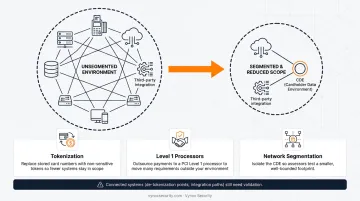
These tactics cut assessor effort. Connected systems (de-tokenization points, integration paths) still need validation.
Current Security Maturity and Readiness
Organizations that already run firewalls, encryption, and access controls move through assessment faster and cheaper. Those starting from scratch face costly remediation, often the largest line item in the compliance budget.
Use of Third-Party Vendors and Processors
Every vendor that touches cardholder data (payment gateways, hosting providers, call centers) extends your compliance responsibility. If that vendor isn't PCI-aligned, you inherit the risk and cost of proving compliance around them.
Cost Breakdown of PCI Compliance
Total PCI compliance cost extends well beyond the audit or SAQ fee. It spans preparation, certification, and year-round maintenance.
| Cost Component | Frequency | Typical Range |
|---|---|---|
| SAQ / RoC audit fee | Annual | $50-$200 (SAQ) to $55,000-$200,000 (RoC) |
| ASV & internal vulnerability scanning | Quarterly | $100-$200 per IP |
| Penetration testing | Annual/semi-annual | $4,000-$35,000+, higher for complex environments |
| Training & policy development | Annual | ~$70 per employee |
| Remediation & monitoring tools | One-time, then periodic | $100-$500,000+ |
Self-Assessment or RoC/QSA Audit Fee
SAQ documentation support typically costs $50-$200. A full QSA-led RoC averages around $15,000 for smaller engagements and climbs to $55,000-$200,000 for large, complex enterprises, according to figures from Paytia's 2026 merchant cost breakdown.
Vulnerability Scanning (ASV) and Internal Scans
Approved Scanning Vendor (ASV) scans generally run $100-$200 per external IP address, required quarterly. Internal scanning programs vary more widely and depend on how many internal systems sit in scope. There's no universal per-IP figure, so budget from your own network inventory.
Penetration Testing
Penetration testing costs cluster between $4,000 and $35,000 for most businesses, with complex enterprise engagements exceeding $100,000. Internal-network testing alone often runs $7,000-$35,000.
Businesses running AI-powered checkout, fraud-detection, or chatbot systems alongside their CDE need testing that covers both traditional infrastructure and AI attack surfaces. A standard infrastructure pentest won't catch prompt injection into a fraud-detection model or agent tool-call hijacking in a payment workflow. Those are blind spots for firms that only test CVEs and misconfigurations.
Vynox Security closes that gap in a single engagement. Instead of hiring a traditional pentest firm plus a separate AI security vendor, Vynox runs a two-layer methodology: AI Security Testing (LLMs, RAG pipelines, autonomous agents) alongside Infrastructure Testing (web, API, cloud, network). Most engagements deliver in 5-15 business days.
Employee Training and Policy Development
Budget roughly $70 per employee for combined training and policy development, based on SecurityMetrics' benchmark. Broader security-awareness platforms range from $0.45 to $6 per employee per month depending on delivery model.
Remediation, Technology Upgrades, and Monitoring Tools
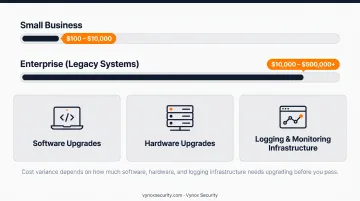
This is the widest-ranging line item by far: $100 to $10,000 for small businesses, and $10,000 to $500,000+ for enterprises with legacy systems. The variance comes down to how much software, hardware, and logging infrastructure needs upgrading before you pass.
Hidden Costs Most Businesses Miss
The line items above are just the visible ones. Three hidden costs catch businesses off guard almost every year.
- Internal labor: Preparing evidence, coordinating with auditors, and resolving assessment findings consistently consumes weeks of staff time—often the most underestimated cost in the entire budget.
- Vendor dependencies: A single non-compliant vendor in your payment chain can force a costly platform switch, or even push you into a higher, more expensive compliance tier.
- Scope creep from poor segmentation: Weak network segmentation pulls systems that never touch cardholder data into PCI scope. You end up applying unnecessary controls—and cost—where they don't belong.
None of these show up on a QSA invoice, but they show up in your budget all the same.
How to Reduce PCI Compliance Costs Without Cutting Corners
You can lower your compliance bill without lowering your actual security. Three approaches make the biggest difference:
- Shrink your CDE scope first. Implement tokenization and network segmentation before budgeting for an assessment. Fewer systems in scope means fewer assessment days and lower fees across the board.
- Consolidate your testing vendors. If AI touches fraud detection, chat, or checkout, don't pay separate firms for vulnerability scanning, penetration testing, and AI-specific security testing. One vendor covering both traditional and AI surfaces (Vynox Security is one example) avoids overlapping fees and can deliver compliance-ready evidence in 5–15 business days.
- Treat compliance as continuous, not annual. Spreading remediation across the year, rather than scrambling before your assessment window, avoids premium pricing from rushed fixes and emergency vendor engagements.
None of these approaches weaken your security posture. They eliminate waste.
Frequently Asked Questions
How much does a PCI audit cost?
A QSA-led onsite audit (RoC) typically costs $55,000–$200,000, far more than an SAQ, which runs $50–$200. The exact figure depends on your merchant level and environment complexity.
Is PCI compliance a one-time cost or an ongoing expense?
It's ongoing. Both SAQ and RoC certification require annual renewal, and vulnerability scans are required quarterly, making PCI compliance a recurring line item, not a one-off purchase.
What is the cheapest way for a small business to become PCI compliant?
Outsource payment processing to a PCI-validated Level 1 processor and complete the applicable SAQ. This removes most cardholder data handling from your environment, cutting scope and cost significantly.
Do small businesses need to hire a QSA?
No. Most small merchants self-validate via SAQ. Only Level 1 merchants and service providers are required to undergo a QSA-led onsite assessment.
What happens if a business doesn't budget enough for PCI compliance?
Underbudgeting leads to rushed remediation, failed assessments, and potential non-compliance fines from acquirers or card brands. Fixing gaps under time pressure almost always costs more than planning ahead.
How much does penetration testing for PCI compliance cost?
Typical penetration testing runs $4,000–$35,000, with complex environments exceeding $100,000. Scope, environment size, and whether AI payment or fraud tools need testing alongside standard infrastructure drive most of the variance.