Introduction
The numbers tell a clear story. The CVE Program published 40,077 vulnerability records in 2024 — a 38% jump from 28,961 the year before. Meanwhile, IBM's 2025 Cost of a Data Breach Report puts the average US breach cost at $10.22 million, with breaches taking 241 days on average to identify and contain.
That gap between discovery and containment is where the real damage happens. Every day a vulnerability sits undetected inside your network is another day an attacker can move laterally, escalate privileges, and reach your most sensitive systems before anyone knows they're in.
A network vulnerability assessment (NVA) is how security-conscious teams get ahead of that problem. This guide covers everything you need to know: what an NVA actually is, the most common vulnerabilities it uncovers, a step-by-step process for conducting one, how it compares to penetration testing, and how often your organization should run one.
Key Takeaways
- An NVA systematically identifies and prioritizes security weaknesses across your network before attackers find them
- Unlike penetration testing, NVA catalogs and prioritizes weaknesses without actively exploiting them
- The six-step process runs from scope definition through reassessment and verification
- PCI DSS mandates quarterly scans; other frameworks use risk-based frequency instead
- SOC 2, ISO 27001, and PCI DSS all require documented vulnerability management as part of audit evidence
What Is a Network Vulnerability Assessment?
A network vulnerability assessment (NVA) is a systematic process of identifying, analyzing, and prioritizing security weaknesses across an organization's network infrastructure — routers, switches, firewalls, endpoints, and cloud-connected assets.
NIST defines vulnerability assessment as a systematic examination used to determine whether security measures are adequate, identify deficiencies, predict their effectiveness, and confirm adequacy after changes are implemented.
What NVA Is — and Isn't
Two common misconceptions worth clearing up:
- Not a one-time event. Over 40,000 new CVEs were published in 2024 alone. An assessment from six months ago reflects a network that no longer exists.
- Not penetration testing. NVA identifies and catalogs weaknesses across a broad scope. Pen testing actively exploits those weaknesses on a narrower set of targets. Think of NVA as the security audit; pen testing is the live drill.
The Core Objective
The goal is straightforward: give security teams a clear, prioritized picture of their attack surface before threat actors can exploit it. That shifts the posture from reactive damage control to proactive remediation.
NVA is typically the first step in a broader vulnerability management lifecycle — discovery, prioritization, remediation, verification, and continuous monitoring. Without a thorough assessment, remediation efforts are guesswork — teams patch what's visible rather than what's critical.
Common Network Vulnerabilities You Need to Know
Verizon's 2025 Data Breach Investigations Report, analyzing over 22,000 incidents, found that vulnerability exploitation accounted for 20% of known initial access vectors, with compromised credentials at 22% and phishing at approximately 15%. Here are the categories NVA is designed to find.
Unpatched and Legacy Software
Outdated operating systems and applications accumulate known vulnerabilities over time. Attackers actively scan for unpatched versions because exploitation is low-effort — the vulnerability details are public, and tools to exploit them are widely available. A system running an unpatched CVE from six months ago is as exposed as one with no security controls at all.
Misconfigured Firewalls and Network Devices
Improper firewall rules, open ports, and insecure default settings create entry points that require no exploitation skills to use. Miscellaneous errors — including misconfiguration — represented 12% of breaches in Verizon's 2025 dataset. Cloud infrastructure compounds this further — misconfigured storage buckets and security groups are easy to introduce and hard to catch without systematic scanning.
Weak Authentication and Access Controls
Weak or reused passwords, absent multi-factor authentication, and overly broad access permissions are a reliable path to credential compromise. Once an attacker has valid credentials, lateral movement across the network becomes much easier — especially without least-privilege controls in place.
Poor Network Architecture and Segmentation
Flat networks without segmentation allow an attacker who gains initial access to move freely toward high-value systems — databases, admin consoles, internal APIs. NVA maps these pathways and identifies where segmentation gaps create unacceptable blast radius.
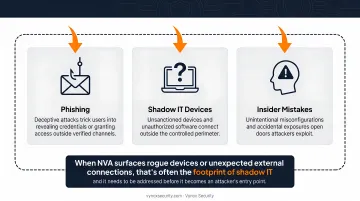
Human Error and Shadow IT
Phishing, unauthorized shadow IT devices, and insider mistakes introduce vulnerabilities outside the controlled perimeter. When NVA surfaces rogue devices or unexpected external connections, that's often the footprint of shadow IT — and it needs to be addressed before it becomes an attacker's entry point.
How to Perform a Network Vulnerability Assessment: Step-by-Step
Step 1 — Define Scope and Goals
Clearly define which systems, networks, and assets are in scope before any scanning begins. Scope creep wastes time; scope gaps leave coverage gaps.
Key elements to establish upfront:
- Which IP ranges, cloud environments, and endpoints are included
- Regulatory requirements that dictate coverage (PCI DSS, HIPAA, SOC 2, ISO 27001)
- Acceptable testing impact (some scans can disrupt production systems)
- Roles and authorization — who approved the assessment
Step 2 — Asset Discovery and Inventory
Build a comprehensive inventory of every network-connected asset before scanning begins. You cannot assess what you cannot see.
Assets to account for include:
- Devices, servers, cloud instances, and endpoints under active management
- Applications and APIs — both internal-facing and external-facing
- Shadow IT — devices and services deployed without IT knowledge, and often the first foothold attackers exploit
Step 3 — Vulnerability Scanning
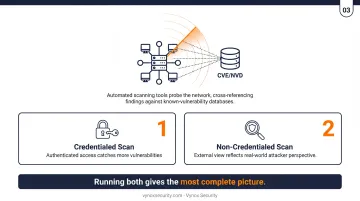
Automated scanning tools probe the network, cross-referencing findings against databases like the CVE/NVD to identify known vulnerabilities.
Two scan types serve different purposes:
| Scan Type | What It Shows |
|---|---|
| Credentialed | Authenticates into systems for deeper visibility into patch status and configuration |
| Non-credentialed | Simulates an external attacker's view without system access |
Running both gives the most complete picture. Credentialed scans catch more; non-credentialed scans reflect real-world attacker perspective.
Step 4 — Analysis and Prioritization
Raw scan results almost always include false positives. Every finding needs manual review to confirm it's real before it enters the remediation queue.
Prioritization uses the CVSS (Common Vulnerability Scoring System) — currently at v4.0 — which scores vulnerabilities from 0.0 to 10.0 across five bands: None, Low, Medium, High, and Critical. A Critical score (9.0–10.0) on an internet-facing system gets addressed before a Medium score on an isolated internal device.
CVSS score alone isn't enough. Asset criticality matters too. A Medium-severity vulnerability on a system processing payment data can carry more business risk than a High-severity finding on a test environment.
Step 5 — Reporting and Remediation
A useful NVA report does more than list vulnerabilities. It should:
- Assign severity ratings (Critical/High/Medium/Low) with CVSS scores and asset criticality context
- Include reproduction steps engineers can use to validate each finding
- Provide stack-specific, developer-ready fix guidance
- Quantify potential business impact so leadership can prioritize resources
For organizations pursuing compliance, Vynox Security's network assessments deliver findings mapped directly to SOC 2, ISO 27001, and PCI DSS control requirements — combining testing and compliance documentation in a single engagement rather than two separate workstreams.
Step 6 — Reassessment and Verification
Patching a vulnerability doesn't automatically mean it's fixed. A follow-up scan after remediation confirms:
- Patches were applied correctly
- Configuration changes didn't introduce new issues
- Previously flagged findings are resolved
Without verification, remediation is an assumption. The follow-up scan is what turns a completed checklist into confirmed risk reduction.
Types of Network Vulnerability Assessments
Different scan types target different parts of the attack surface:
| Scan Type | Focus Area |
|---|---|
| Network-based | Open ports, exposed protocols, firewall misconfigurations |
| Host-based | Individual device configurations and patch status |
| Wireless | Rogue access points, weak encryption, unauthorized networks |
| Application | Web app vulnerabilities (SQL injection, XSS, business logic flaws) |
Internal vs. external scans serve complementary roles:
- Internal scans simulate an insider threat or compromised device already on the network
- External scans simulate what an attacker on the internet can see and target
Cloud environments don't fit neatly into either category. Traditional on-premises tools frequently miss misconfigurations in cloud infrastructure, containers, and serverless functions — environments where IPs are dynamic and workloads are short-lived.
NIST SP 800-190 notes that host-oriented scanning tools are poorly suited for containerized workloads. Cloud-specific assessments need to cover:
- IAM configurations and privilege escalation paths
- Storage bucket exposure and data access controls
- Security group rules and network segmentation
- Secrets management and credential leakage risks
Network Vulnerability Assessment vs. Penetration Testing
Knowing which tool to use — and when — is one of the most common decisions security teams get wrong.
Think of an NVA as a building inspector walking through a property and cataloging every structural weakness. A penetration test is like hiring someone to actually try to break in — picking locks, testing windows, working every entry point until one gives.
| Dimension | Vulnerability Assessment | Penetration Testing |
|---|---|---|
| Purpose | Identify and catalog weaknesses broadly | Actively exploit weaknesses to confirm real-world impact |
| Scope | Wide — many assets | Narrow — targeted attack paths |
| Automation | Primarily automated scanning | Manual, iterative exploitation |
| Output | Prioritized vulnerability list with remediation steps | Evidence of exploitability and actual attack paths |
| Frequency | Continuous or regular intervals | Scheduled milestones |
When you need both:
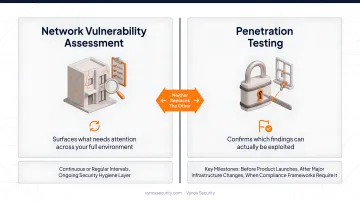
These tools serve different cadences, not competing priorities. NVA runs continuously or at regular intervals — it's your ongoing security hygiene layer. Penetration testing belongs at key milestones: before product launches, after major infrastructure changes, or when compliance frameworks require it.
Neither replaces the other. An NVA surfaces what needs attention across your full environment; a penetration test confirms which of those findings can actually be exploited — and what an attacker could do with access.
How Often Should You Conduct a Network Vulnerability Assessment?
Frequency guidance varies by framework and risk profile.
Baseline recommendations:
- Quarterly — minimum for most organizations
- Monthly — high-risk environments or systems that change frequently
- Weekly — edge networks and critical internet-facing infrastructure
Compliance requirements:
| Framework | Requirement Type | Cadence |
|---|---|---|
| PCI DSS 4.0.1 (Req. 11.3.1) | Prescriptive | Internal scans every 3 months; external scans quarterly via ASV; rescan after significant changes |
| HIPAA | Risk-based | Periodic reassessment required; frequency left to organizational risk judgment |
| SOC 2 | Risk-based | Evidence of vulnerability management required; no fixed interval prescribed |
| ISO 27001 | Risk-based | Periodic reassessment required; frequency determined by risk assessment |
Key variables that should drive your cadence:
- Rate of infrastructure change (new deployments, software updates, configuration changes)
- Sensitivity of the data your systems handle
- History of past incidents or vulnerabilities
- Specific regulatory requirements that apply to your industry
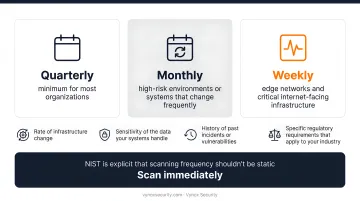
NIST is explicit that scanning frequency shouldn't be static. When newly disclosed vulnerabilities may affect your systems, don't wait for the next scheduled cycle — scan immediately.
Frequently Asked Questions
What is network vulnerability assessment?
A network vulnerability assessment is a systematic process for identifying, analyzing, and prioritizing security weaknesses across an organization's network infrastructure — covering devices, systems, configurations, and connected assets. The goal is to surface exploitable weaknesses before attackers do, enabling proactive remediation.
What are the 4 network vulnerabilities?
The four most commonly exploited categories are: unpatched or outdated software, misconfigured devices and firewalls, weak authentication and access controls, and poor network architecture or segmentation. These categories account for the majority of initial access vectors seen in breach investigations.
What does a 9.8 CVSS score mean?
A 9.8 falls in the Critical band (9.0–10.0) of the 0–10 CVSS scale — meaning the vulnerability is network-reachable, requires no privileges or user interaction, and carries high impact across confidentiality, integrity, and availability. It requires immediate remediation, though asset context should also factor into prioritization.
What is the difference between CVE and CVSS?
CVE (Common Vulnerabilities and Exposures) is a unique identifier and catalog entry for a specific known vulnerability — it names it. CVSS (Common Vulnerability Scoring System) is the standardized framework that rates the severity of that vulnerability — it scores it. In practice, the NVD links each CVE entry to its corresponding CVSS score, so you'll typically see both together.
How often should a network vulnerability assessment be performed?
Most organizations should run assessments at least quarterly. High-risk environments with frequent infrastructure changes benefit from monthly scans, and critical internet-facing systems may warrant weekly scans. PCI DSS explicitly requires quarterly internal scans and quarterly ASV external scans as a compliance floor.
What is the difference between a vulnerability assessment and a penetration test?
A vulnerability assessment uses automated tools to broadly identify and prioritize weaknesses across many assets — it's frequent and produces a remediation-focused report. A penetration test involves security professionals actively exploiting those weaknesses to demonstrate real-world impact — it's targeted, manual, and runs less often.