Yet "red teaming" and "penetration testing" still get used as if they're the same thing. They aren't. Picking the wrong one creates false confidence and leaves real gaps undiscovered, especially now that AI systems and LLMs sit on infrastructure that neither testing method was originally built to cover.
This article breaks down what each approach actually tests, how they compare side by side, and how to decide which one (or both) fits your organization's maturity stage.
Key Takeaways
- Pentesting catalogs vulnerabilities inside a defined, time-boxed scope.
- Red teaming simulates covert, multi-week attacks to test detection and response.
- Mature security programs layer both, plus continuous testing as attack surfaces expand.
- AI systems like LLMs, RAG pipelines, and agents need testing beyond either method's design.
Red Teaming vs Penetration Testing: Quick Comparison
Before the deeper breakdown, here's a fast snapshot of how the two methods differ.
| Dimension | Red Teaming | Penetration Testing |
|---|---|---|
| Goal | Tests resilience, detection, and response against a realistic adversary | Identifies and documents exploitable vulnerabilities in a defined scope |
| Scope & Visibility | Broad, covert; spans people, process, and technology; defenders usually unaware | Narrow, pre-agreed scope; organization knows testing is happening |
| Duration & Cost | Weeks to months; higher cost due to complexity and specialized skill | Days to a couple of weeks; more cost-efficient and repeatable |
| Techniques | Full attack chains — social engineering, physical intrusion, lateral movement, persistence | Map-scan-exploit approach targeting known vulnerability classes |
What Is Red Teaming?
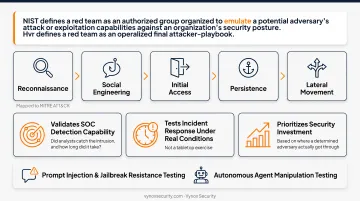
NIST defines a red team as an authorized group organized to emulate a potential adversary's attack or exploitation capabilities against an organization's security posture. Notice the word "emulate": a red team plays the role of a specific attacker pursuing a defined objective, rather than hunting for bugs.
The methodology follows the attacker's actual playbook: reconnaissance, social engineering, initial access, persistence, and lateral movement, usually mapped to MITRE ATT&CK so the team can emulate a particular threat actor's behavior rather than run generic scans. The goal is whether that specific type of attacker can achieve their objective and whether anyone would notice, not how many vulnerabilities exist.
That framing changes what red teaming actually delivers:
- Validates SOC detection capability: did your analysts catch the intrusion, and how long did it take?
- Tests incident response under real conditions, not a tabletop exercise
- Prioritizes security investment based on where a determined adversary actually got through, not a theoretical checklist
Red teaming has also expanded well past networks and badge readers. Adversarial testing now extends to AI systems: probing LLMs for prompt injection and jailbreak resistance, testing whether an autonomous agent can be manipulated into taking unintended actions. This is one of the fastest-growing corners of the discipline, and it's exactly where most legacy red team providers have zero playbook.
Use Cases of Red Teaming
Red teaming tends to show up later in a security program's lifecycle, after foundational controls already exist. It's standard practice in:
- Regulated industries (finance, healthcare, critical infrastructure) needing to demonstrate resilience for frameworks like SOC 2 or ISO 27001
- Organizations facing board or regulatory scrutiny that requires adversarial assurance, not just a vulnerability list
- Companies with a mature SOC that wants to validate detection under real pressure, not assumptions
CISA's own published case is a useful illustration. Its red team assessment of a US critical infrastructure organization ran for roughly three months. The team's initial spearphishing attempts against 13 employees failed outright; a technical control blocked the payloads.
Instead, they pivoted to a pre-existing web shell left over from an earlier vulnerability assessment. They compromised a domain controller within two weeks of gaining access and established persistence across four Linux hosts using different mechanisms each time. That depth is exactly what a scanner or checklist pentest would never surface.
What Is Penetration Testing?
Penetration testing is a time-boxed, scope-defined assessment where ethical hackers attempt to exploit known vulnerability classes, with the organization's full knowledge and cooperation. There's no stealth requirement here. Everyone knows testing is happening; the goal is coverage and confirmed findings, not realism.
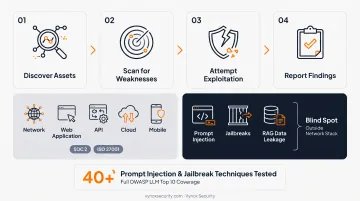
The methodology follows a straightforward map-scan-exploit approach: discover assets, scan for weaknesses, attempt exploitation to confirm which ones are real, then report. It typically covers network, web application, API, cloud, or mobile assets. This trades attacker realism for efficient, repeatable coverage of a defined attack surface.
That trade-off is exactly why pentesting remains so widely used:
- Directly identifies exploitable vulnerabilities with proof, not theory
- Satisfies compliance and audit requirements for SOC 2, ISO 27001, and similar frameworks
- Produces a prioritized remediation list engineering teams can act on immediately
The biggest limitation: traditional pentesting methodology was built for classic IT infrastructure (servers, endpoints, APIs, cloud config). It was never designed to catch prompt injection, jailbreaks, or RAG data leakage. Those attack surfaces live inside the model and its data pipeline, not the network stack a conventional pentester is scoped to test.
Vynox Security's AI and RAG pipeline testing closes exactly this gap. It applies full OWASP LLM Top 10 coverage plus 40+ prompt injection and jailbreak techniques directly against the model, not just the infrastructure around it.
Use Cases of Penetration Testing
Pentesting fits naturally into a release cycle. It's typically required:
- Annually, as a baseline compliance requirement
- After major infrastructure changes — a new cloud migration, a rebuilt API layer
- As part of enterprise vendor security reviews before a deal closes
It's standard practice for SaaS companies ahead of funding rounds, healthcare organizations handling protected health data, and fintechs under regulatory pressure. Increasingly, though, annual testing alone isn't fast enough.
Fast-moving teams are shifting toward continuous, sprint-aligned testing (PTaaS). New code doesn't wait months to get tested, and retests happen the same day a fix hits staging, not weeks later.
Red Teaming vs Penetration Testing: Which One Do You Need?
The honest answer: it depends on what question you're trying to answer. Weigh these factors:
- Regulatory requirements: does a framework mandate a specific type of test, or just evidence of security testing generally?
- Security program maturity: do you already have detection and response capability worth stress-testing?
- Budget and timeline — a scoped pentest fits a release cycle; a red team engagement doesn't.
- The actual goal: are you hunting for vulnerabilities, or testing whether your team notices an attack?
Choose your approach based on the goal:
- Penetration testing fits when you need efficient, comprehensive vulnerability coverage tied to a compliance deadline or a new release.
- Red teaming fits when you need to know whether your SOC and blue team would actually catch and respond to a realistic, sustained attack.
Most organizations follow a predictable maturity curve: pentesting first, to build a baseline and close known gaps, then red teaming once foundational controls and detection capability actually exist. Testing detection before you've fixed the basics just tells you what you already suspected.
A hybrid, purple teaming approach bridges the two: red and blue teams collaborating in real time rather than working in isolation. Vynox's two-layer methodology follows this logic, testing AI systems and traditional infrastructure together rather than as separate exercises.
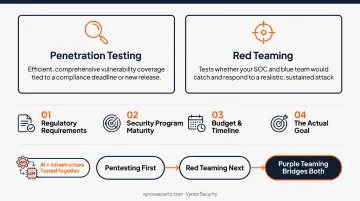
That combined view matters most for AI-powered products. A compromised API feeding an LLM, for instance, is simultaneously an infrastructure vulnerability and an indirect prompt injection channel; treating them separately misses half the picture.
The priority is matching methodology to risk and maturity stage, increasingly on a continuous, sprint-aligned cadence rather than an annual cycle that can't keep pace with how fast AI attack surfaces evolve.
Real-World Example: Why the Right Testing Strategy Matters
Consider an organization handling patient identifiable data, a healthcare-adjacent platform where a breach carries real regulatory and reputational weight. This is the profile of a Vynox client, Roy M., who left a verified five-star G2 review.
Roy highlighted what mattered most in the engagement: "a very detailed and high-quality assessment," while remaining "focused on the real-world security risks of handling patient identifiable data."
That distinction is the whole point of choosing the right testing strategy. A checkbox vulnerability scan wouldn't have surfaced risk framed around actual patient data exposure.
Two verified reviews highlight what the right approach delivers:
- Depth over checkbox scanning: Roy's engagement prioritized real attacker impact instead of a generic findings list.
- Same-day retest turnaround: Cody I. confirmed that fixes were verified the same day an engineer pushed them to staging, compared to the days or weeks typical of traditional firms.
The takeaway: organizations building or shipping AI products need testing that covers both traditional infrastructure and AI-specific attack surfaces. Otherwise, the blind spot doesn't show up until it's already been exploited.
If you're not sure whether your next step should be a penetration test, a red team engagement, or AI-specific security testing, book a free 30-minute discovery call with Karan Singh. The team will review your stack, flag your highest-risk areas, and recommend the right scope, with no long sales cycle required.
Frequently Asked Questions
What is red teaming?
Red teaming is an authorized adversarial simulation where a team emulates a real attacker's tactics to test an organization's detection and response capability, per NIST's definition. It's objective-driven, not vulnerability-driven.
What is the difference between red teaming and blue teaming?
Red teams attack; blue teams defend. The two often work together through purple teaming, sharing findings in real time to strengthen detection and response rather than operating in silos.
Is red teaming the same as penetration testing?
No. Pentesting is a broader, vulnerability-focused assessment within a known scope. Red teaming is narrower in purpose but broader in method, using stealthy, scenario-driven techniques focused on realistic attacker objectives.
How often should organizations conduct red teaming vs penetration testing?
Pentesting typically happens annually or with each major release. Red teaming happens less often due to cost and complexity, though continuous, sprint-aligned testing is becoming necessary for fast-moving AI environments.
Which costs more, red teaming or penetration testing?
Red teaming generally costs more. Longer engagements, broader scope, and specialized adversary-emulation skills add complexity that a scoped, time-boxed pentest doesn't require.
Can red teaming and penetration testing be used together?
Yes — most mature security programs use both. Pentesting typically comes first to close known gaps, with red teaming layered in afterward to validate detection and response readiness.