What is vulnerability scanning?
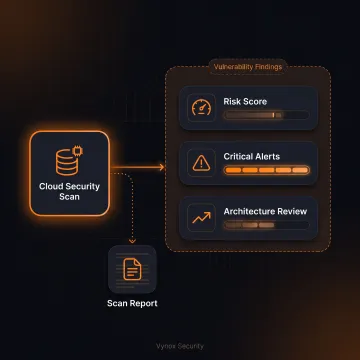
Vulnerability scanning is the process of identifying known weaknesses, insecure configurations, exposed services, missing patches, and risky software components across systems such as applications, APIs, cloud environments, and networks. A scan provides a broad view of potential issues. Vynox Security complements tool-assisted discovery with expert validation, helping distinguish exploitable risks from false positives and providing actionable remediation guidance.
How is vulnerability scanning different from penetration testing?
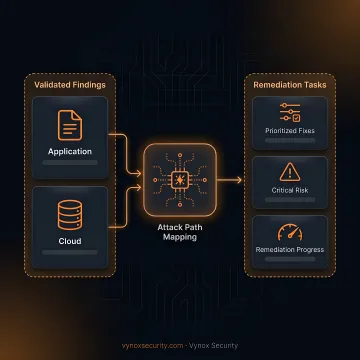
Vulnerability scanning generally uses automated tools to identify potential weaknesses at scale, while penetration testing uses skilled testers to validate whether those weaknesses can be exploited and what impact an attacker could achieve. A scan may flag a missing control; a pentest can demonstrate an authorization bypass, data exposure, or privilege-escalation chain. Vynox Security uses human-led, adversarial testing for validated findings and practical prioritization.
What systems can Vynox Security assess?
Vynox Security assesses web applications, REST and GraphQL APIs, iOS and Android apps, AWS, GCP, and Azure environments, internal and external networks, and CI/CD-related attack paths. For AI-powered products, coverage also includes LLM applications, RAG pipelines, autonomous agents, model inversion risks, and prompt injection or jailbreak resilience. Scope is defined during a 30-minute discovery call.
Can you test AI and LLM applications for vulnerabilities?
Yes. Vynox Security tests AI systems for risks conventional scanning often misses, including direct and indirect prompt injection, jailbreaks, system-prompt leakage, sensitive data disclosure, RAG access-control bypass, cross-tenant retrieval, vector database poisoning, agent tool-call injection, goal hijacking, and model extraction. AI engagements cover the OWASP LLM Top 10 and include developer-ready evidence and remediation guidance.
How long does a vulnerability assessment take?
Timing depends on the environment and engagement type. Cloud and API security testing typically takes 3–5 business days, while web, mobile, and network penetration tests commonly take 5–10 business days. More comprehensive AI, RAG, or agent assessments generally take 10–15 business days. Vynox Security confirms scope, timeline, and the appropriate Rapid Secure or Deep Secure tier during discovery.
Will the report help with SOC 2 or ISO 27001?
Yes. Vynox Security maps findings to SOC 2 and ISO 27001 evidence requirements, helping teams document independent security testing and remediation work for audits and customer security questionnaires. Reports include an executive summary, technical findings, evidence screenshots, CVSS scores, reproduction steps, and prioritized fixes. This is security-testing evidence, not a certifying audit or certification service.
Do you provide continuous vulnerability testing?
Yes. Vynox Security offers PTaaS, or Penetration Testing as a Service, for teams that need security validation aligned with product development rather than a single annual assessment. The program supports testing around model updates and sprints, real-time vulnerability tracking, severity visibility, and same-day retests when fixes are deployed to staging. Findings can continuously contribute to compliance evidence.
What happens after vulnerabilities are identified?
Your team receives a report designed for both engineering and leadership. Each validated issue includes severity information, supporting evidence, reproduction steps, and stack-specific remediation guidance so developers can address the root cause. Vynox Security can then verify fixes through retesting, including same-day retests for PTaaS engagements when remediation is deployed to staging within the agreed scope.