McKinsey found 71% of organizations regularly use generative AI in at least one business function, up from just 33% in 2023. Every one of those deployments introduces prompts, training data, and model behavior that traditional pentesting was never built to inspect.
Ignore that gap and you're not just risking a breach. You're risking EU AI Act violations, failed SOC 2 audits, and compromised automated decisions that ripple through connected systems. This guide breaks down the most common AI security risks, what happens when they go unmanaged, and the concrete steps to fix them.
TL;DR
- AI expands the attack surface into prompts, models, training data, RAG pipelines, and AI agents
- Prompt injection and data leakage evade tools built for conventional software, and shadow AI often goes unnoticed
- Ignoring these risks means regulatory fines, breach costs, and compromised automated decisions
- Preventing these risks starts with strong governance, complete AI asset inventories, and AI-specific testing
- Long-term control needs continuous monitoring, documentation, and developer-ready remediation
Common AI Security Risks and Dangers
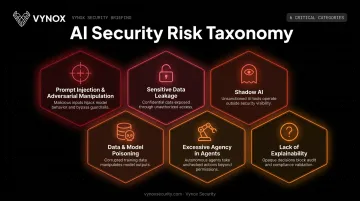
AI security risks target the model, its data, and its permissions rather than just the code around them. Traditional security tools scan for known vulnerability patterns in static software. AI systems behave non-deterministically: the same input can produce different outputs depending on context, conversation history, or retrieved content.
Most of these risks trace back to a handful of root issues: unvalidated inputs reaching the model, sensitive data sitting inside training sets or context windows, and agents holding more permission than their task requires. Here's where each of those failures shows up in practice.
Prompt Injection and Adversarial Manipulation
Attackers craft inputs, direct or indirect, that override a model's instructions. A direct injection comes straight through the chat interface. An indirect injection hides inside a document, email, or web page the model later retrieves and processes: no access to the prompt box required.
The clearest recent example: EchoLeak (CVE-2025-32711), a zero-click vulnerability in Microsoft 365 Copilot. Researchers demonstrated that a crafted email, once processed by Copilot, could trigger an AI command injection that disclosed sensitive information over the network, without the victim clicking anything. Microsoft patched the service-side flaw before confirmed customer compromise, but the exploit path proved indirect injection isn't theoretical.
Testing for this risk means checking direct prompts, retrieved content, rendering behavior, and data egress together, not in isolation.
Sensitive Data Leakage
Models memorize patterns from training data and context windows. Ask the right question and a seemingly benign query can surface PII, credentials, or data from a connected system that was never meant to be exposed.
This isn't hypothetical. Kaspersky's dark-web analysis found roughly 688,000 OpenAI credential records circulating between 2021 and 2023, with nearly 664,000 appearing in 2023 alone (a reported 33-fold jump in a single year).
Group-IB separately identified over 100,000 devices with saved ChatGPT credentials in infostealer logs. These are credentials harvested from infected endpoints, not evidence of a provider breach, but they show how much sensitive AI-related data is already circulating in criminal markets.
Shadow AI (Unsanctioned Tool Usage)
Employees don't wait for approval. They paste client data into a free chatbot to draft an email faster, or wire an unsanctioned AI plugin into their IDE. Security teams have zero visibility into any of it.
Microsoft's 2024 Work Trend Index found 78% of AI users bring their own AI tools to work, rising to 80% at small and mid-sized companies. That's company data moving through unmanaged, unmonitored tools every single day.
Cisco's parallel research found 48% of professionals had entered non-public company information into GenAI tools, while 27% of organizations had already banned GenAI outright over privacy concerns.
Data, Model, and Supply Chain Poisoning
Poisoning attacks corrupt outputs by manipulating what a model learns or retrieves. That includes training data, RAG knowledge bases, and third-party model files pulled from public repositories.
JFrog documented roughly 100 malicious model artifacts on Hugging Face in a single sweep, some containing PyTorch/pickle payloads that executed code on load, with one demonstrating a reverse shell opened to an external server.
That's a supply-chain compromise triggered by simply loading a model file, not a training-data issue. The lesson is the same: artifact scanning has to check for load-time code execution, not just accuracy metrics.
Excessive Agency in Autonomous Agents
Agents granted broad permissions (database writes, financial transactions, API access) can take unauthorized actions if compromised, misconfigured, or simply manipulated by a crafted prompt.
Adoption is accelerating faster than governance. McKinsey's 2025 survey found 23% of organizations already scaling agentic AI, with another 39% experimenting. Gartner projects task-specific agents will appear in 40% of enterprise applications by 2026, up from under 5% in 2025. Permissions and approval gates need to exist before that scale hits, not after.
Lack of Explainability and Testing Gaps
Black-box decision-making breaks traditional pass/fail QA. A model that behaves correctly in staging can drift once deployed: same weights, different behavior under real traffic, different context windows, different edge cases.
Standard test suites check for known bugs. They don't catch a model quietly changing its answers to the same question over time. That drift is exactly the blind spot conventional QA processes were never designed to catch.
What Happens If AI Security Risks Are Ignored
Unmanaged AI risk isn't abstract. It shows up as regulatory exposure, operational damage, and eroded trust, often all three at once.
On the regulatory side, the EU AI Act's Article 15 requires high-risk AI systems to maintain accuracy, robustness, and cybersecurity throughout their lifecycle. It explicitly names data poisoning, model poisoning, and adversarial evasion as attacks these systems must resist. GDPR obligations layer on top whenever personal data touches model training or deployment.
The financial signal is real too. According to IBM's 2025 Cost of a Data Breach Report, organizations with high shadow-AI use paid $670,000 more per breach on average than those with low or no shadow AI usage.
That cost differential ties directly to ungoverned tool adoption. The same report found 13% of breached organizations had incidents involving AI models or applications, and 97% of that group lacked proper AI access controls.
Operationally, a compromised model doesn't just leak data. An over-permissioned agent integration can move laterally into connected systems: CRMs, payment platforms, internal databases. Left unchecked long enough, that erodes the one thing hardest to rebuild: customer trust in your product's decisions.
Warning Signs You're About to Experience an AI Security Incident
Watch for these early indicators before they become a full incident:
- Unusual query patterns: spikes in model API calls, unexpected prompt structures, or repeated probing of the same endpoint
- Unapproved tool usage: employees using AI tools that IT and security have no record of vetting
- No AI asset inventory: unclear ownership of which models, agents, and integrations are actually live in production
How to Manage and Mitigate AI Security Risks
Managing AI risk is an ongoing practice, not a one-time project. You run it continuously, adjusting as your AI stack grows.
Build an AI Governance and Data Classification Framework
Define who owns each model, what data it can touch, and what access controls apply across the AI lifecycle , from training to production. This closes the gap where sensitive data gets exposed simply because nobody was accountable for classifying it.
Roll this out before deploying any AI system, and revisit it quarterly as new models and integrations get added.
Maintain a Complete AI Asset Inventory
You can't secure what you don't know exists. Catalog every model, agent, plugin, RAG pipeline, and third-party AI integration in active use.
This single practice eliminates shadow AI blind spots and lets you prioritize testing based on actual risk, not guesswork. Update it continuously, with every new deployment or integration triggering an entry.
Conduct AI-Specific Security Testing Beyond Traditional Pentesting
Standard pentesting checks for SQL injection and misconfigured servers. It doesn't test whether your model can be jailbroken, whether your RAG pipeline leaks cross-tenant data, or whether your agent can be tricked into an unauthorized transaction.
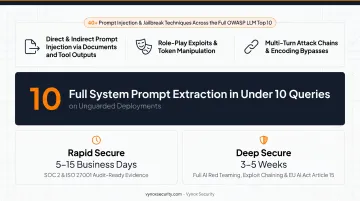
This is where Vynox Security's approach to AI security testing fills the gap traditional firms leave open, testing against the full OWASP LLM Top 10 with 40+ prompt injection and jailbreak techniques, including:
- Direct and indirect prompt injection via documents and tool outputs
- Role-play exploits and token manipulation
- Multi-turn attack chains and encoding bypasses
In practice, this methodology has demonstrated full system prompt extraction in under 10 queries on unguarded deployments.
Engagements run as Rapid Secure (compliance-ready, 5–15 business days) for teams needing fast SOC 2 or ISO 27001 audit evidence. Deep Secure (3–5 weeks) suits organizations needing full AI red teaming with exploit chaining and unlimited retests, mapping directly to EU AI Act Article 15 adversarial testing requirements.
One healthcare client, in a verified G2 review, praised the balance of thoroughness and pragmatism when the assessment centered on patient identifiable data. That's proof this testing adapts to the actual sensitivity of what's at risk, not a generic checklist.
Run this at every major model update, before production launch, and continuously via PTaaS aligned to development sprints.
Apply Least Privilege and Guardrails to AI Agents
Scope agent permissions to exactly what the task requires. Require human approval for anything high-impact: financial transactions, data writes, irreversible actions.
This single control limits the blast radius if an agent is compromised or simply misconfigured. Apply this at the agent design stage, and review permissions with every capability expansion.
Map Security Findings to Compliance Frameworks
Align every finding and remediation record with SOC 2, ISO 27001, and NIST AI RMF requirements. When an auditor or regulator asks for evidence, you want it already organized, not scrambled together after the fact.
This directly reduces regulatory exposure as enforcement milestones like the EU AI Act's 2026 deadlines approach. Apply this continuously, folding it into existing audit and compliance review cycles rather than treating it as a separate workstream.
Tips for Long-Term AI Security Control
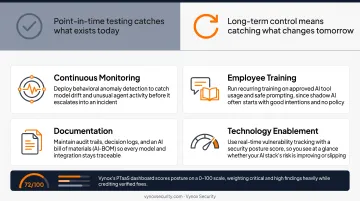
Point-in-time testing catches what exists today. Long-term control means catching what changes tomorrow.
- Continuous monitoring: Deploy behavioral anomaly detection to catch model drift and unusual agent activity before it escalates into an incident.
- Employee training: Run recurring training on approved AI tool usage and safe prompting, since shadow AI often starts with good intentions and no policy.
- Documentation: Maintain audit trails, decision logs, and an AI bill of materials (AI-BOM) so every model and integration stays traceable.
- Technology enablement: Use real-time vulnerability tracking with a security posture score, so you see at a glance whether your AI stack's risk is improving or slipping.
Vynox's PTaaS dashboard scores posture on a 0–100 scale, weighting critical and high findings heavily while crediting verified fixes. That turns security from a quarterly report into a live number your team actually watches.
Conclusion
AI security risks aren't random. They trace back to the same recurring causes: unvalidated inputs, ungoverned data, and over-permissioned agents. That's good news, because recurring causes can be systematically tested for.
Proactive governance paired with AI-native testing, not traditional pentesting alone, is what makes prevention achievable. Partnering with a specialized provider like Vynox Security for continuous AI-specific assessments, whether through Rapid Secure compliance testing or Deep Secure red teaming, gives engineering and security teams a way to ship AI products confidently. This approach keeps them ahead of the breaches and compliance fines that catch unprepared organizations off guard.
Frequently Asked Questions
What is the biggest security risk with AI?
Prompt injection is the most critical AI security risk. It can hijack model behavior directly, and because it works through both direct and indirect inputs, it can expose any system the model is connected to.
What are the 4 types of AI risk?
Most frameworks group AI risk into four categories: security risks (prompt injection, data leakage), operational risks (model drift, hallucination), compliance risks (regulatory violations), and reputational or ethical risks (bias, misinformation).
How is AI security different from traditional cybersecurity?
Traditional cybersecurity secures code and infrastructure. AI security must also address non-deterministic model behavior and the risks embedded in prompts and training data, attack surfaces conventional tools and pentesting methods weren't built to inspect.
What is the first step to securing AI in my organization?
Build a complete AI asset inventory first. You can't apply governance or run meaningful security testing on models, agents, or integrations your team doesn't even know are in production.
Can AI be used to improve security defenses?
Yes. AI-powered tools can speed up threat detection and incident triage. They still need human oversight, since automated systems can miss context or generate false positives.
How do I detect shadow AI in my environment?
Use discovery tools that scan SaaS platforms, browser extensions, and IDE plugins for unauthorized AI usage. Pair that visibility with a clear, published policy on which AI tools are approved for company data.