That single vulnerability sat on devices organizations trusted as their first line of defense. It's a reminder that installing a firewall and never testing it again is its own kind of risk.
Firewall penetration testing gets referenced constantly in security discussions, but rarely explained at the level that matters: what testers actually do, in what order, and with which tools. This guide breaks down the definitions, the methods, the six-phase process, and the toolset behind a real firewall pen test.
TL;DR
- Firewall pen testing simulates real attacks on rules, ACLs, and configs to expose exploitable gaps
- Engagements are external, internal, or blended, using black box, white box, or gray box methodology
- The process runs through six phases: reconnaissance, port scanning, banner grabbing, policy testing, exploitation, and reporting
- Nmap, Hping, Netcat, and Firewalk generate data, but expert interpretation drives real exploit paths
What Is Firewall Penetration Testing & Why It Matters
Firewall penetration testing is a simulated attack against a firewall's rules, configuration, and access controls, designed to identify weaknesses an attacker could actually exploit. NIST frames it as assessors mimicking real-world attacks to find ways around a system's security features, not just cataloging them.
The goal is proof: does this firewall's policy actually block unauthorized traffic in practice, or only on paper?
Pen Testing vs. Scanning vs. Auditing
These three terms get used interchangeably, and they shouldn't be:
- Vulnerability scanning flags known issues automatically (CVEs, outdated firmware, missing patches)
- Firewall audits review configuration against a documented checklist or policy
- Penetration testing actively attempts exploitation to confirm whether a flagged issue (or an undocumented one) is truly exploitable
A scan tells you a port might be a problem. A pen test proves whether it is.
The Cost of Skipping It
The 2025 Verizon Data Breach Investigations Report found vulnerability exploitation as an initial-access vector jumped 34% year over year, now accounting for 20% of breaches.
Edge devices and VPNs (the exact systems firewalls are meant to protect) made up 22% of exploitation targets, up from just 3% previously. Only about 54% of those edge-device vulnerabilities were fully remediated within the year, with a median fix time of 32 days.
That gap between "we patched it" and "it's actually fixed" is where firewall pen testing earns its keep.
The Compliance Angle
PCI DSS 4.0.1, Requirement 11.4, is explicit: organizations must run internal and external penetration tests at least once every 12 months and after any significant infrastructure change. Testing must follow a documented, industry-accepted methodology covering the entire cardholder data perimeter.
Service providers relying on network segmentation must test that segmentation every six months.
SOC 2 and ISO 27001 don't mandate a fixed testing cadence in their public frameworks, but both expect risk-based evidence that perimeter controls work, and a firewall pen test report is exactly that evidence.
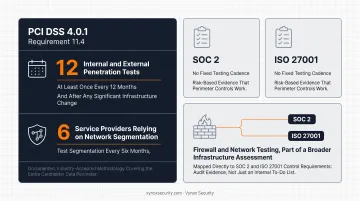
Providers like Vynox Security deliver firewall and network testing as part of a broader infrastructure assessment, mapping every finding directly to SOC 2 and ISO 27001 control requirements so the report can double as audit evidence, not just an internal to-do list.
Types & Methods of Firewall Penetration Testing
Not every firewall test looks the same. The method depends on what threat you're simulating and how much the tester already knows going in.
External vs. Internal Testing
External testing checks how the firewall holds up against outside attackers hitting internet-facing systems. Internal testing simulates an insider or an attacker who's already slipped past the perimeter, focusing on lateral movement and segmentation. Most serious engagements blend both, because real breaches rarely stay on one side of the fence.
Black Box, White Box, and Gray Box
| Method | Tester's knowledge | Best for |
|---|---|---|
| Black box | None — simulates a true outside attacker | Realistic worst-case scenario testing |
| White box | Full rules, architecture, connected systems | Thorough design validation |
| Gray box | Partial knowledge (some access or docs) | Balancing realism with efficiency |
Core Techniques Used Across Methods
Regardless of which box you're in, testers lean on a similar toolkit:
- Direct traffic tests against firewall rules
- On-path (man-in-the-middle) interception attempts
- Port scanning to map open, closed, and filtered states
- Rule bypassing to find gaps in policy enforcement
The right choice comes down to risk profile and compliance scope. A startup preparing for its first SOC 2 audit might run a gray box test to move faster. A bank protecting cardholder data, on the other hand, usually wants full black box realism.
Step-by-Step Firewall Penetration Testing Process
Most engagements follow a scan → analyze → exploit → report → remediate flow, though depth and sequencing shift based on scope. A focused test might wrap in a single day. A complex, segmented enterprise network can take several.
Step 1: Reconnaissance & Firewall Location
Testers send crafted TCP, UDP, and ICMP packets using tools like Nmap and Hping to locate the firewall itself. Traceroutes map the network path, revealing hop counts and connected devices before any active probing begins.
Step 2: Port Scanning & Service Fingerprinting
Nmap's SYN scan (-sS) sends a SYN packet to each port. A SYN/ACK reply means open; a RST means closed; silence or an ICMP error usually means filtered. Once testers identify open ports, service/version detection scans (-sV) reveal exactly what's running behind each one: a web server, an SSH daemon, a database listener.
Step 3: Banner Grabbing & Firewall Identification
Using Netcat or Ncat, testers initiate direct connections to capture service banners (the text a port sends back when a connection opens). This often reveals the firewall's vendor and version, which testers cross-reference against known public exploits (like CVE-2024-3400).
Step 4: Access Control & Policy Testing
This is where documented policy meets reality:
- ACK scans (
-sA) map firewall rules by determining whether ports are filtered or unfiltered - Firewalking sends packets with a TTL one hop beyond the gateway to infer which protocols actually pass through
- Testers compare live firewall behavior against the written security policy; mismatches here are often the most valuable finding of the entire engagement
Step 5: Exploitation & Bypass Attempts
If gaps exist, testers attempt controlled exploitation:
- Port redirection: forwarding traffic to reach services the firewall should be blocking
- Covert channel creation: hiding data transfer inside traffic the firewall permits
- HTTP tunneling: encapsulating traffic inside HTTP requests to bypass proxy restrictions
Each technique proves whether a theoretical weakness translates into an actual breach path.
Step 6: Reporting & Remediation
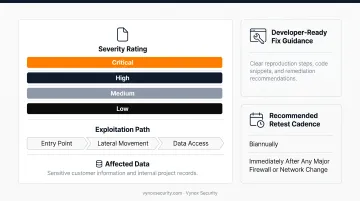
Testers document findings with severity ratings, exploitation paths, and affected data. Good reports go further, pairing each issue with developer-ready fix guidance and a recommended retest cadence, typically biannually or immediately after any major firewall or network change.
Tools Used in Firewall Penetration Testing
The tooling here is mature and mostly free, but no tool replaces the person interpreting its output.
| Tool | What it does |
|---|---|
| Nmap | Port and service discovery, OS fingerprinting |
| Hping | Crafts custom TCP/UDP/ICMP packets for precise firewall probing |
| Netcat / Ncat | Banner grabbing and direct service interaction |
| Firewalk | Maps which protocols pass through a gateway to devices behind it |
| Nessus | Automated vulnerability scanning (not a substitute for exploitation testing) |
| Tcpreplay | Replays captured traffic to test how security controls respond |
These tools generate data and elicit firewall responses. They don't chain findings into a proven exploit path — that step still requires an experienced tester who knows what a suspicious response actually means.
This is where Vynox Security's approach differs from raw scan output: their network penetration testing pairs this tooling with manual, expert-led testing across firewalls, segmentation, and the broader infrastructure stack.
Engagement details include:
- Findings ship with reproduction steps, CVSS scores, and stack-specific remediation guidance
- Available as Rapid Secure (fast, compliance-ready) or Deep Secure (comprehensive adversarial) tiers
- Engagements typically run 5–15 business days
- Results map directly to SOC 2 and ISO 27001 evidence requirements
Common Issues, Misconceptions & When Testing Falls Short
"Set and forget" is the most expensive assumption in network security. A firewall configured correctly today can be misconfigured by next quarter's change request. Rules get added, exceptions pile up, and nobody circles back to check if the original policy still holds.
A related misconception: treating a vulnerability scan as equivalent to a pen test. A scan flags a potential issue. A pen test proves it's exploitable, a distinction that matters when deciding what to fix first.
Firewall testing alone doesn't cover everything, either. It's one piece of a much bigger attack surface:
- Web and mobile applications need their own testing
- Cloud environments (AWS, GCP, Azure) carry separate misconfiguration risks
- API endpoints are frequently the actual entry point, not the firewall
- AI systems (LLMs, RAG pipelines, autonomous agents) introduce attack surfaces firewalls were never designed to address
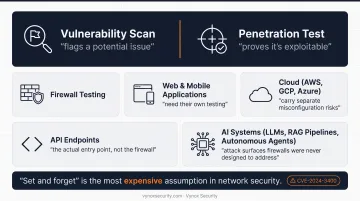
Vynox Security, for instance, pairs firewall testing with web, mobile, cloud, API, and AI-specific assessments for a consolidated security view.
The value of firewall penetration testing comes from applying it correctly and regularly, aligned to real risk. Running it once and assuming permanent protection is how organizations end up as the next CVE-2024-3400 headline.
Frequently Asked Questions
What is firewall penetration testing?
It's a simulated attack against a firewall's rules, configuration, and access controls, designed to uncover exploitable gaps before real attackers find them. Unlike a scan, it proves exploitability rather than flagging a possible issue.
What are the 5 stages of penetration testing?
Reconnaissance, scanning, exploitation, reporting, and remediation/retest. These map to NIST's four-phase model (planning, discovery, attack, reporting), with remediation and retesting forming a practical fifth step under frameworks like PCI DSS.
Is pentesting illegal?
No — penetration testing is legal when performed with explicit written authorization and a clearly defined scope from the system owner. Testing without that authorization, even with good intentions, can expose the tester to legal liability.
What are the three types of penetration testing?
Black box (no prior knowledge), white box (full access to rules and architecture), and gray box (partial knowledge, blending realism with efficiency). Each suits different risk profiles and compliance needs.
How often should firewall penetration testing be performed?
At least once every 12 months, per PCI DSS 4.0.1 guidance, and again after any major firewall or network change. Organizations handling segmented cardholder data as service providers should test segmentation every six months.
How much does firewall penetration testing cost?
Cost depends on network complexity, IP count, and testing depth (Rapid Secure vs. Deep Secure). Pricing should scale transparently from startup-stage engagements to full enterprise assessments, with a scoping call clarifying exact costs upfront.