Introduction
Five years ago, "infrastructure" meant a firewall, a few servers, and maybe a VPN. Today it means multi-cloud accounts, containerized workloads, dozens of APIs, and increasingly, AI systems like LLMs and RAG pipelines sitting on top of it all.
89% of organizations have adopted cloud-native practices, and 91% now run containers in production, according to CNCF's 2024 annual survey. Yet most infrastructure pentest guides still read like it's 2019 — firewalls, switches, on-prem servers, done.
That gap leaves cloud-native environments and AI-integrated systems dangerously undertested. This guide covers what infrastructure penetration testing actually means today, the types of engagements available, and the process behind them. It also shows how to evaluate a partner built for a stack that includes both traditional servers and AI pipelines.
Key Takeaways
- Infrastructure pentesting simulates attacks to expose weaknesses in servers, networks, and cloud
- Modern scope spans cloud, containers, APIs, and AI systems like LLMs and RAG pipelines
- Engagements run internal, external, or integrated, using black, gray, or white box testing
- A standard pentest follows five phases: planning, recon, scanning, exploitation, and reporting
- Fast turnaround and compliance-mapped reporting cut remediation time and audit friction
What Is Infrastructure Penetration Testing?
Infrastructure penetration testing is controlled, ethical hacking of a company's hardware, network, and software environment. Testers act like real attackers (within agreed boundaries) to see whether defenses actually hold up.
A modern engagement typically covers:
- Internal devices and servers: both on-prem and cloud-hosted
- Network hardware: firewalls, routers, switches, VPNs
- Storage systems: file servers, databases, backup infrastructure
- Cloud-native services: AWS, GCP, and Azure workloads, IAM configurations, storage buckets
- APIs and containers: the connective tissue most legacy pentests skip entirely
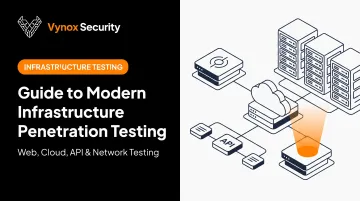
Vynox Security's Infrastructure Testing layer, for example, scopes engagements around web applications, REST and GraphQL APIs, iOS and Android apps, AWS/GCP/Azure environments, and internal-external networks. This reflects how "infrastructure" has grown well beyond the office network.
Cloud security testing now extends into AI workload isolation and pipeline access review. A misconfigured S3 bucket can expose model weights and training data just as easily as it exposes customer records.
Infrastructure Pentesting vs. Vulnerability Scanning
These two terms get used interchangeably, and that's a mistake. NIST draws a clear line: a vulnerability scan is largely automated and flags potential weaknesses. A penetration test has a human actively exploiting those weaknesses to prove real business impact.
The difference matters because:
- Scanners produce high false-positive rates: someone still has to verify exploitability
- Scans can't demonstrate authorization bypass, business logic abuse, or lateral movement
- Compliance auditors increasingly expect evidence of exploitation, not just a scan printout
Vynox is explicit that its testing is "manual, expert-driven — not an automated scan." One verified reviewer noted that testers "invested time in understanding our application's architecture and business logic before probing it," a level of context automated tools simply can't replicate.
Types of Infrastructure Penetration Testing: Internal, External & Integrated
Internal vs. External Testing
External testing simulates an outside attacker hitting your public-facing surface: firewalls, public IPs, web servers, and mail servers. It answers the question, "What can someone on the internet reach?"
Internal testing assumes a foothold already exists (a compromised laptop, a phished credential) and asks how far that attacker could travel. This matters more than most teams assume: Verizon's 2025 Data Breach Investigations Report, which analyzed over 12,000 confirmed breaches, attributed 18% to internal actors.
Vynox delivers internal and external testing as one unified Network Pentest rather than two separate purchases. The internal component covers:
- Firewall and segmentation bypass
- Lateral movement simulation
- Credential relay attacks (NTLM and similar)
- Privilege escalation toward crown-jewel systems
- CI/CD attack paths, a supply-chain angle most firms overlook
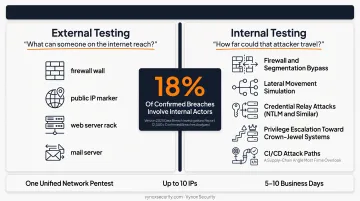
Standard scope runs up to 10 IPs, delivered in 5–10 business days.
Black, Gray & White Box Methodologies
- Black box engagements give testers zero internal knowledge, mirroring a real external attacker
- Gray box testing provides partial information, such as limited credentials or architecture diagrams
- White box engagements grant full visibility, including source code and system design
Choose black box when you want to measure real-world exposure. White box works better when you need deep, exhaustive coverage, such as ahead of a compliance audit. Most standard pentests lean black box by default, while source code review adds a white-box layer that catches what can't be reached from outside.
What Is an Integrated Penetration Test?
An integrated penetration test is a single, unified engagement that tests multiple attack surfaces together (network, cloud, applications, and AI systems) instead of running separate, disconnected assessments.
The reasoning is simple: attackers don't respect your org chart. A compromised API can become an indirect prompt injection channel into an AI pipeline, while a misconfigured IAM role can expose the training data feeding a RAG system.
Vynox structures engagements exactly this way. Its API testing explicitly evaluates whether a broken authorization flaw could poison model context, while cloud testing is framed around protecting the pipeline feeding LLMs and agents, not just the servers around it. Siloed tests miss this chaining entirely.
The Modern Infrastructure Pen Testing Process: Step-by-Step
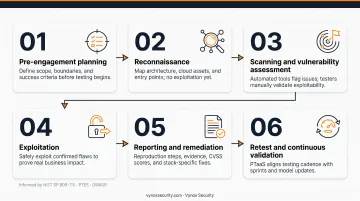
Regardless of provider, most engagements follow the same five-phase backbone informed by frameworks like NIST SP 800-115, PTES, and OWASP, with modern programs adding a sixth phase for continuous validation.
Pre-engagement planning: Define scope, boundaries, and success criteria before anyone touches a system. This is where you agree what's in scope: 20 API endpoints, 10 IPs, a specific cloud account.
Reconnaissance: Map network architecture, cloud assets, exposed services, and entry points. No exploitation happens yet; this is pure intelligence gathering.
Scanning and vulnerability assessment: Automated tools flag misconfigurations and outdated software, then human testers manually validate which ones are actually exploitable.
Exploitation: Testers safely exploit confirmed vulnerabilities to prove real business impact, redacting sensitive data throughout the process.
Reporting and remediation: A clear report with reproduction steps, evidence screenshots, CVSS-scored findings, and stack-specific fix guidance (not generic CVE advice).
Retest and continuous validation: Modern programs are moving past the once-a-year audit model. Under a PTaaS (Penetration Testing as a Service) approach, testing cadence aligns with sprints and model updates. Vynox, for instance, verifies fixes the same day they're pushed to staging, tracked through a live dashboard rather than waiting for the next annual cycle.
The Modern Attack Surface: Why Cloud & AI Systems Change the Game
Cloud-native, containerized, and API-first architecture has stretched the attack surface far past what legacy pentests were built to handle. Add LLMs, RAG pipelines, and autonomous agents into production, and most traditional pentest firms aren't equipped to test what's actually running.
This isn't a theoretical gap. Roughly 13% of organizations studied by IBM reported a breach involving AI models or applications, and 97% of those lacked proper AI access controls, per IBM's 2025 Cost of a Data Breach report. That's a near-total absence of guardrails on systems that increasingly touch sensitive data.
AI infrastructure introduces attack classes that don't exist in a traditional network:
- Prompt injection and jailbreak attempts against system instructions
- Cross-tenant retrieval bypass and vector database poisoning in RAG pipelines
- Tool-call injection and privilege escalation through agent chaining
- Model inversion attacks that reconstruct training data
Standard infrastructure testing doesn't probe for any of these attack classes.
Vynox tests against the full OWASP LLM Top 10 in every AI engagement, applying 40+ prompt injection and jailbreak techniques, covering direct injection, indirect injection via retrieved documents, role-play exploits, and multi-turn attack chains. A dedicated AI Red Teaming engagement runs 3–5 weeks, reflecting the depth of scenario-based simulation involved, compared to the 5–15 business days typical of standard infrastructure testing.
That timeline gap reflects a real difference in scope: enumerating known vulnerabilities versus simulating a determined adversary chasing an objective.
Benefits & Choosing the Right Infrastructure Pen Testing Partner
Done well, infrastructure pentesting delivers:
- Reduced breach risk through validated, exploited findings, not theoretical ones
- Stronger security posture with prioritized fixes instead of an unranked vulnerability dump
- Compliance readiness for frameworks like SOC 2 and ISO 27001, where a pentest report often becomes key audit evidence
- Cost-effective remediation by directing engineering time toward what's actually exploitable first
What to Evaluate in a Partner
Not every provider handles the modern stack equally well. Look for:
- Methodology coverage: Does the firm test cloud, containers, APIs, and AI systems, or just legacy networks?
- Reporting clarity: Are findings written for engineers (reproduction steps, CVSS scores) and leadership (executive summary) alike?
- Retest speed: How fast is a fix confirmed after deployment?
Vynox delivers most engagements in 5–15 business days, compared to an industry average of 4–8 weeks. Turnaround depends on scope:
- API or cloud testing: 3–5 days
- Standard infrastructure engagements: 5–15 business days
- AI Agent or RAG pipeline testing: 10–15 days
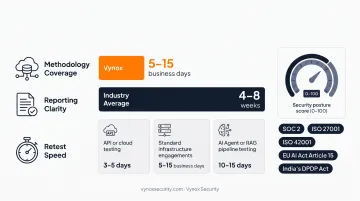
Findings map to SOC 2, ISO 27001, ISO 42001, EU AI Act Article 15, and India's DPDP Act. A real-time dashboard scores security posture on a 0–100 scale and tracks retests as they happen.
For teams running both traditional infrastructure and AI systems, that single-engagement view is the difference between patching gaps and guessing where they are.
Frequently Asked Questions
What is infrastructure pentesting?
It's controlled, ethical hacking of a company's servers, networks, devices, and cloud systems to uncover exploitable security weaknesses before real attackers do. Testers actively attempt to breach systems, not just scan them.
What is an integrated pen test?
A unified engagement that tests multiple attack surfaces together (network, cloud, applications, and AI systems) rather than running them as separate, disconnected assessments. This catches cross-system risks siloed tests miss.
Is pen testing difficult?
Yes, it requires specialized expertise, tooling, and constant awareness of new attack techniques. That's why most organizations work with experienced third-party providers rather than attempting it in-house.
How often should infrastructure penetration testing be performed?
At minimum, annually, and after any major infrastructure change. Organizations shipping frequent updates increasingly move toward continuous testing aligned with deployment cycles instead.
What's the difference between a vulnerability scan and an infrastructure pen test?
A scan automatically identifies potential flaws using known signatures. A pen test actively exploits those flaws to prove real-world risk and business impact, something scanners can't do.
How long does an infrastructure penetration test take?
Timelines typically range from a few days to several weeks depending on scope and asset count. Modern providers can deliver focused engagements, like API or cloud testing, in as little as 3–5 business days.