The stakes are real. Veracode's 2025 State of Software Security data puts the overall flaw half-life at 252 days, with average fix times now 47% longer than they were in 2020. Vulnerabilities aren't just slipping through, they're sitting in production for months.
This guide walks through a category-by-category, OWASP-aligned checklist for manual secure code review, how to triage what you find, and the mistakes that quietly undermine the process. We'll also cover a gap most checklists still ignore: AI and LLM-specific code risks that traditional review was never built to catch.
Key Takeaways
- A category checklist keeps input validation, auth, crypto, logging, and dependency checks consistent
- Broken Access Control and Security Misconfiguration top OWASP risks, so prioritize authorization checks
- Severity triage (Critical/High/Medium/Low) decides what blocks a release versus the backlog
- Prompt injection and insecure RAG data handling need specialized testing beyond standard checklists
- Diff-based review on every pull request beats relying only on periodic baseline audits
What You Need Before Starting a Secure Code Review
How thorough and fast a review goes depends almost entirely on what's ready before you open the diff. Reviewers who start cold, without context on intent or architecture, end up either rubber-stamping changes or spending hours reconstructing information the PR author already had.
Tools and Resources Required
Set up the following before review begins:
- SAST/static analysis tools to catch pattern-based issues automatically
- Linters for code quality and style consistency
- Dependency and secret scanners (Dependabot or similar) to flag known-vulnerable packages and exposed credentials
- A standardized checklist or PR template so every reviewer checks the same categories
You'll also need documentation: the PR description explaining intent, architecture or data-flow context for the affected area, and any prior findings or threat model notes tied to that component.
Preconditions and Setup
Three conditions matter more than any tool:
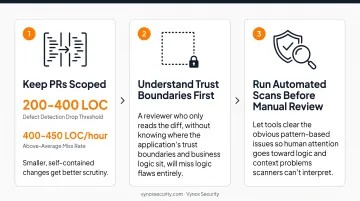
- Keep PRs scoped. Peer-reviewed research from Cisco found defect detection drops sharply past 200-400 lines of code, with above-average miss rates once reviewers exceed 400-450 LOC/hour. Smaller, self-contained changes get better scrutiny.
- Understand trust boundaries first. A reviewer who only reads the diff, without knowing where the application's trust boundaries and business logic sit, will miss logic flaws entirely.
- Run automated scans before manual review. Let tools clear the obvious pattern-based issues so human attention goes toward logic and context problems scanners can't interpret.
The Complete Security Code Review Checklist by Category
Work through each risk category systematically rather than reading top to bottom. Mapping findings to OWASP Top 10 or CWE identifiers as you go makes triage and reporting faster later.
Input Validation & Injection Prevention
Check for:
- Server-side validation on every input (never trust client-side checks alone)
- Allowlist-based validation instead of blocklists
- Parameterized queries in place of string concatenation for any database call
- Context-specific output encoding (HTML, JS, URL, depending on where data lands)
This category maps directly to SQL injection and cross-site scripting, and both remain heavily represented in vulnerability data. MITRE's 2025 CWE Top 25 list ranks Cross-Site Scripting (CWE-79) at #1 and SQL Injection (CWE-89) at #2, with mapped CVE records climbing year over year.
These aren't legacy problems. They're still the most common way applications get broken into.
Authentication & Session Management
Verify:
- Passwords are salted and hashed with a modern algorithm, never stored in plaintext or reversible encryption
- Session tokens use high-entropy generation, not predictable sequences
- Cookies carry HttpOnly, Secure, and SameSite flags
- Failed login attempts trigger lockout or rate-limiting
- MFA is required for sensitive actions (password changes, financial transactions, admin access)
Access Control & Authorization
This is where reviewers should spend disproportionate time. Look for:
- Server-side enforcement on every request, not just at the UI layer
- Deny-by-default policy on new endpoints
- Ownership checks on record-level queries to prevent IDOR (can user A fetch user B's record by changing an ID?)
- Granular role validation instead of binary admin/non-admin checks
Broken Access Control has topped OWASP's rankings since at least 2021, and it still holds the #1 spot in the 2025 OWASP Top 10, with the widest total occurrence count of any category tracked.
Security Misconfiguration climbed from #5 in 2021 to #2 in 2025. If your review time is limited, prioritize these two categories first.
Cryptography & Secrets Management
Confirm:
- No hardcoded API keys, tokens, or credentials anywhere in the codebase, including test files
- Approved algorithms only (AES-256, RSA 2048+; avoid MD5, SHA-1, or DES for anything security-relevant)
- A defined key rotation process, not indefinite key reuse
- Cryptographically secure random number generation for tokens, salts, and nonces
Error Handling & Security Logging
Check that:
- Error messages shown to users are generic, no stack traces, no internal paths, no database schema hints
- Sensitive data (passwords, tokens, PII) never lands in log files
- Authentication and authorization events generate an audit trail
- Log storage is protected against tampering or unauthorized access
Dependency, API & Business Logic Review
Look at:
- Third-party libraries against known CVE databases
- API authentication and rate limits on every exposed endpoint
- Multi-step workflows for bypass opportunities (can a step be skipped or replayed?)
- CSRF tokens present on all state-changing requests
Business logic flaws are the category automated tools handle worst. A discount stacking bug, a refund loop, or a workflow that lets someone submit step 3 before step 1: none of that trips a SAST rule.
It takes a human reading the code with the business process in mind.
AI & LLM-Specific Code Review Considerations
Standard checklists stop at web and application risks. They were never designed for LLM-integrated or agentic code, and that gap is widening fast as more teams ship AI features.
Add these checks for any AI-integrated codebase:
- Prompt construction and template handling: is user input concatenated directly into prompts without sanitization?
- RAG pipeline data validation: does retrieval logic enforce document-level access control, or can one user's query surface another tenant's data?
- Model output handling: is the model's output executed, rendered, or passed to downstream systems without validation first?
- Agentic tool-call permission scoping: can a tool definition be manipulated into triggering unintended API calls or privilege escalation?
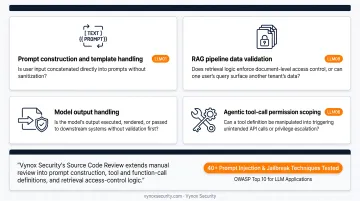
These map to specific categories in the OWASP Top 10 for LLM Applications, including prompt injection (LLM01), RAG and embedding weaknesses (relevant to LLM08), and excessive agency (LLM06). None of these have a mature static-analysis equivalent yet.
This is exactly where a standard checklist should hand off to specialized testing. Vynox Security's Source Code Review service extends manual review into prompt construction, tool and function-call definitions, and retrieval access-control logic.
That review pairs with LLM penetration testing covering 40+ prompt injection and jailbreak techniques across the full OWASP LLM Top 10. Teams shipping agentic or RAG-based features get a layer of scrutiny code review alone can't provide.
How to Interpret and Prioritize Code Review Findings
Not every finding deserves the same response. Misjudge severity and you either stall a release over something minor, or let a genuine risk through because it got buried under a pile of style nitpicks. Consistent triage criteria fix both problems.
| Severity | Examples | Action |
|---|---|---|
| Critical/High | Unauthenticated access, injection flaws, hardcoded secrets | Blocks merge or deployment until fixed |
| Medium | Missing security headers, incomplete logging | Track with a defined fix deadline, don't block release |
| Low/Informational | Style deviations, minor best-practice gaps | Log to backlog, no blocking needed |
Critical and High severity findings should never ship. Unauthenticated access to sensitive endpoints, injection flaws, and hardcoded API keys sitting in config files are the findings that turn into breach headlines.
Medium severity findings deserve a deadline, not a block. A missing Content-Security-Policy header is worth fixing, but it rarely justifies delaying a release by itself.
Low severity findings go to the backlog. A style inconsistency or a minor deviation from best practice doesn't need to hold anything up.
For every finding, map it to a CWE or OWASP category and document reproduction steps. This single habit lets a developer verify and close an issue in minutes instead of going back and forth with the reviewer over what was meant.
Every finding should include:
- A CWE or OWASP category mapping
- Documented, step-by-step reproduction details
Vynox Security holds every source code review finding to this same standard, so developers receive reproducible, ready-to-fix issues instead of vague flags.
Common Mistakes That Undermine Secure Code Reviews
Even teams running a solid checklist trip over the same handful of process gaps.
- Reviewing the diff in isolation. A clean-looking diff can still be risky once you factor in the reverse proxy or gateway rules sitting in front of it.
- Leaning entirely on SAST output. Automated tools miss business logic and authorization flaws by design, leaving the biggest gaps unreviewed.
- Not re-reviewing after "quick fixes." A one-line patch can introduce a new bug or leave the issue half-fixed; treat every remediation as its own review.
Best Practices for Embedding Security Code Reviews into Your SDLC
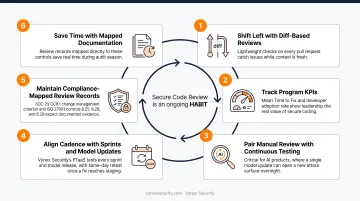
Code review works best as a continuous habit, not a pre-release scramble.
- Shift left with diff-based reviews on every PR. Lightweight checks on every pull request catch issues while context is fresh, instead of stacking everything into one pre-release baseline audit.
- Track program KPIs. Mean Time to Fix and developer adoption rate give leadership a concrete way to see the value of secure coding practices, beyond a vague sense that "we do reviews."
- Pair periodic manual review with continuous testing. This matters most for AI-powered products, where a single model update can open a new attack surface overnight.
- Align testing cadence with sprints and model updates. Vynox Security's PTaaS tests every sprint and model release, with same-day retest once a fix reaches staging.
- Maintain review records mapped to compliance frameworks. SOC 2's CC8.1 change management criterion and ISO 27001 controls 8.25, 8.28, and 8.29 expect documented evidence of secure development practices.
- Save time with mapped documentation. Review records that map directly to these controls save real time during audit season.
Conclusion
A category-based checklist paired with consistent severity triage is what separates a genuine security code review from a routine functional one. Skip either piece and you either miss real risk or waste time arguing about what counts as blocking.
Traditional checklists also need to stretch further than they used to. As more teams ship LLM-integrated and agentic features, these areas need a place in the review process, not an afterthought once something breaks:
- Prompt construction and injection surfaces
- RAG data handling and retrieval boundaries
- Tool-call permissions for autonomous agents
Disciplined internal review handles most of this. But pairing it with specialized testing, across both AI-specific and traditional infrastructure, gives teams the full-stack assurance a checklist alone can't provide. That's the gap Vynox Security's combined source code review and AI security testing is built to close, with developer-ready fix guidance and reproduction steps that make remediation fast rather than another back-and-forth.
Frequently Asked Questions
What is a secure code review and why is it important?
A secure code review is a manual examination of source code focused on finding security vulnerabilities, not just bugs or style issues. It catches logic and context flaws, like broken authorization or business-logic bypasses, that automated scanners consistently miss.
How is a secure code review different from a regular code review?
Regular code review focuses on functionality, readability, and style. Secure code review specifically targets vulnerabilities like injection flaws, broken authentication, and authorization gaps that could be exploited.
What tools are used for secure code review?
Teams typically use SAST tools, linters, and dependency or secret scanners like Dependabot. These tools complement manual review by clearing pattern-based issues, but they don't replace human judgment on business logic.
How often should secure code reviews be conducted?
Run lightweight, diff-based reviews on every pull request, and supplement with periodic baseline reviews at major releases or compliance cycles. This catches new risk early instead of waiting for a scheduled audit.
What's the difference between SAST and manual secure code review?
SAST tools automatically scan code for known vulnerability patterns at speed and scale. Manual review catches business-logic and context-specific flaws, like authorization bypasses, that pattern-matching tools structurally can't interpret.
Can traditional code review checklists catch AI/LLM-specific vulnerabilities like prompt injection?
No. Standard checklists are built around web and application risks, not AI-native ones. Prompt injection, insecure RAG retrieval, and agentic tool-call abuse need specialized testing methodologies designed for LLM systems specifically.