
Introduction
Most organizations discover network vulnerabilities the hard way — after an attacker has already exploited them. According to Mandiant's M-Trends 2026 report, the global median attacker dwell time reached 14 days in 2025, meaning threat actors can spend two weeks inside a network before anyone notices. Meanwhile, the 2026 Verizon Data Breach Investigations Report found that vulnerability exploitation was the initial access vector in 31% of breaches — a figure that underscores how often unpatched and misconfigured systems serve as the open door.
Network penetration testing exists to find that door first.
This guide covers everything security-conscious teams need to know: what network pen testing actually is, how it differs from vulnerability scanning, the five core phases of the process, common vulnerabilities it uncovers, the tools involved, and why it matters for compliance and risk management.
Key Takeaways
- Network pen testing actively exploits vulnerabilities, not just flags them
- Five phases: planning, scanning, vulnerability assessment, exploitation, and reporting
- Covers both internal threats (lateral movement) and external perimeter attacks
- Produces CVSS-rated findings with prioritized, actionable remediation steps
- Required or recommended under PCI DSS, SOC 2, and ISO 27001
What Is Network Penetration Testing?
Network penetration testing is an authorized, simulated cyberattack on an organization's network infrastructure — routers, switches, firewalls, servers, endpoints — conducted by ethical hackers to find and exploit vulnerabilities before real attackers do.
The key word is authorized. Everything happens within an agreed scope, with written permission from the system owner. Without that authorization, the same actions would constitute illegal computer access.
At a high level, ethical hackers (often called red teams) work through a structured process:
- Reconnaissance — mapping the target environment using passive and active intelligence gathering
- Scanning — identifying open ports, running services, and OS versions
- Exploitation — actively attempting to compromise identified weaknesses
- Reporting — documenting findings with evidence and remediation guidance
The output isn't a list of theoretical risks. It's a demonstrated attack path showing exactly what a real threat actor could access, how far they could go, and what needs to be fixed.
Pen Testing vs. Vulnerability Scanning: What's the Difference?
A vulnerability scanner is an automated tool that identifies potential weaknesses across networked assets. It can tell you a door might be unlocked. A network penetration test tries to open that door, walk through it, and show what's behind it — confirming whether the weakness is actually exploitable in your specific environment.
NIST SP 800-115 explicitly notes that vulnerability scanners can have a "high false positive error rate," reporting vulnerabilities that don't actually exist. Scanner output represents potential findings — not confirmed risks. A pen test provides that confirmation through manual expert analysis and active exploitation attempts.
Vulnerability scans are useful for routine hygiene, but they can't replace a pen test when you need proof of exploitability, compliance evidence, or a realistic picture of your attack surface.
Types of Network Penetration Testing
Internal vs. External Network Penetration Testing
These two approaches test fundamentally different threat scenarios.
External network penetration testing simulates an attacker with no prior access targeting internet-facing assets: web servers, email gateways, DNS servers, VPNs, and firewalls. The goal is to identify perimeter weaknesses before an attacker finds them.
Vynox Security's external testing covers perimeter probing and exposed-service testing to validate exactly what's visible and reachable from outside the network boundary.
Internal network penetration testing simulates a threat actor who has already gained a foothold: an insider, a compromised employee account, or an attacker who bypassed the perimeter. The focus shifts to lateral movement, privilege escalation, and access to sensitive internal assets.
Vynox's internal testing covers firewall and segmentation bypass, credential relay attacks, lateral movement simulation, and privilege escalation chains targeting crown-jewel systems. CI/CD attack paths are also in scope, which matters for teams running AI workloads on shared infrastructure.
Most mature security programs test both. External testing tells you how hard it is to get in. Internal testing tells you how bad it gets once someone does.
Black Box, Gray Box, and White Box Testing
The testing methodology determines how much information the tester starts with:
| Method | Starting Knowledge | Best Used For |
|---|---|---|
| Black box | Zero — no prior knowledge of the target | Most realistic external attacker simulation |
| Gray box | Partial — some credentials, IP ranges, or architecture details | Insider threat or compromised partner scenarios |
| White box | Full — complete access to documentation, configs, architecture | Deep structural vulnerability review, compliance validation |
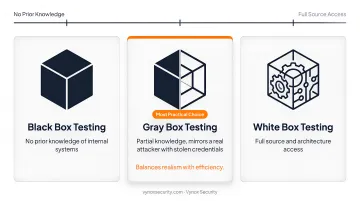
Gray box is often the most practical choice. It balances realism with efficiency — giving testers enough context to find deep vulnerabilities without spending days on reconnaissance that a real attacker with stolen credentials would skip entirely.
The 5 Steps of Network Penetration Testing
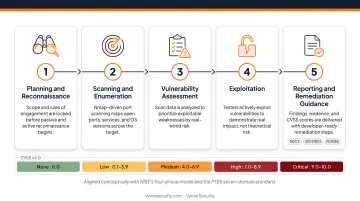
This five-phase process aligns conceptually with NIST's four-phase model (Planning, Discovery, Attack, Reporting) and the seven sections defined by the Penetration Testing Execution Standard (PTES). Consider it a practical synthesis of both frameworks.
Step 1 — Planning and Reconnaissance
Before any active testing begins, the scope, rules of engagement, and objectives are formally agreed upon. Defined scope is what separates authorized testing from illegal access.
Once scope is locked, testers conduct passive and active reconnaissance: DNS lookups, WHOIS data, OSINT, and network topology mapping to understand the target environment and build an attack plan.
Step 2 — Scanning and Enumeration
Testers use tools like Nmap to perform port scanning (TCP and UDP) across the scoped network, identifying open ports, running services, OS versions, and potential entry points. This phase builds the map that guides exploitation — without it, the rest of the engagement is guesswork.
Step 3 — Vulnerability Assessment
All reconnaissance and scan data is analyzed to identify exploitable weaknesses: unpatched software, misconfigured services, weak or default credentials, insecure protocols, and missing network segmentation. This phase prioritizes which vulnerabilities to pursue based on real-world risk, not just technical severity scores.
Step 4 — Exploitation
Testers actively attempt to exploit identified vulnerabilities — gaining unauthorized access, escalating privileges, moving laterally, and reaching sensitive data. The goal is to demonstrate actual impact, not flag theoretical possibilities. This is what separates a pen test from every other security assessment.
Step 5 — Reporting and Remediation Guidance
All findings are documented with evidence (screenshots, captured data, logs), CVSS severity ratings, and prioritized remediation steps. CVSS v4.0, released November 2023, defines five severity bands:
- None: 0.0
- Low: 0.1–3.9
- Medium: 4.0–6.9
- High: 7.0–8.9
- Critical: 9.0–10.0
A strong final report addresses both the technical team and business leadership — showing what was found, how it was exploited, and exactly what to fix.
Vynox Security's network pentest reports include executive summaries, technical findings, evidence screenshots, CVSS scores, and developer-ready, stack-specific remediation guidance — all mapped to SOC 2, ISO 27001, and PCI DSS control requirements in a single assessor-ready document.
Common Vulnerabilities Network Pen Testing Uncovers
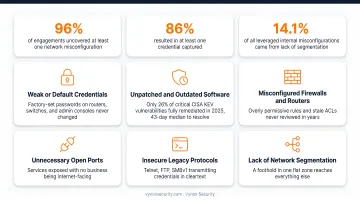
Automated scanners surface possibilities. Pen tests confirm whether those possibilities are actually exploitable. Here's what consistently surfaces during network penetration testing engagements:
- Weak or default credentials — factory-set passwords on routers, switches, and admin consoles that were never changed
- Unpatched and outdated software — known CVEs left open for weeks or months; the 2026 DBIR found only 26% of critical CISA KEV vulnerabilities were fully remediated in 2025, with a 43-day median for full resolution
- Misconfigured firewalls and routers — overly permissive rules, stale ACLs, and firewall policies that haven't been reviewed in years
- Unnecessary open ports — services exposed that have no business being internet-facing
- Insecure legacy protocols — Telnet, FTP, SMBv1, and similar protocols that transmit credentials in cleartext or have known critical exploits
- Lack of network segmentation — flat networks where a foothold in one zone provides access to everything else
The Rapid7 "Under the Hoodie" research (85 internal assessments) found that 96% of engagements uncovered at least one network misconfiguration that was actively leveraged, and 86% resulted in at least one credential being captured. Lack of network segmentation accounted for 14.1% of all leveraged internal misconfigurations.
Why Active Testing Is Necessary
A scanner would flag most of these as potential issues. A pen test walks through the entire attack chain — demonstrating the blast radius, not just the entry point. That gap matters: "this port is open" tells you almost nothing compared to "we used this port to relay credentials, move laterally to your CI/CD server, and extract environment variables containing production API keys."
That attack-chain evidence is also what compliance auditors require — not just a scan report. Each of the vulnerabilities above maps to specific control failures:
- PCI DSS Requirements 11.4.2 and 11.4.3 — mandate internal and external penetration testing at least once every 12 months
- SOC 2 Trust Services Criteria (CC7.1) — includes vulnerability scanning and penetration testing as a point of focus for security controls
- Unaddressed findings — risk audit failures, certification delays, and direct regulatory exposure
Key Tools Used in Network Penetration Testing
Experienced pen testers combine multiple tools depending on the phase and what they're looking for. The core toolkit includes:
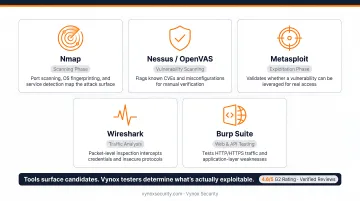
- Nmap (Network Mapper) — port scanning, OS fingerprinting, and service detection; maps the full attack surface during the scanning phase by identifying what's running, what version, and what may be exploitable
- Nessus / OpenVAS (Greenbone) — automated vulnerability scanners that flag known CVEs, misconfigurations, and software weaknesses across the scoped network; experienced testers then verify and prioritize findings manually — the tools surface candidates, the testers determine what's actually exploitable
- Metasploit — a penetration testing framework for developing and executing exploits against identified vulnerabilities, validating whether a weakness can be leveraged for real access
- Wireshark — a network protocol analyzer for packet-level traffic inspection; useful for intercepting credentials, identifying insecure protocols, and analyzing network behavior during testing
- Burp Suite — used for web-facing network assets and APIs, testing HTTP/HTTPS traffic and application-layer weaknesses
At Vynox Security, testers don't lead with automated tooling. The methodology is manual and expert-driven — tools support the process, but understanding the architecture comes first. Verified G2 reviewers have highlighted this distinction as a differentiator in how engagements are conducted.
Benefits of Network Penetration Testing
Proactive Risk Reduction
The core ROI argument is straightforward: finding a vulnerability during a controlled test costs far less than discovering it after a breach. IBM's 2025 Cost of a Data Breach Report puts the global average breach cost at USD $4.44 million. A network penetration test typically costs a fraction of that — and remediating the findings reduces the probability of reaching that number.
Beyond the financial case, pen testing builds organizational muscle memory. Security teams that run through an exercise with ethical hackers are better prepared to detect and respond to real attacks when they happen.
Compliance Readiness
Compliance is increasingly a direct driver of pen testing decisions:
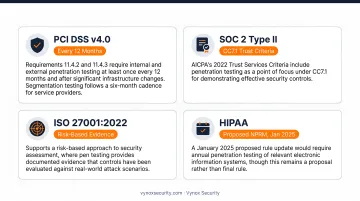
- PCI DSS v4.0 — Requirements 11.4.2 and 11.4.3 explicitly require internal and external penetration testing at least once every 12 months and after significant infrastructure changes. Segmentation testing has a six-month cadence for service providers.
- SOC 2 Type II — AICPA's 2022 Trust Services Criteria include penetration testing as a point of focus under CC7.1 for demonstrating effective security controls.
- ISO 27001:2022 — Supports a risk-based approach to security assessment, where pen testing provides documented evidence that controls have been evaluated against real-world attack scenarios.
- HIPAA — A January 2025 proposed rule update (NPRM) would require annual penetration testing of relevant electronic information systems, though this remains a proposal rather than final rule.
Validated Security Controls
A pen test doesn't just find vulnerabilities — it tests whether your existing controls actually work. Two common examples illustrate this:
- A firewall rule that looks correct in a configuration review may not hold up when an attacker approaches from a specific network position
- An IDS/IPS configured to detect lateral movement may generate zero alerts during a live simulation
That gap between "configured" and "actually working" is where real exposure lives — and where pen testing delivers its clearest value.
Vynox Security delivers network pentest findings in 5–10 business days, compared to the 4–8 weeks typical of traditional firms. Reports map directly to SOC 2, ISO 27001, and PCI DSS control requirements, with developer-ready remediation guidance that engineering teams can act on immediately.
Frequently Asked Questions
What is a network penetration test?
A network penetration test is an authorized simulation of a cyberattack on an organization's network infrastructure, conducted by ethical hackers to identify and exploit vulnerabilities before real attackers can. It produces a detailed report with severity ratings, evidence of exploitation, and prioritized remediation recommendations.
What are the 5 steps of network penetration testing?
The five steps are planning and reconnaissance, scanning and enumeration, vulnerability assessment, exploitation, and reporting. Each phase builds on the previous one, producing a thorough, evidence-backed picture of the network's security posture.
Which tool is commonly used for network penetration testing?
Nmap is a widely used tool for network discovery and port scanning. It's typically used alongside Nessus or OpenVAS for vulnerability assessment, Metasploit for exploitation, and Wireshark for traffic analysis.
Is network penetration testing illegal?
No — it's completely legal when conducted with explicit written authorization from the system owner. Without that authorization, the same actions constitute unauthorized computer access under the Computer Fraud and Abuse Act (18 U.S.C. § 1030), so a formal scope and rules of engagement must be agreed upon before testing begins.
How is network penetration testing different from a vulnerability scan?
A vulnerability scan is automated and identifies potential weaknesses without confirming whether they're actually exploitable. A network pen test actively exploits those weaknesses, demonstrating real-world impact and providing a much higher level of assurance than scan output alone.
How often should organizations conduct network penetration testing?
At minimum, once per year — which aligns with NIST SP 800-115 guidance and PCI DSS's explicit 12-month requirement. Organizations in regulated industries or those with high-value data should also test after significant infrastructure changes, new deployments, or compliance renewals. Teams with frequent release cycles or regular model updates often adopt a continuous PTaaS cadence to keep testing aligned with each sprint.