Introduction
APIs are everywhere. They power the mobile apps on your phone, the SaaS platforms your team uses daily, the AI systems processing sensitive data, and nearly every digital product built in the last decade. According to Cloudflare's 2024 API Security and Management Report, APIs account for 57% of dynamic HTTP traffic — making them the primary interface of the modern internet.
That scale creates risk. Akamai recorded 108 billion API attacks between January 2023 and June 2024, with attack volume growing 49% year-over-year. Yet despite this, only 7.5% of organizations have a dedicated API security testing program, according to Salt Security's 2024 research.
That gap between exposure and investment is exactly where attackers operate. This guide covers what API security testing is, how it works as a structured process, which vulnerabilities it catches, and which testing methods security teams use in practice.
Key Takeaways
- API security testing evaluates endpoints for exploitable weaknesses — not just whether the API functions correctly
- Testing follows a defined sequence: scoping, active attack simulation, analysis, and remediation reporting
- The OWASP API Security Top 10 (2023) defines the core vulnerability taxonomy every API test should cover
- Effective programs combine SAST, DAST, fuzzing, and manual penetration testing — no single method covers the full attack surface
- Security testing should run continuously throughout the development lifecycle, not just pre-release
What Is API Security Testing?
API security testing is the systematic evaluation of an API's endpoints, authentication mechanisms, authorization logic, and data handling to identify vulnerabilities an attacker could exploit. The goal isn't to verify that the API works — it's to determine whether it can be manipulated, bypassed, or coerced into revealing data or granting access it shouldn't.
This distinction matters. Functional, integration, and load testing all ask "does this work as designed?" API security testing asks "what happens when someone tries to break it?"
Why APIs Need Their Own Security Discipline
APIs expose raw business logic and sensitive data directly, without the HTML rendering layer that sits in front of traditional web applications. A standard web scanner interacting with a frontend never sees the underlying API endpoints: a significant portion of the attack surface goes untested with conventional tools.
The OWASP API Security Top 10 exists for exactly this reason — created because APIs present a unique threat surface that standard application security frameworks weren't built to address, and updated in 2023 to reflect how those attack patterns have matured.
Types of APIs That Require Testing
Each API type carries a distinct risk profile, and testing approaches need to match accordingly:
- REST APIs — the most common type; vulnerable to BOLA, injection, and broken authentication
- GraphQL APIs — flexible query structure creates specific risks: introspection abuse exposes the full schema, and unbounded nested queries can trigger denial-of-service conditions that REST testing approaches won't catch
- SOAP APIs — XML-based; vulnerable to XML injection and schema poisoning
- gRPC APIs — binary protocol; harder to intercept but still susceptible to authorization flaws
Internal APIs and third-party integrations require testing too. Cloudflare's machine-learning discovery found 30.7% more API endpoints than customers self-reported — those undocumented "shadow APIs" often lack authentication controls entirely, and attackers don't distinguish between public and private endpoints.
How Does API Security Testing Work?
API security testing isn't a single action. It's a defined sequence of stages, each building on the last to produce a complete picture of risk.
Scoping and Reconnaissance
Testing starts before a single request is sent. Testers catalog every API endpoint — including undocumented and legacy ones — using API documentation (OpenAPI/Swagger specs, Postman collections, HAR files), traffic analysis, and active crawling. Getting this inventory right matters: you can't test what you don't know exists.
During reconnaissance, testers also profile:
- Authentication model (OAuth, API keys, JWT)
- Rate limiting behavior and HTTP methods supported
- Input/output formats and data types
- Error handling patterns that might leak system information
This informs which attack vectors to prioritize in the active testing phase.
Active Testing and Attack Simulation
Testers simulate real-world attack scenarios against each endpoint, adopting the attacker's perspective rather than verifying correct functionality. Typical attack simulations include:
- Probing object-level authorization (BOLA) to check if User A can access User B's resources by manipulating IDs
- Testing authentication bypass paths — expired tokens, missing validation, credential manipulation
- Injecting malformed payloads to see whether inputs reach backend systems unsanitized
- Checking for excessive data exposure in API responses beyond what the client requires
- Attempting rate limit bypass to simulate brute-force or resource exhaustion attacks
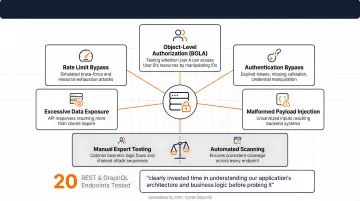
Both manual expert testing and automated scanning are used together. Manual testing catches business logic flaws and chained attack sequences that tools miss; automated scanning ensures consistent coverage across every endpoint.
That balance matters in practice. Vynox's API security engagements are manual-first — hand-exercised testing across up to 20 REST and GraphQL endpoints. As one verified G2 reviewer noted, the testers "clearly invested time in understanding our application's architecture and business logic before probing it" rather than running automated tools against it.
Analysis, Prioritization, and Reporting
After active testing, findings are ranked by severity. A broken object-level authorization flaw on an endpoint exposing PII is far more critical than a missing security header. Findings are mapped to the OWASP API Security Top 10 to contextualize risk, and false positives are filtered so the final report reflects only real, exploitable issues.
The output is a structured security report containing:
- CVSS severity scores for each finding
- Proof-of-concept reproduction steps so developers can replicate the exploit
- HTTP-level evidence — exact request/response captures showing how the vulnerability was exploited
- Stack-specific remediation guidance tailored to the actual technology in use
- Compliance mapping to SOC 2, ISO 27001, and PCI DSS controls
Vynox's API security reports are structured for two audiences: engineering teams get developer-ready, stack-specific guidance they can act on within the same sprint, while the executive summary gives leadership and compliance stakeholders what they need to assess and document risk.
What Vulnerabilities Does API Security Testing Catch?
OWASP API Security Top 10 (2023)
The current OWASP API Security Top 10 defines the core vulnerability taxonomy:
| ID | Category |
|---|---|
| API1 | Broken Object Level Authorization (BOLA) |
| API2 | Broken Authentication |
| API3 | Broken Object Property Level Authorization |
| API4 | Unrestricted Resource Consumption |
| API5 | Broken Function Level Authorization |
| API6 | Unrestricted Access to Sensitive Business Flows |
| API7 | Server Side Request Forgery (SSRF) |
| API8 | Security Misconfiguration |
| API9 | Improper Inventory Management |
| API10 | Unsafe Consumption of APIs |
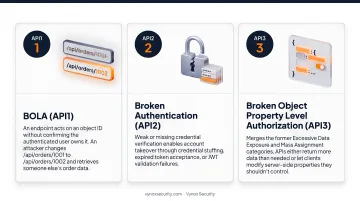
The three most commonly exploited:
- BOLA (API1): An endpoint acts on an object ID without confirming the authenticated user owns it. An attacker changes
/api/orders/1001to/api/orders/1002and retrieves someone else's order data. - Broken Authentication (API2): Weak or missing credential verification enables account takeover through credential stuffing, expired token acceptance, or JWT validation failures.
- Broken Object Property Level Authorization (API3): Merges the former "Excessive Data Exposure" and "Mass Assignment" categories — APIs either return more data than needed or let clients modify server-side properties they shouldn't control.
Misconfigurations, Injection, and Rate Limiting
Authorization flaws get the most attention, but three other vulnerability classes show up just as reliably in production:
- Security Misconfiguration (API8): Salt Labs found 54% of API attacks in observed customer traffic tied to misconfiguration — debug mode left on in production, overly permissive CORS policies, default API keys never rotated, missing HTTPS enforcement.
- Injection flaws: SQL injection, command injection, and SSRF exploited through API inputs. All preventable at the code level, yet routinely surfaced during testing.
- Rate limiting gaps (API4): No limits on request frequency, payload size, or resource consumption open the door to brute-force attacks and denial-of-service conditions.
API Security Testing Methods
No single method covers the full attack surface. Effective programs layer multiple approaches:
| Method | What It Does | Best Stage |
|---|---|---|
| SAST | Static analysis of source code — catches vulnerabilities before the API runs | Early development |
| DAST | Dynamic testing of a running API — simulates external attacks against live endpoints | Pre-production |
| Fuzzing | Feeds unexpected or malformed inputs to surface undefined behavior and crashes | Pre-production |
| Penetration Testing | Manual, expert-led exploitation attempting to chain vulnerabilities and abuse business logic | Pre-release, major changes |
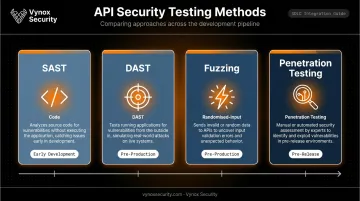
SAST and code review catch issues at the lowest cost — before anything is deployed. DAST and fuzzing validate what actually runs in your environment. Penetration testing covers what automated tools are structurally incapable of finding.
Why Manual Penetration Testing Remains Essential
Automated scanners reliably find known vulnerability patterns in expected locations. Business logic abuse is a different problem — detecting attacks like scalping, reservation manipulation, or account enumeration through timing differences requires understanding what the API is supposed to do, not just what inputs it accepts.
OWASP API6 (Unrestricted Access to Sensitive Business Flows) explicitly notes that identifying sensitive flows requires understanding the business model, rating automated detection as "Average." Expert-led penetration testing addresses this directly — a tester who understands your checkout flow can spot a reservation manipulation attack that no scanner would flag.
Choosing the Right Method
- Development phase — SAST and code review; fix issues before they ship
- Pre-production — DAST (OWASP ZAP supports OpenAPI, SOAP, and GraphQL natively) and fuzzing
- Pre-release / handling sensitive data — manual penetration testing
- Continuous deployment — all three, embedded in CI/CD pipelines with each significant code change
API Security Testing Best Practices
Shift Testing Left in the SDLC
The cost of fixing a vulnerability found in development is a fraction of remediating a production breach. NIST's foundational research on defect repair costs shows post-release fixes can cost up to 30x more than catching the same issue at the requirements stage.
Embed API security checks into CI/CD pipelines so code commits trigger automated scans. NIST SP 800-204C places SAST in the build phase and DAST at the packaging stage for microservices architectures — a concrete template for pipeline integration.
Maintain a Complete API Inventory
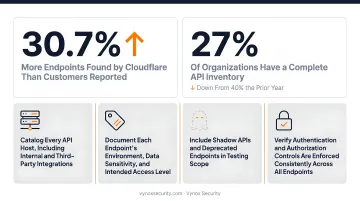
You cannot test what you don't know exists. With Cloudflare finding 30.7% more endpoints than customers reported, and only 27% of organizations having a complete inventory of APIs handling sensitive data (down from 40% the prior year), inventory gaps are a pervasive, measurable risk.
Best practices for inventory management:
- Catalog every API host, including internal and third-party integrations
- Document each endpoint's environment, data sensitivity, and intended access level
- Include shadow APIs and deprecated endpoints in testing scope
- Verify authentication and authorization controls are enforced consistently across all endpoints — not just the ones in the documentation
Test Continuously, Not Periodically
APIs change with every sprint. New endpoints are added, logic is modified, dependencies are updated. One annual penetration test is insufficient for any team shipping weekly.
Only 13% of organizations test APIs in real time, according to Akamai's 2024 research — meaning the vast majority are operating with significant coverage gaps between assessments. Continuous testing closes that window by validating APIs at every meaningful change point:
- Scanning new endpoints added during a sprint before they reach production
- Regression-testing modified business logic for broken access control or injection flaws
- Re-evaluating third-party dependency updates that may introduce new attack surface
For teams running continuous deployment, this is where Pentest-as-a-Service (PTaaS) models become valuable. Vynox's PTaaS engagements align with sprint and model-update cadences, with same-day retest verification when fixes reach staging.
Frequently Asked Questions
What is API security testing?
API security testing evaluates API endpoints for exploitable vulnerabilities — including broken authorization, authentication flaws, and injection risks — by simulating attacker behavior rather than verifying correct functionality. It's distinct from functional testing, which confirms the API works as designed but doesn't assess whether it can be manipulated or bypassed.
What is an example of API security testing?
A classic BOLA test involves creating two user accounts, authenticating as User A, and attempting to access User B's resources by manipulating object IDs in API requests. If GET /api/users/102/profile returns User B's data when authenticated as User A, you've confirmed an exploitable BOLA vulnerability.
How do you test secured APIs?
Testing secured APIs starts with valid credentials scoped to a specific test account, then systematically attempts to exceed those permissions — horizontal privilege escalation, vertical escalation to admin functions, token manipulation, and authentication bypass. Each scenario is tested deliberately and documented with reproduction steps.
What's the best API security testing tool?
Burp Suite handles manual testing with strong API workflow support; OWASP ZAP provides open-source DAST with native OpenAPI, SOAP, and GraphQL scanning. Neither tool is a complete solution on its own. For business logic flaws and chained attack sequences, expert-led penetration testing remains essential — automated tools consistently miss these.
How is API security testing different from web application security testing?
Web application security testing typically interacts with the HTML frontend layer. API security testing targets endpoints directly — APIs expose raw business logic and data that the frontend never renders. Traditional web scanners miss a significant portion of the API attack surface because they have no visibility into these endpoints.
When should API security testing be performed?
API security testing should start at the design phase and continue throughout development — SAST in early development, DAST and fuzzing in pre-production, and penetration testing before major releases. Teams shipping continuously benefit most from an ongoing cadence rather than point-in-time assessments tied to annual audits.