The distinction matters practically. One engagement tells you which vulnerabilities exist in a defined set of systems. The other tells you whether a determined adversary could reach your most critical data without anyone noticing. Those are not the same question, and the gap between them is where real breaches happen.
The stakes are real: IBM's 2025 Cost of a Data Breach Report puts the global average breach cost at $4.4 million. Meanwhile, the penetration testing market is projected to grow from $1.82 billion in 2023 to $5.24 billion by 2030, reflecting how seriously organizations are taking structured security testing.
This article explains exactly what separates these two approaches — scope, stealth, goals, reporting, and when each one is the right call.
Key Takeaways
- Pentesting finds vulnerabilities in defined systems; red teaming tests whether your entire defense can stop a real attacker
- Scope, duration, and stealth differ fundamentally — the two approaches serve entirely different security objectives
- Pentest outputs serve engineering teams and compliance audits; red team outputs inform security strategy and executive decision-making
- Security maturity determines which approach delivers actionable learning — and which one simply confirms what you already know
- Most resilient programs use both: continuous pentesting plus periodic red team exercises
Red Teaming vs. Penetration Testing: Quick Comparison
The table below maps out the key differences across six dimensions — use it to quickly identify which approach fits your current security goals.
| Dimension | Penetration Testing | Red Teaming |
|---|---|---|
| Goal | Find and document exploitable vulnerabilities in defined scope | Simulate a real adversary achieving a specific objective while evading detection |
| Scope | Narrow — specific systems, apps, or network segments | Broad — people, processes, technology, potentially physical access |
| Duration | 1–6 weeks depending on complexity | 4 weeks to several months |
| Awareness | Usually announced — IT teams know it's happening | Covert — only a small group of stakeholders knows |
| Primary output | Prioritized vulnerability list with remediation steps | Attack narrative revealing systemic gaps in detection and response |
| Best fit | Building a security baseline, compliance prep, new launches | Mature programs with SOCs validating detection and response |
What Is Penetration Testing?
Penetration testing is a structured, authorized assessment where skilled testers use manual techniques and targeted tooling to find exploitable vulnerabilities within a predefined scope — then document them with severity ratings and actionable remediation guidance.
How a Pentest Works
The standard methodology follows four phases:
- Planning — Define scope, rules of engagement, and success criteria
- Discovery — Reconnaissance and enumeration of the target environment
- Attack — Manual exploitation of identified vulnerabilities to confirm impact
- Reporting — Prioritized findings with CVSS scores, reproduction steps, and remediation guidance
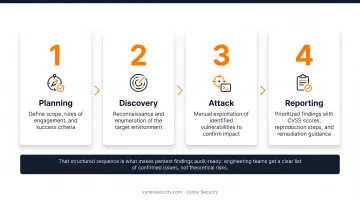
That structured sequence is what makes pentest findings audit-ready — engineering teams get a clear list of confirmed issues, not theoretical risks.
Pentest Types
Most organizations run one or two engagements per cycle. The scope depends on what's being shipped or reviewed:
- Web application — OWASP Top 10, business logic, authentication and session flaws
- API — REST and GraphQL testing, BOLA, mass assignment, injection chains
- Mobile — iOS and Android, static/dynamic analysis, reverse engineering
- Cloud — IAM misconfigurations, public exposure review, privilege escalation paths
- Network — Internal/external infrastructure, lateral movement, firewall bypass
- AI-specific — LLM prompt injection, RAG pipeline data leakage, agent misuse; a surface most traditional firms aren't equipped to test
Why Pentests Deliver Immediate Value
The output is a concrete, prioritized vulnerability list — not a scanner dump. Reports include CVSS scores, reproduction steps, and stack-specific remediation guidance that developers can act on without interpretation.
For compliance, pentest reports serve as evidence for SOC 2, ISO 27001, and PCI DSS. PCI DSS explicitly requires penetration testing at least annually and after significant changes. SOC 2 and ISO 27001 don't mandate a universal annual pentest, but pentest evidence typically satisfies examination requirements.
One area where traditional pentesting falls short: AI-powered applications. LLM prompt injection, RAG pipeline data leakage, and autonomous agent misuse don't appear in CVE databases — they require purpose-built methodology. When evaluating providers, look for full OWASP LLM Top 10 coverage and documented prompt injection techniques. Vynox's AI Security Testing layer, for example, runs 40+ prompt injection and jailbreak techniques per engagement.
Penetration Testing Use Cases
Pentesting fits a specific set of scenarios — compliance prep, pre-launch validation, and continuous development cycles:
- Organizations preparing for SOC 2, ISO 27001, PCI DSS, or HIPAA audits
- Teams validating new applications before launch
- Companies establishing a security baseline for the first time
- SaaS companies ahead of enterprise sales cycles requiring security documentation
- Engineering teams running sprint-aligned security reviews
What Is Red Teaming?
Red teaming is an objective-driven, adversary-emulation exercise where a dedicated team simulates a real-world attacker — not to catalog every vulnerability, but to answer one question: can they reach a specific objective (like accessing crown jewel data) without being caught?
The Core Philosophy
The critical distinction: red teaming tests people, processes, and technology simultaneously. A red team chains together social engineering, technical exploitation, and lateral movement in sequence — the same way an advanced persistent threat (APT) actually operates. The goal isn't compliance; it's compromise.
This requires a covert operation. Defenders don't know testing is happening, which creates realistic conditions to measure actual detection and response capabilities — including mean time to detect (MTTD) and mean time to respond (MTTR).
How a Red Team Engagement Runs
- Planning and rules of engagement — Define the objective, authorized tactics, and what's off-limits
- OSINT and reconnaissance — Gather intelligence on the target environment through open sources
- Initial access — Establish a foothold using any authorized method (phishing, exploit, credential attack)
- Persistence and lateral movement — Move through the environment toward the objective without triggering alerts
- Objective achievement — Reach the defined target (data access, system compromise, etc.)
- Readout — Debrief with the blue team on what happened, what was missed, and why
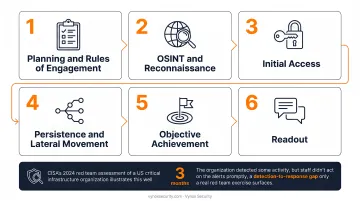
CISA's 2024 red team assessment of a US critical infrastructure organization illustrates this well. The engagement ran approximately three months, progressing from open-source reconnaissance through privilege escalation, domain compromise, and access to sensitive systems.
The organization detected some activity — but staff didn't act on the alerts promptly. That detection-to-response gap is precisely what only a real red team exercise surfaces.
The Red/Blue/Purple Dynamic
| Team | Role |
|---|---|
| Red | Attacks — simulates adversary, attempts to achieve objectives |
| Blue | Defends — monitors, detects, investigates, and responds |
| Purple | Collaborative — red and blue work together in real time to transfer knowledge and tune defenses faster |
Purple team exercises are worth considering for organizations that want the learning benefits of red teaming with a faster feedback loop.
Red Teaming Use Cases
Red teaming is the right choice for:
- Organizations with established SOCs and blue teams actively monitoring and responding to threats
- Enterprises with multiple completed pentests that want to validate whether defenses actually hold
- Companies preparing for advanced persistent threat scenarios
- Regulated sectors — financial services, healthcare, defense — where breach costs far exceed testing investment
- Organizations with high-risk AI systems subject to EU AI Act Article 15 adversarial-testing requirements
Key Differences That Actually Matter
Goal Orientation
Pentesting asks: "What vulnerabilities exist, and how severe are they?"
Red teaming asks: "Can a determined attacker reach our most critical assets without being caught?"
That goal difference drives every other distinction. A pentest is optimized for coverage and remediation evidence. A red team is optimized for realistic adversarial pressure and response validation.
Attack Freedom
Pentests work within a defined scope — specific IPs, applications, or domains. Red teams have freedom to use any attack vector not explicitly excluded in the rules of engagement, including social engineering, supply chain vectors, and insider threat simulation.
This freedom is what makes red team findings harder to dismiss. When nothing is out of scope, the results reflect whether your defenses actually held.
Stealth vs. Speed
Pentests prioritize finding as many vulnerabilities as possible quickly — sometimes making them detectable to alert security teams. Red teams prioritize avoiding detection above all else, using living-off-the-land techniques (exploiting native system tools to avoid triggering alerts) and anti-forensic methods.
The stealth factor produces metrics a pentest never will: how long an attacker can remain undetected in your environment, and whether your SOC turns alert noise into actual action.
Output and Reporting
Pentest reports deliver:
- Prioritized vulnerability list with CVSS severity scores
- Reproduction steps and evidence screenshots
- Developer-ready, stack-specific remediation guidance
- Compliance evidence mappings (SOC 2, ISO 27001, PCI DSS, OWASP frameworks)
Red team reports reveal:
- Systemic weaknesses across people, process, and technology
- Attack narrative aligned to adversary TTPs
- Detection and response gap analysis (MTTD/MTTR)
- Board-level strategic findings for executive and governance audiences
Both report types are stronger when mapped to recognized frameworks. MITRE's ATT&CK framework gives red team findings a common language around behaviors and mitigations — confirm your provider does this mapping before scoping an engagement.
Security Maturity Requirement
This is the dimension most organizations underestimate. The practical model:
- Start with vulnerability assessments and targeted pentests to build a security baseline
- Progress to regular pentesting that validates your baseline and meets compliance requirements
- Add red teaming once you have functional logging, a blue team capable of responding, and meaningful objectives worth testing against
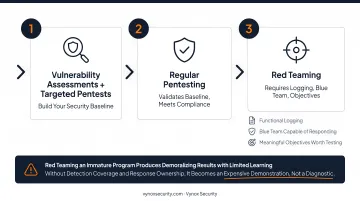
Running a red team exercise against an immature security program typically produces demoralizing results with limited learning. Without detection coverage and response ownership, it becomes an expensive demonstration rather than a diagnostic.
Which Approach Is Right for Your Organization?
Choose penetration testing if you:
- Are building your first security program
- Need compliance evidence for SOC 2, ISO 27001, or PCI DSS
- Are launching a new product, feature, or AI system
- Have a defined budget and timeline for a specific scope
- Want fast, actionable remediation guidance for engineering teams
Choose red teaming if you:
- Already run regular pentests and have addressed foundational vulnerabilities
- Have a functioning SOC with active monitoring and response capability
- Want to validate whether your detection and response actually works under realistic pressure
- Are preparing for advanced threat scenarios or regulatory adversarial testing requirements
- Have AI systems requiring EU AI Act Article 15 compliance testing
The strongest security programs use both. Continuous pentesting — or PTaaS aligned to development sprints — handles ongoing vulnerability reduction. Periodic red team exercises, typically every 12–18 months for mature organizations, then validate whether those improvements actually harden the overall posture.
If you're unsure where to start, Vynox offers scoping calls to assess your AI and infrastructure security gaps and identify which approach fits your maturity level and risk profile.
Frequently Asked Questions
What is a red team in penetration testing?
A "red team" in security is a dedicated group of ethical hackers who simulate real-world adversaries to test an organization's overall defenses — distinct from traditional penetration testers who assess specific systems for vulnerabilities within a defined scope. Red teams are measured by whether they reached an objective, not by how many vulnerabilities they logged.
What is the difference between red team and blue team testing?
Red teams play the offensive role — attacking and attempting to breach systems. Blue teams play the defensive role — monitoring, detecting, and responding to threats. Red team exercises exist specifically to measure how well the blue team detects and contains a realistic attack.
What is the difference between a penetration tester and a red teamer?
Penetration testers systematically find and document vulnerabilities within a scoped target using structured methodology. Red teamers emulate sophisticated adversaries across a broader attack surface — combining technical exploitation with stealth and lateral movement to achieve a specific objective without being detected.
Which is more expensive: red teaming or penetration testing?
Red teaming is typically more expensive — broader scope, longer duration, and the operational complexity of sustained stealth all add cost. Pricing varies significantly by scope, team size, and engagement length. CREST's buyer guidance recommends evaluating cost by authorized tester-days and deliverables, not by label alone.
How often should organizations conduct penetration testing or red team exercises?
Most organizations should run penetration tests at least annually — PCI DSS mandates this minimum — or continuously via PTaaS aligned to development sprints. Red team exercises are typically conducted every 12–18 months for organizations with mature security programs, with cadence adjusted for threat exposure and material environment changes.
Can small or mid-sized businesses benefit from red team testing?
Most SMBs should prioritize foundational penetration testing before considering red teaming. Red team exercises require an established blue team and security operations capability to generate meaningful learning — without that, the results are difficult to act on. Pentesting is the more accessible and immediately valuable starting point for most small and mid-sized organizations.