Introduction
Critical infrastructure has moved online. Now AI is following the same path, and fast. Large language models, RAG pipelines, and autonomous agents are shipping into production at a pace that outstrips most security teams' ability to test them.
Many businesses still confuse red teaming with penetration testing. They don't know when to invest in either, and they definitely don't know how to evaluate a provider for AI-specific risk.
That confusion gets expensive once an LLM-powered feature leaks customer data or an agent takes an action nobody authorized.
This guide breaks down what red team consulting actually is, how the methodology works phase by phase, and how it differs from pentesting and adversary simulation. It also covers what to look for in a partner, including AI-native providers like Vynox Security.
Key Takeaways
- Red team consulting tests detection and response, not just whether flaws exist
- The methodology runs through scoping, reconnaissance, exploitation, and reporting
- Pentesting, red teaming, and adversary simulation each answer a different security question
- Modern engagements now need to cover LLMs, RAG pipelines, and AI agents
- Speed matters: AI-native providers deliver in days, not months
What Is Red Team Consulting?
Red team consulting means hiring outside experts to simulate a real adversary's behavior against your organization — surprise, deception, multi-vector attacks, the works. The real goal is answering a harder question: can your team detect and respond when someone is actively trying to breach you?
A red team consultant is a specialized offensive security professional who adopts attacker tactics, techniques, and procedures (TTPs) under agreed rules of engagement. They act like a real intruder would, within boundaries everyone has signed off on.
Where the Practice Comes From
Red teaming traces back to Cold War military simulations, where analysts role-played as Soviet "red" forces against American "blue" forces to stress-test strategy. RAND documents this lineage directly, describing red teaming as adversarial role-play that later spread into intelligence analysis, aviation security testing, and eventually cybersecurity.
The Terminology You'll Encounter
- Red team — the attackers simulating adversary behavior
- Blue team — the defenders trying to detect and stop them
- Purple team — a collaborative setup where red and blue work together in real time
- White team — oversight, referees the rules of engagement and safety limits
Red team consulting used to mean networks and physical facilities. That scope has expanded. Modern digital ecosystems, including cloud, APIs, and now AI systems, fall under that same umbrella today. AI systems represent the next frontier, introducing attack surfaces traditional red teaming was never designed to test.
The Red Team Methodology: How a Red Team Engagement Works
What is the red team methodology? It's a phased approach that most consulting engagements follow, built on a lifecycle NIST formalized in SP 800-115: planning, discovery, attack, and reporting. Established firms add threat intelligence and debriefing on top of that backbone.
Phase 1: Scoping and Rules of Engagement
Before anyone touches a system, objectives, boundaries, legal authorization, and escalation contacts get locked in writing. This protects production systems and gives both sides a clear stop condition if something goes sideways. Any deviation from the agreed scope requires written permission. No exceptions.
At Vynox, infrastructure engagements run 3-15 business days; AI-focused red team assessments take 3-5 weeks given the added attack surface.
Phase 2: Reconnaissance
The red team builds an attacker's view of the target through:
- OSINT gathering (public records, social media, leaked credentials)
- Network and asset mapping
- Credential hunting across breach databases and exposed repositories
This phase informs the attack hypotheses that follow and forms the foundation the entire engagement rests on.
Phase 3: Exploitation and Lateral Movement
Once inside, testers escalate privileges and chain smaller weaknesses together toward a defined objective: domain compromise, sensitive data access, or whatever the scope specifies. A validated exploit can open access to additional resources, which starts the cycle over: discover, attack, escalate, repeat.
This chaining is the mechanism that turns a handful of "low" or "medium" findings into a full compromise. A misconfigured share here, a reused password there: individually minor, collectively devastating when strung together by someone who knows what they're looking for.
Phase 4: Reporting and Debrief
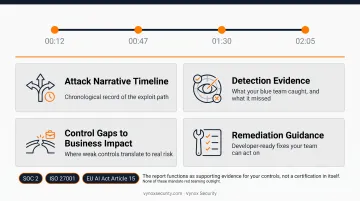
A strong report includes:
- Attack narrative with a timestamped timeline
- Detection evidence — what your blue team caught, and what it missed
- Control gaps mapped to business impact
- Remediation guidance developers can actually act on
These findings can support evidence requirements under frameworks like SOC 2, ISO 27001, and for AI-specific engagements, the EU AI Act's Article 15 adversarial testing provisions, though none of these mandate red teaming outright. The report functions as supporting evidence for your controls, not a certification in itself.
Red Teaming vs. Penetration Testing vs. Adversary Simulation
These three terms get used interchangeably. They shouldn't be.
| Service | Core question | Best used when |
|---|---|---|
| Penetration testing | What vulnerabilities exist in this defined scope? | Establishing a security baseline |
| Red teaming | Can a realistic attacker achieve an objective? | Basic controls and detection are already mature |
| Adversary simulation | Can we detect specific known techniques? | Validating detection against a named threat profile |
Pentesting comes first for most organizations — it builds the baseline. Red teaming makes sense once you have controls worth stress-testing and a detection capability worth validating. Adversary simulation sits alongside both, often using MITRE ATT&CK to emulate a specific threat actor's playbook.
Alongside these three established categories, AI security testing is emerging as its own related-but-distinct discipline. Most traditional providers weren't built to test:
- A model's behavior under adversarial prompts
- A retrieval pipeline's data exposure risks
- An agent's tool permissions and autonomous actions
That gap is what the next section covers.
Why AI Systems Demand a New Red Team Approach
Traditional red team and pentest methodologies were built for networks, applications, and identity systems. They were not built for probabilistic model outputs, untrusted natural-language inputs, or agents that take autonomous actions. That's a structural gap traditional testing was never designed to close.
The New Attack Techniques in Scope
- Prompt injection (direct and indirect): overriding system instructions through crafted inputs or poisoned retrieved content
- Jailbreaks: manipulating a model into bypassing its own guardrails
- Excessive agency: agents given too much autonomy or too many permissions
- Unsafe tool use: tool-call injection that triggers unintended API calls or data writes
- RAG and vector database exposure: cross-tenant retrieval bypass, embedding inversion, document leakage
The OWASP Top 10 for LLM Applications (2025) has become the reference framework guiding comprehensive coverage here, spanning prompt injection, data poisoning, supply chain risk, and unbounded resource consumption.
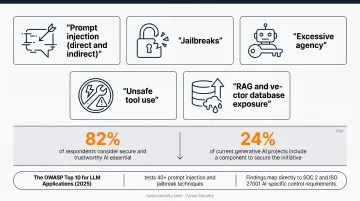
Yet the gap between deployment and testing remains wide. IBM found that 82% of respondents consider secure and trustworthy AI essential, yet only 24% of current generative AI projects include a component to secure the initiative. Organizations are shipping AI faster than they're securing it.
This is the gap Vynox Security was built to close. Every AI engagement covers the full OWASP LLM Top 10 and tests 40+ prompt injection and jailbreak techniques, including multi-turn attack chains and encoding bypasses. Findings map directly to SOC 2 and ISO 27001 AI-specific control requirements. Nothing generic, nothing left to a CVE scanner that has no idea what a system prompt even is.
What to Look for in a Red Team Consulting Partner
Not every provider is equipped to test what your organization has actually built. A few things separate the ones worth hiring from the ones just running a scanner with a fancy name.
- Methodology transparency: The provider should walk you through rules of engagement, safety controls, and communication protocols before testing starts.
- Reporting and remediation quality: Findings should include developer-ready, stack-specific fix guidance with reproduction steps.
- Speed and continuity: Look for fast retest turnaround and a cadence that keeps pace with sprints and model updates.
A one-time annual pentest made sense when applications changed slowly. It makes far less sense when a model gets fine-tuned every month and a RAG pipeline gets new data sources every sprint.
How Vynox Security Delivers Red Team Consulting for the AI Era
Vynox's engagements start with a discovery call, typically led by Karan Singh, where the AI and infrastructure testing needs get scoped precisely before anything begins. That call covers what's in your stack, including LangChain orchestration, custom agents, and multi-tenant RAG data. It also confirms whether you're facing a compliance deadline like SOC 2 or the EU AI Act's Article 15 adversarial testing requirement.
Full-stack coverage is the differentiator. A single engagement spans:
- LLMs, RAG pipelines, and autonomous agents
- APIs (REST and GraphQL)
- Web and mobile applications (iOS/Android)
- Cloud infrastructure (AWS, GCP, Azure)
- Network penetration testing
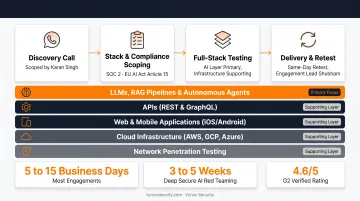
Traditional firms stop at infrastructure. Vynox tests the AI layer as the primary focus and infrastructure as the supporting layer, so nothing in the stack goes unchecked.
Delivery is fast by design: most engagements complete in 5 to 15 business days, compared to the multi-week timelines common at traditional firms. Full AI Red Teaming (the Deep Secure tier) runs 3 to 5 weeks for scenario-driven adversarial simulation.
Retests happen the same day a fix hits staging. A dedicated engagement lead like Shubham keeps communication responsive throughout, a point that verified reviewers consistently call out.
That consistency shows up in the numbers. Vynox holds a 4.6/5 rating on G2 across verified reviews, with clients in software, IT services, and AI-powered businesses praising the depth of manual testing and the clarity of the final reports.
Frequently Asked Questions
What is a Red Team consultant?
A red team consultant is an offensive security expert who simulates real adversary behavior, including deception and multi-vector attacks. The goal is to test an organization's detection and response capabilities under agreed rules of engagement.
What is the Red Team methodology?
It's a phased approach covering scoping and rules of engagement, reconnaissance, exploitation and objective pursuit, and reporting with a detailed attack narrative and remediation guidance.
How is red teaming different from penetration testing?
Red teaming is objective-driven, testing whether a realistic attacker can achieve a specific goal and whether you'd detect it. Penetration testing is vulnerability-focused within a defined, bounded scope.
When should a company invest in red team consulting services?
Red teaming delivers the most value once you already have baseline security controls in place and want to validate detection, response, and overall resilience against a real attacker.
Should AI systems be included in a red team engagement?
Yes. Any AI system connected to sensitive data, APIs, or business workflows represents a real attack surface. Prompt injection and agent hijacking are no longer theoretical risks.
How long does a typical red team consulting engagement take?
Traditional providers often need several weeks depending on scope. AI-native providers like Vynox typically deliver most engagements in 5–15 business days, with full AI Red Teaming running 3–5 weeks.