Introduction
Black box web application penetration testing is a security assessment where an external tester probes a live web application with zero prior knowledge of its architecture, source code, or infrastructure — exactly as a real attacker would.
This guide is written for security engineers, CTOs, and compliance-focused teams at software and AI-powered companies. Web applications sit at the center of the modern attack surface: externally exposed login flows, public APIs, and user-facing functions are precisely what real attackers target first.
According to the 2024 Verizon Data Breach Investigations Report, exploitation of vulnerabilities as an initial breach vector increased by 180% in 2024 — with web applications as the primary entry point.
This guide covers how black box testing works, what it finds, where its blind spots are, and how to decide whether it's the right assessment for your application.
Key Takeaways
- Black box testing gives testers only a target URL — no source code, credentials, or architecture docs
- It covers all externally reachable surfaces: login flows, APIs, public endpoints, and third-party integrations
- Testing follows a defined process: reconnaissance → scanning → exploitation → reporting
- Coverage has structural limits; pairing with gray or white box methods closes gaps
- Strong reports deliver exploitable findings with CVSS ratings, reproduction steps, and developer-ready fixes
What Is Black Box Web Application Penetration Testing?
In a black box engagement, the tester receives only the target URL and an agreed scope document — no source code, no architecture diagrams, no credentials, no internal documentation. The tester has no visibility into what's running inside the application and must reconstruct the attack surface entirely from the outside.
The goal is to validate what an external, unauthenticated attacker can discover and exploit within a defined window of time — producing evidence of real exploitability, not a list of theoretical risks.
How It Compares to Gray Box and White Box Testing
| Method | What the Tester Receives | Best For |
|---|---|---|
| Black box | Target URL and scope only | Simulating an external attacker |
| Gray box | Credentials, sometimes API docs | Authenticated testing with broader coverage |
| White box | Full source code and architecture | Code-level review, maximum coverage |
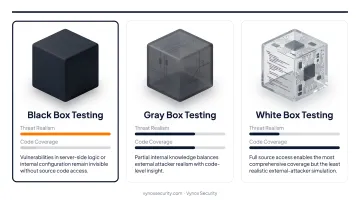
Black box most accurately simulates the external threat actor. It is also the least efficient at achieving comprehensive code-level coverage; vulnerabilities buried in server-side logic or internal configuration will stay invisible without source code access.
Why Organizations Use Black Box Web App Pentesting
Black box testing provides something internal security reviews structurally cannot: an outsider's view of what the application exposes. It covers login pages, registration flows, public APIs, third-party integrations, and any user-facing function accessible without internal access.
Organizations typically run black box engagements for four specific reasons:
- Compliance mandates — PCI-DSS v4.0.1 explicitly requires annual external penetration testing of the cardholder data environment. SOC 2 and ISO 27001 don't mandate it explicitly, but auditors expect demonstrable evidence of external security validation
- Pre-launch security gates — testing before a new product or major feature ships to production
- Third-party vendor assessments — verifying that external-facing applications meet security requirements before integration
- Post-incident hardening — confirming that an exposed surface has been properly closed after a security event
The risk of skipping external testing is straightforward: organizations without regular assessments are blind to what an attacker sees when they scan their application. Basic Web Application Attacks accounted for 881 confirmed data breaches in 2024 alone. Each of those breaches started from an exposure that a black box assessment is specifically designed to find first.
How Black Box Web App Pentesting Works
The tester starts with a URL and a scope document. Everything else — the tech stack, the endpoints, the authentication mechanisms, the API structure — gets built through reconnaissance and testing.
Scoping and Rules of Engagement
Before any testing begins, the tester and client agree in writing on:
- Exact targets in scope (domains, subdomains, IP ranges, specific endpoints)
- What is explicitly out of scope
- Authorized testing windows
- An emergency contact in case a critical system is inadvertently affected
This document is the legal foundation of the engagement. It defines authorization boundaries for both parties — no document, no testing.
Passive and Active Reconnaissance
Reconnaissance is where black box testing earns its value. The tester builds a picture of the application's attack surface using two categories of methods:
Passive methods (no direct contact with the target):
- Google dorking and OSINT to surface exposed configurations, job postings revealing the tech stack, and sensitive files indexed by search engines
- Certificate Transparency logs — over 2.5 billion certificates have been logged since 2013, making subdomain discovery reliable
- Shodan for internet-connected assets and service banners
- WHOIS and ICANN lookups for domain registration data
Active methods (direct probing begins):
- Subdomain enumeration using tools like Amass and theHarvester
- DNS enumeration
- Technology fingerprinting to identify web frameworks, CMS platforms, and server versions
This phase frequently surfaces forgotten subdomains, exposed admin panels, and outdated dependencies that development teams didn't know were publicly reachable.
Scanning and Enumeration
With a reconnaissance picture in place, the tester runs port scans (Nmap, Naabu) to identify open services, maps the application's structure through directory brute-forcing and endpoint discovery, and flags services running on non-standard ports.
The output is a map of the application's full external footprint — every reachable entry point before active exploitation begins.
Vulnerability Identification and Exploitation
This is the core of the engagement. The tester probes each identified surface against the OWASP Top 10:2025 categories, which include:
- Broken Access Control (A01) — the most frequently occurring category, appearing in 1.8 million+ test cases
- Security Misconfiguration (A02) — exposed admin panels, default credentials, verbose error messages
- Injection (A05) — SQL injection, command injection, XXE, template injection
- Authentication Failures (A07) — brute force resilience, session token entropy, credential stuffing
- IDOR / BOLA — broken object-level authorization in API endpoints
- Cross-Site Scripting (XSS) — reflected, stored, and DOM-based variants
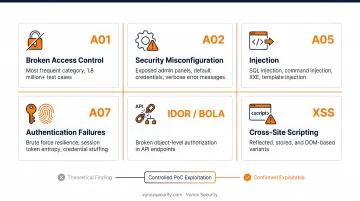
The tester performs controlled proof-of-concept exploitation to confirm each finding is genuinely exploitable — not just theoretically possible. That distinction is what separates a useful pentest report from automated scanner output.
Reporting and Remediation Guidance
A high-quality black box web application pentest report contains:
- Executive summary — business risk context for leadership, not just a vulnerability count
- Technical findings — full documentation of each issue with severity context
- Evidence screenshots — visual proof of exploitation for compliance audit trails
- CVSS scores — standardized severity ratings (critical/high/medium/low) for remediation prioritization
- Developer-ready remediation guidance — stack-specific fix instructions with reproduction steps, not generic CVE summaries
Vynox Security's black box web application engagements deliver findings in this exact format. Reports are explicitly structured to be assessor-ready for SOC 2, ISO 27001, and PCI-DSS, eliminating the need for a separate compliance mapping workstream. Standard engagements covering up to 20 endpoints typically deliver in 5–10 business days.
Key Techniques Used in Black Box Web App Pentesting
Authentication and Session Testing
Authentication weaknesses carry disproportionate impact because compromising login mechanisms exposes the entire authenticated surface. Testers probe:
- Credential stuffing and brute-force lockout enforcement
- Session token entropy (OWASP requires at least 64 bits)
- Token fixation vulnerabilities
- Insecure "remember me" implementations
- Cookie attributes:
Secure,HttpOnly, andSameSitepresence - Session ID renewal after privilege changes
Generic error messages matter here — applications that return different HTTP response codes or response times for valid vs. invalid usernames leak enumerable information that attackers use in targeted attacks.
Input Validation and Fuzzing
Testers systematically fuzz all input fields, HTTP headers, URL parameters, and API request bodies using crafted payloads.
- Mutation-based fuzzing modifies known valid inputs to generate edge cases — effective when the tester has observed legitimate request formats during reconnaissance
- Generation-based fuzzing produces inputs from a formal grammar — better for blind-probing endpoints where no prior request format is known
Used together, these approaches surface implementation faults that manual inspection or single-method testing would miss — and set up the conditions for finding deeper API-layer issues.
API and Business Logic Testing
Many web applications expose REST or GraphQL APIs that warrant their own testing focus. Testers enumerate for:
- Hidden or undocumented endpoints
- Unauthenticated access to sensitive functions
- IDOR vulnerabilities in object identifiers
- Mass assignment flaws
- Rate-limiting gaps
Business logic flaws deserve special attention. Automated scanners cannot detect them — they lack the application context needed to recognize that a price field shouldn't be modifiable mid-checkout, or that a workflow step can be skipped. Finding these requires manual testing and actual understanding of what the application is supposed to do. Vynox includes business logic and workflow abuse as a standard component of every web application engagement, not an add-on.
The Core Toolset
| Tool | Primary Role |
|---|---|
| Burp Suite Professional | Intercept, modify, and replay HTTP requests |
| OWASP ZAP | Automated scanning and active probing |
| Nmap / Naabu | Port and service discovery |
| theHarvester / Amass | OSINT and subdomain enumeration |
| Nikto | Server-level misconfiguration checks |
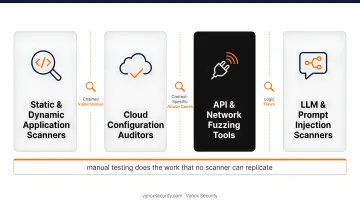
Each tool covers a defined role in the workflow. The gaps between them — chained vulnerabilities, context-specific abuse cases, and logic flaws — are where manual testing does the work that no scanner can replicate.
Limitations and When to Go Beyond Black Box
The Coverage Misconception
The most common misconception about black box testing: it covers everything because it "tests like a real hacker." It doesn't. A real attacker has unlimited time. A pentest engagement has a defined window. Coverage is bounded by scope and hours — testers may not find every externally reachable vulnerability in a large application with dozens of API endpoints.
What Black Box Cannot Find
Some vulnerability classes are structurally invisible to a black box tester:
- Insecure cryptographic implementations in server-side code
- Hardcoded secrets in application logic
- Race conditions in asynchronous operations
- Internal misconfigurations not exposed externally
These require gray box or white box testing to surface.
When to Combine Methods
Consider a layered approach when:
- Preparing for SOC 2 or ISO 27001 audits where auditors expect authenticated testing of internal controls
- Launching applications with significant custom business logic
- Deploying AI-powered web applications where the attack surface extends to LLM interfaces, RAG query endpoints, and agent action APIs
That last scenario is where AI-specific testing becomes essential alongside conventional coverage. Vynox Security's assessments address both in a single engagement: full OWASP Top 10 coverage alongside prompt injection testing, RAG pipeline security, and agent action API testing, with findings consolidated into one report.
A Warning Sign to Watch For
An organization running only annual black box tests — with no authenticated testing, no code-level review, and no API documentation shared with the tester — is likely leaving critical internal attack paths unvalidated. That's not a failure of black box testing. It's a failure to choose the right testing method for the job.
Frequently Asked Questions
What is the difference between black box and gray box web application penetration testing?
Gray box testing gives the tester partial knowledge — typically credentials to access authenticated functionality and sometimes API documentation. Black box provides nothing beyond the target URL. Gray box finds more vulnerabilities per hour of testing but less accurately simulates a fully external attacker with zero prior access.
What information does a tester need to begin a black box web app pentest?
Typically only the target URL and a signed scope and authorization agreement. The tester derives everything else — tech stack, endpoints, API structure — through reconnaissance and scanning. That derivation process is the defining characteristic of the methodology.
Which vulnerabilities does black box web application pentesting commonly find?
Authentication weaknesses, SQL injection and XSS in input fields, IDOR and broken access control in API endpoints, security misconfigurations (exposed admin panels, default credentials, verbose error messages), and outdated or vulnerable third-party libraries identifiable from HTTP response headers.
How long does a black box web application penetration test typically take?
Most engagements take one to three weeks depending on application size and API endpoint count. Vynox's standard web application pentest covering up to 20 endpoints typically delivers in 5–10 business days, compared to the 4–8 week timelines common at traditional firms.
Is black box web app pentesting sufficient for SOC 2 or ISO 27001 compliance?
Black box testing produces compliance-relevant evidence of external security validation — PCI-DSS explicitly requires it. SOC 2 and ISO 27001 don't mandate it explicitly, but auditors typically expect it alongside authenticated testing of internal controls. Confirm the required scope and evidence format with your auditor before assuming black box alone is sufficient.
How often should organizations conduct black box web application penetration tests?
At minimum annually, but teams shipping frequently should test after major releases, significant architecture changes, or new externally facing functionality. Continuous testing via PTaaS serves fast-moving teams better than annual point-in-time assessments. Vynox's PTaaS model aligns testing to development sprints with same-day retest verification when fixes reach staging.