"Internal pen testing" gets thrown around a lot, but its scope, methodology, and actual findings are widely misunderstood. This article breaks down what internal penetration testing really is, why it matters, exactly how it's performed step-by-step, and where it falls short.
Key Takeaways
- Simulates an attacker who already has insider access or a breached perimeter
- Targets lateral movement, privilege escalation, and internal misconfigurations, not perimeter defenses
- Follows six stages: planning, reconnaissance, exploitation, privilege escalation, documentation, and remediation
- Common techniques include NTLM relay, Kerberoasting, and Active Directory misconfigurations
- Traditional internal testing skips AI-specific surfaces like LLMs and RAG pipelines, which need specialized methods
What Is Internal Penetration Testing?
Internal penetration testing is a controlled, ethical simulation of an attacker who already has a foothold inside the network, whether through a compromised account, an infected device, or physical access to a workstation. The tester's job is to escalate that foothold and reach sensitive systems, exactly the way a real intruder would.
The goal is to establish a realistic "blast radius": what an attacker could actually see, touch, or destroy once inside, regardless of how they got there.
This is different from vulnerability scanning. A scanner flags known weaknesses and moves on. Internal penetration testing manually chains those weaknesses together to prove real-world impact, showing a single misconfigured share turning into full domain compromise, for example.
Internal vs. External Penetration Testing
The core difference comes down to starting position:
| Aspect | External Testing | Internal Testing |
|---|---|---|
| Starting point | Outside the network, attacking via the internet | Already has network access (compromised account, device, or physical access) |
| Primary targets | Firewalls, VPNs, public-facing web applications | Lateral movement paths, privilege escalation, trust relationships between systems |
| Attacker profile simulated | Anonymous external hacker | Insider threat, phished employee, or malware-infected endpoint |
Security best practice is to run both. Many organizations still test their external perimeter more consistently than their internal network, which leaves a blind spot: a hardened perimeter means nothing if a single phished employee can move freely once inside. Running internal and external assessments together gives a complete picture of what an attacker can do from either direction.
Why Internal Penetration Testing Matters
Internal attacks tend to cause more damage than external ones, simply because internal networks expose far more systems, trust relationships, and sensitive data to a single compromised account. An external attacker hitting a login page faces one wall. An attacker who's already inside faces almost none.
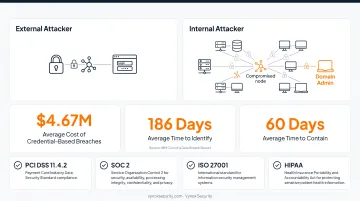
The numbers back this up. Breaches involving compromised credentials averaged $4.67 million and took 186 days to identify and another 60 days to contain, according to IBM's Cost of a Data Breach Report. The same research found malicious-insider breaches carried an even higher average cost.
Compliance is catching up to this reality too. Internal penetration testing is increasingly expected or explicitly required under:
- PCI DSS (Requirement 11.4.2 mandates internal testing at least every 12 months and after significant changes)
- SOC 2 (as evidence of independent security testing supporting Trust Services Criteria)
- ISO 27001 (as risk-based evidence within the information security management system)
- HIPAA (as part of periodic technical evaluation of ePHI security)
Without internal testing, the usual culprits go unchecked: unpatched internal services, weak SMB and authentication configurations, and Active Directory misconfigurations that let one weak login snowball into domain admin access. These attack paths define the default state of most untested networks.
How Internal Penetration Testing Is Done: Step-by-Step Process
The process moves in one direction: from understanding the environment, to actively exploiting weaknesses, to proving impact, to reporting and fixing. It mirrors exactly how a real attacker would operate once they're past the perimeter.
Step 1: Planning and Scoping
The team and client define the assumed-breach scenario before any testing begins:
- Black box – tester starts with no account or internal knowledge
- Gray box – tester starts with a standard user account, modeling a typical phished employee
- White box – tester starts with full internal knowledge, useful for deep architecture reviews
This stage also locks in target systems, rules of engagement, and objectives. A scoping call at this point determines which scenario fits the client's risk profile and compliance needs. Vynox Security offers a free 30-minute version of this call at cal.id/karan-singh.
Step 2: Reconnaissance and Network Discovery
Testers map the internal network: enumerating exposed services, identifying Active Directory structure, and passively listening for weak protocols. Common findings at this stage include LLMNR and NBT-NS name resolution requests answered by unauthorized hosts, and SMB traffic that isn't signed, both of which open the door to credential interception later in the engagement.
Step 3: Vulnerability Identification and Exploitation
This is where theory becomes proof. Testers exploit unpatched services, capture and relay authentication requests (NTLM relay being the classic example), attempt password spraying against exposed accounts, and probe misconfigured services that require no authentication at all.
Often, this stage reveals how quickly a single weak configuration hands over valid credentials without the victim ever noticing. One unsigned SMB connection can be enough.
Step 4: Privilege Escalation and Lateral Movement
With a foothold established, testers work to climb higher. Common techniques include:
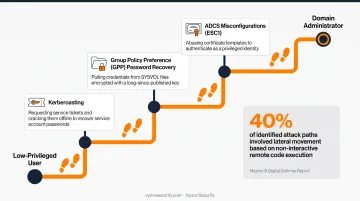
- Kerberoasting – requesting service tickets and cracking them offline to recover service account passwords
- Group Policy Preference (GPP) password recovery – pulling credentials from SYSVOL files encrypted with a long-since-published key
- ADCS misconfigurations (such as ESC1) – abusing certificate templates to authenticate as a privileged identity
Microsoft's own research found that 40% of identified attack paths involved lateral movement based on non-interactive remote code execution, according to the Microsoft Digital Defense Report. Testers document each attack path as they go, showing exactly how far a real attacker could travel, low-privileged user to domain administrator, step by step.
Step 5: Documentation and Reporting
Findings get compiled with reproduction steps, risk ratings, and business impact. Quality reporting doesn't just dump raw vulnerability data. A well-built report includes an executive summary for leadership, technical findings with evidence, CVSS scores, and developer-ready remediation guidance that engineers can act on without a translation layer.
Step 6: Remediation and Retesting
Fixes get verified through retesting. Mature security programs treat this as a continuous cycle, not a once-a-year checkbox. Vynox Security's model, for instance, verifies fixes the same day engineers push them to staging rather than waiting for the next scheduled test window, which keeps remediation from stalling.
Key Factors, Common Misconceptions, and When It May Not Be Enough
Key Factors That Affect Internal Pen Test Results
Results depend heavily on three variables:
- Active Directory complexity – larger, older AD environments tend to accumulate more misconfigurations over time
- Testing scenario – black, gray, or white box access changes how much ground the test can cover
- Scope – which systems are included, and which are quietly excluded
Beyond these three factors, tester experience matters more than most buyers realize. Modern attack techniques like NTLM relay chains and Kerberos abuse require testers who actively track how these methods evolve. A tester running the same playbook from three years ago will miss what a current attacker would find in an afternoon.
Common Misconceptions About Internal Pen Testing
Two assumptions cause the most trouble.
"It's the same as vulnerability scanning." It isn't. Scanning identifies known weaknesses automatically, while internal penetration testing manually chains those weaknesses into proven, exploitable impact.
"A secure perimeter means we don't need this." Most breaches today start with a compromised credential or an insider, not a firewall bypass. A secure front door doesn't say anything about what happens once someone's already through it.
When Internal Pen Testing Alone May Not Be Enough
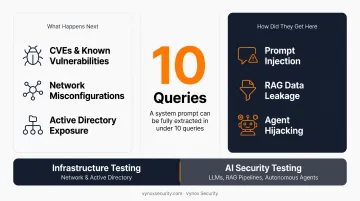
Internal testing doesn't replace external testing or red teaming, and it doesn't explain how an attacker first got in. It answers "what happens next," not "how did they get here."
There's also a coverage gap that's easy to miss: traditional internal pen testing methodologies were built for CVEs, network misconfigurations, and Active Directory, not for LLMs, RAG pipelines, or autonomous agents. A system prompt can be fully extracted in under 10 queries, and that kind of exploit is invisible to a CVE scanner or a conventional network test.
Organizations running AI-powered products need testing built specifically for that surface, covering prompt injection, RAG data leakage, and agent hijacking, alongside their standard infrastructure testing. Providers like Vynox Security run both layers, testing the network and Active Directory environment while also covering AI-specific attack paths that a traditional pentest firm simply isn't scoped to find.
Conclusion
Internal penetration testing simulates an attacker who already has a foothold, showing exactly what damage is possible through lateral movement and privilege escalation. Understanding this process matters because insider threats and compromised credentials are now leading causes of major breaches, and compliance frameworks increasingly expect this level of proof rather than a checkbox scan.
Applied correctly, internal testing works alongside external testing, AI-specific testing where relevant, and a continuous rather than once-a-year cadence. Organizations weighing which combination fits their environment can book a free scoping call with Vynox Security to work through the details before committing to an engagement.
Frequently Asked Questions
What is internal penetration testing?
It's a simulated attack conducted from the perspective of someone who already has network access, aimed at identifying what damage or data exposure is possible from that foothold. It focuses on impact, not entry.
What is the difference between internal and external penetration testing?
External testing targets perimeter defenses from an outsider's perspective, such as firewalls and public-facing applications. Internal testing assumes access already exists and focuses on lateral movement and privilege escalation.
What are the three types of penetration testing?
Black box (no prior knowledge or access), gray box (standard user-level access), and white box (full internal knowledge). The choice depends on which attacker scenario the organization wants to model.
How long does an internal penetration test take?
Most internal pen tests take anywhere from a few days to a couple of weeks, depending on network size and scope. Vynox Security's infrastructure engagements typically run 5-15 business days, compared to the 4-8 week timelines common at traditional firms.
How much does internal penetration testing cost?
Pricing varies based on network size, scope, and tester experience, with no fixed industry benchmark. Transparent, stage-appropriate pricing models exist for organizations ranging from early-stage startups to enterprises, usually confirmed during a scoping call.
How often should internal penetration testing be performed?
At least annually, and PCI DSS explicitly requires it every 12 months plus after significant changes. Organizations undergoing frequent infrastructure or application changes should consider continuous testing aligned with development sprints rather than a single yearly test.