But here's the problem: most pentesting firms still test GCP like it's AWS with a different logo. They miss IAM hierarchy flaws, service account impersonation paths, and exposed metadata servers that are unique to how Google Cloud actually works.
This guide breaks down what GCP penetration testing really is, what should be in scope, the exact methodology testers use, the tools involved, and how to pick a partner who won't just run a scanner and call it a day.
Key Takeaways
- Misconfiguration drives 30% of cloud security incidents, so audit IAM and storage first.
- GCP's hierarchical IAM (Org > Folder > Project > Resource) opens escalation paths that flat AWS/Azure models lack.
- Metadata server abuse remains a top privilege-escalation technique testers must specifically validate
- AI workloads like Vertex AI and RAG pipelines need testing scope beyond traditional cloud pentests
- You don't need Google's approval to test your own projects, but AUP limits still apply.
What Is Google Cloud Penetration Testing?
Google Cloud penetration testing is the ethical simulation of real-world attacks against your GCP-hosted assets — IAM roles, GKE clusters, Cloud Functions, storage buckets, and Compute Engine instances. The goal is to prove what an attacker could actually do with a real foothold, not just catalog theoretical issues.
Pentesting vs. Vulnerability Scanning
These terms get used interchangeably, and that's a mistake. Automated vulnerability assessment flags known misconfigurations against a checklist. Penetration testing goes further, using manual and hybrid exploitation to chain smaller weaknesses into real business impact.
A scanner might flag an over-permissioned service account. A tester will show you exactly how that account gets used to move laterally into a production project holding customer data.
The Misconfiguration Problem
Google's own Cloud Threat Horizons report found misconfiguration was the initial-access vector in 29.4% of observed cloud incidents in H1 2025, second only to weak or absent credentials at 47.1%. Separately, Unit 42 research found that 99% of cloud users, roles, services, and resources carried unused excessive permissions, a baseline of unnecessary risk sitting in most environments.
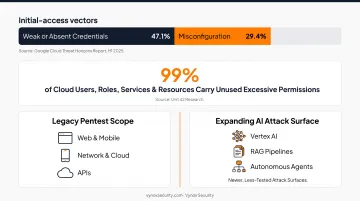
As teams push more workloads onto Vertex AI and build RAG pipelines, the traditional pentest scope has to expand too. These are newer, less-tested attack surfaces, and most legacy testing checklists simply weren't built with them in mind.
How GCP Pentesting Differs from AWS, Azure & Traditional Testing
Google secures the underlying infrastructure. You're responsible for IAM configuration, data protection, and how your resources are set up. That's the shared responsibility model, and it shifts weight onto customers as you move from IaaS toward SaaS-style managed services.
Where GCP gets genuinely tricky is its IAM hierarchy:
- Organization sits at the top, with policies cascading downward
- Folders (optional) group projects by team, department, or environment
- Projects hold the actual resources
- Resources inherit permissions from every ancestor above them
A resource's effective permissions are the union of its own policy plus everything inherited from folders and the organization. That inheritance creates a blind spot AWS and Azure don't share in quite the same way:
| Cloud Platform | IAM Structure | Common Blind Spot |
|---|---|---|
| GCP | Organization → Folders → Projects → Resources (full inheritance) | Missed grants set two or three levels up the hierarchy |
| AWS | Flatter account/organization model | Cross-account role assumptions overlooked |
| Azure | Management groups → Subscriptions → Resource groups | Subscription-level policy overlap |
This complexity also means most security tooling built for AWS doesn't translate cleanly. GCP requires purpose-built tools like GCPBucketBrute and ScoutSuite. Testers also need to understand service account impersonation and how lateral movement works across GCP projects.
Rules & Permissions: Is GCP Penetration Testing Allowed?
Yes, with conditions. Google's guidance is direct: you don't need to notify Google before pentesting your own project, as long as testing complies with the Acceptable Use Policy and Terms of Service.
What's restricted:
- Testing resources you don't own or control
- Denial-of-service or stress testing beyond normal usage limits
- Social engineering or phishing aimed at Google-managed infrastructure
When you need explicit permission:
Managed services like Apigee have their own security testing procedures. If you're planning stress, load, or penetration tests against Apigee, you'll need to file a support request and get approval before starting. The general "no notification needed" rule doesn't cover it.
Scope & Top Vulnerabilities in GCP Environments
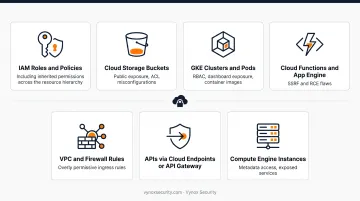
A solid GCP pentest should cover:
- IAM roles and policies: including inherited permissions across the resource hierarchy
- Cloud Storage buckets: public exposure, ACL misconfigurations
- GKE clusters and pods: RBAC, dashboard exposure, container images
- Cloud Functions and App Engine: SSRF and RCE flaws
- VPC and firewall rules: overly permissive ingress rules
- APIs via Cloud Endpoints or API Gateway
- Compute Engine instances: metadata access, exposed services
The Metadata Server Risk
This one deserves special attention. Every Compute Engine instance can query a metadata server at 169.254.169.254 for configuration data, including service account tokens. If an attacker gains SSRF or RCE access, that endpoint becomes a direct path to stealing credentials.
Google now requires a Metadata-Flavor: Google header on metadata requests, which closes off classic SSRF techniques that worked against older configurations. Testers still need to verify this control is actually enforced rather than assuming it by default.
GKE and Container Risks
Beyond individual VM instances, Kubernetes environments introduce their own failure modes. Weak RBAC policies, an exposed dashboard, or unscanned container images can all hand an attacker a path to cluster-wide access. Google recommends least-privilege RBAC and Workload Identity Federation specifically because overbroad cluster-admin bindings remain one of the most common findings in GKE reviews.
Expanding Scope: AI Workloads on GCP
Organizations running LLMs, RAG pipelines, or Vertex AI models introduce attack surfaces a traditional cloud pentest scope simply doesn't touch:
- Prompt injection: direct and indirect, including injection through documents fed into a RAG pipeline
- Model and data extraction: pulling training data or replicating model behavior
- Insecure AI-facing APIs: broken authorization on endpoints serving model predictions
NIST's adversarial machine learning taxonomy formally categorizes these as prompt injection, prompt extraction, model extraction, and poisoning attacks. These are distinct risk classes that generic cloud scanners were never designed to catch, which is exactly where AI-native testing providers add value that traditional firms can't.
Typically out of scope: Google-managed infrastructure internals (BigQuery internals, Cloud Spanner backends) and resources belonging to other tenants.
GCP Penetration Testing Methodology: Step-by-Step
A proper GCP engagement follows a structured path:
- Reconnaissance: Mapping APIs, domains, storage buckets, and IP ranges using OSINT and passive scanning that avoids tripping alerts.
- Threat modeling: Identifying likely attack paths for your specific architecture, such as an IAM role tied to a sensitive Cloud Function.
- Vulnerability identification: Combining automated scanning with manual testing to uncover insecure storage permissions, over-privileged service accounts, leaked secrets, and SSRF/RCE flaws.
- Exploitation and privilege escalation: Ethically demonstrating impact through service account token theft, IAM privilege escalation chains, and lateral movement across projects.
- Reporting and remediation: The report should include:
- Proof-of-concept evidence for every verified finding
- Severity ratings based on business impact, not just technical scoring
- Step-by-step fixes your developers can implement directly
- Compliance mapping to frameworks like SOC 2 or ISO 27001
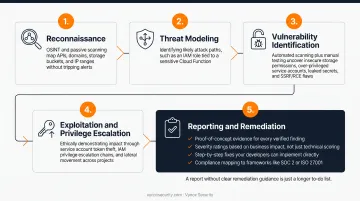
That last step matters more than most people realize: a report without clear remediation guidance is just a longer to-do list.
Vynox Security pairs every GCP finding with developer-ready fixes and direct mapping to SOC 2 and ISO 27001 controls, turning findings into an actionable remediation roadmap.
Tools Commonly Used in GCP Pentesting
Different tools solve different problems. No single scanner covers IAM, network, and application layers at once.
| Tool | Role | Layer Tested |
|---|---|---|
| ScoutSuite | Multi-cloud security posture auditing | IAM, storage, network config |
| Prowler | Compliance and security checks | IAM, config, compliance controls |
| GCPBucketBrute | Storage bucket enumeration and access testing | Cloud Storage |
| Burp Suite | Web app and API interception/scanning | Application layer |
| Nmap | Network discovery and port scanning | Network |
| Metasploit | Exploit validation | Authorized hosts and services |
Automated tools deliver speed and broad coverage — they'll flag a public bucket in seconds. What they won't do is chain that public bucket into a full privilege escalation path, or figure out that a "low severity" IAM grant actually opens a route to admin access three projects away. That's where manual testing earns its keep. Vynox Security pairs automated scans with hands-on GCP exploitation testing to catch chained risks that scanners miss.
Choosing the Right GCP Penetration Testing Partner
Not every firm that claims cloud expertise actually has it. Here's what to look for:
- Proven GCP-specific expertise: can they explain IAM hierarchy, GKE hardening, and Cloud Functions risks without generic answers?
- Compliance alignment: mapping to SOC 2, ISO 27001, or other frameworks your auditors expect
- Hybrid testing approach: automated scanning plus manual exploitation, not one or the other
- Fast retest turnaround: a testing cadence that keeps pace with your sprint cycles, not a once-a-year audit that's outdated by the time it's delivered
This last point matters more as teams ship faster. A pentest report from six months ago tells you nothing about the IAM role your engineer added last sprint.
This is the gap Vynox Security was built to close. Vynox's Cloud Security Testing service covers GCP alongside AWS and Azure, with scope that includes:
- IAM privilege escalation path mapping
- Public exposure review of storage and snapshots
- Network configuration analysis
- Secrets management review
- AI workload isolation testing, which matters directly for teams running model pipelines on GCP since a single misconfigured bucket can leak model weights and training data alongside customer data
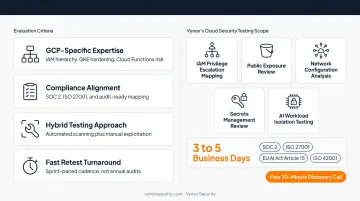
Cloud engagements typically deliver in 3 to 5 business days, with findings mapped to SOC 2, ISO 27001, EU AI Act Article 15, and ISO 42001 requirements depending on what your compliance program needs. For teams also running LLMs or RAG pipelines on GCP, Vynox tests both layers in one engagement rather than requiring a separate AI security vendor.
If you want to see how your specific GCP environment scopes out, Vynox offers a free 30-minute discovery call where the team reviews your architecture and provides indicative timelines and pricing before you commit to anything.
Frequently Asked Questions
What is cloud penetration testing?
Cloud penetration testing simulates real attacks against cloud-hosted assets to uncover exploitable misconfigurations and access flaws. Unlike traditional on-premise testing, it must account for shared responsibility models and provider-specific controls like IAM.
What is SIEM in GCP?
SIEM stands for Security Information and Event Management. In GCP, Security Command Center, Chronicle SIEM, and Cloud Logging provide centralized threat detection that complements, but doesn't replace, penetration testing.
How much does a GCP penetration test cost?
Cost depends on scope, project complexity, and whether compliance reporting like SOC 2 or ISO 27001 mapping is required. Most providers scope pricing after a discovery call rather than publishing a flat rate.
How long does a GCP pentest take?
Most engagements run 5 to 15 business days depending on environment complexity. Some providers, including Vynox, deliver standard cloud engagements within 3 to 5 business days.
Do I need Google's permission before running a pentest on my GCP project?
No prior approval is needed to test your own resources under the Acceptable Use Policy. Permission is required for shared or commercial managed services like Apigee.
Is GCP penetration testing required for SOC 2 or HIPAA compliance?
It isn't strictly mandatory by name in either framework, but auditors increasingly expect it as evidence that security controls actually work, not just that they exist on paper.