Introduction
Compliance frameworks used to be satisfied with a vulnerability scan and a checkbox. Not anymore. SOC 2, ISO 27001, HIPAA, and PCI DSS auditors increasingly want proof that someone actively tried to break into your systems, not just proof that you ran a scanner against them.
Here's the common pain point: security and compliance teams rarely know which framework actually requires a pentest. They're just as unsure how often it needs to happen, or what the resulting report has to contain before an auditor will accept it.
That confusion costs time. It delays audits, and sometimes fails a customer's vendor security review at the worst possible moment.
This guide breaks pentesting compliance down framework by framework. It covers realistic testing frequency and lists what a report must include to survive an audit. It also explains how to pick a testing partner who speaks the language auditors use.
Key Takeaways
- Only PCI DSS mandates penetration testing explicitly; others treat it as supporting evidence.
- Annual testing is the baseline, with retesting required after major infrastructure changes.
- Auditors reject reports lacking retest verification or clear control mapping.
- HIPAA's rules may tighten soon: a 2024 proposal would mandate annual pentesting.
- AI-native companies face a new gap: traditional pentests rarely cover LLMs, RAG pipelines, or AI agents.
What Is Pentesting Compliance and Why It Matters
Pentesting compliance means running controlled, adversarial security tests specifically to satisfy a regulatory or industry standard's requirement to find and fix exploitable vulnerabilities. It's not the same as general security testing: the scope, documentation, and reporting all need to trace back to a specific control an auditor can point to.
Auditors care about this because a pentest is evidence that controls work under attack conditions, not just evidence that they exist on paper. A firewall policy document proves nothing if nobody has tried to get past the firewall.
A pentest report showing an attempted breach, and what happened when it was attempted, is a different class of proof.
The Regulatory Direction Is Only Tightening
That standard for proof is exactly what regulators are now writing into policy, and momentum isn't slowing down.
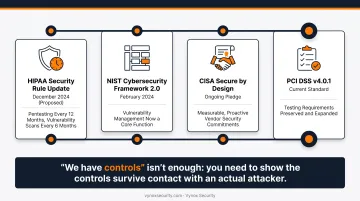
Under a proposed HIPAA Security Rule update from December 2024, HHS would require covered entities to run penetration testing at least every 12 months and vulnerability scanning every six months — a rule that doesn't exist yet, but signals where regulators are heading.
Meanwhile:
- NIST's Cybersecurity Framework 2.0 (February 2024) formalized vulnerability identification and management as a core function.
- CISA's Secure by Design pledge pushes measurable, proactive security commitments from software vendors.
- PCI DSS v4.0.1 preserved and expanded its testing requirements rather than relaxing them.
None of this is a coincidence. Regulators are converging on the idea that "we have controls" isn't enough: you need to show the controls survive contact with an actual attacker.
Who Needs Penetration Testing for Compliance?
Three groups run into this requirement most often:
- Regulated industries: finance, healthcare, and government entities, where sector-specific rules (or their auditors) expect independent security testing as standard practice.
- Any organization handling customer or cardholder data: even outside PCI DSS's direct scope, storing sensitive data invites contractual and regulatory scrutiny.
- Vendors and service providers: security obligations written into customer contracts increasingly require an annual pentest report as a condition of doing business.
SaaS and AI companies pursuing SOC 2 or ISO 27001 fall into a slightly different bucket. Neither framework hard-mandates a pentest, but in practice, enterprise customers and auditors expect one anyway. It's become the default way to demonstrate a working vulnerability management program, even when the framework's language is technically flexible.
Common misconception: Third-party testing isn't always a strict legal requirement. In most frameworks, it's simply the most credible way to satisfy a broader control. Auditors accept it because it's harder to fake than a checklist, not because a rule mandates an outside tester.
Penetration Testing Requirements Across Major Compliance Frameworks
Requirements vary a lot by framework. Some name a fixed cadence. Others fold pentesting into a broader risk-management control and leave the specifics to your auditor's judgment. A compliance-ready pentest has to be scoped to whichever control language actually applies.
SOC 2
SOC 2 has no hard pass/fail pentest requirement. The Trust Services Criteria (specifically CC7.1) require you to identify and evaluate vulnerabilities, but nearly every auditor accepts an annual third-party pentest report as evidence that this control functions in practice.
Timing matters more than most teams realize:
- Type 1 reports on control design at a single point in time, so a pentest from anywhere in the prior 12 months typically works.
- Type 2 reports on operating effectiveness across the entire audit period, meaning your pentest evidence needs to fall within that window, not just be recent.
Auditor expectations vary by firm, so confirm directly with yours before assuming a prior test will be accepted.
ISO 27001
ISO/IEC 27001:2022 Annex A control 8.8 requires organizations to identify, evaluate, and remediate technical vulnerabilities. It doesn't name penetration testing specifically, but it's a widely accepted way to satisfy this control.
The certification cycle runs three years, with surveillance audits in years one and two before recertification in year three. In practice, that means pentest evidence needs refreshing at least annually to stay audit-ready across the full cycle.
HIPAA
HIPAA's Security Rule doesn't currently name "penetration testing" anywhere. What it does require, under 45 CFR 164.306(a)(2), is protection against reasonably anticipated threats to ePHI — a standard pentesting directly supports.
Scope matters here: testing needs to cover every system that stores, processes, or transmits ePHI, and findings should feed directly into the risk assessment documentation HIPAA already requires. That said, remember the proposed rule mentioned earlier would make this explicit and mandatory. It isn't law yet, so don't tell an auditor pentesting is "required" under current HIPAA text. It isn't, technically.
PCI DSS
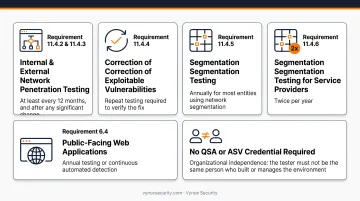
PCI DSS is the one framework with a genuinely explicit mandate. Requirement 11.4 of PCI DSS v4.0.1 requires:
- Internal and external network penetration testing at least every 12 months, and after any significant change (11.4.2 and 11.4.3)
- Correction of exploitable vulnerabilities followed by repeat testing to verify the fix (11.4.4)
- Segmentation testing annually for most entities using network segmentation to reduce scope (11.4.5)
- Segmentation testing twice per year specifically for service providers (11.4.6)
Requirement 6.4 separately covers public-facing web applications, either through annual testing or a continuous automated detection solution.
One clarification: PCI DSS doesn't require the tester to hold a QSA or ASV credential. What it requires is organizational independence: the person testing your environment shouldn't be the same person who built or manages it.
How Often Should You Run a Compliance Pentest?
Most frameworks converge on the same floor: annual testing at minimum, with additional testing whenever something significant changes in your environment.
| Framework | Fixed minimum cadence | Change-triggered testing |
|---|---|---|
| SOC 2 | None specified | When needed to support the audit period |
| ISO 27001 | None specified | Risk-based, when exposure changes |
| HIPAA (current) | None specified | Update risk analysis after operational changes |
| PCI DSS | Annual (twice yearly for service provider segmentation) | After significant infrastructure/application changes |
What Counts as a "Significant Change"
Across frameworks, this generally includes:
- New payment integrations or processing flows
- Cloud migrations or infrastructure overhauls
- Major feature releases that touch authentication, data flow, or access control
- New system components introduced into a previously tested environment
PCI DSS makes this explicit, requiring re-testing after any segmentation change that could affect the cardholder data environment's boundaries. SOC 2 and ISO 27001 leave the timing to your judgment, but auditors increasingly expect the same discipline even without a written mandate.
Waiting for your next scheduled audit cycle to test these changes creates a real exposure window. A vulnerability introduced in March doesn't wait politely for your November recertification.
The Shift Toward Continuous Testing
This is where PTaaS (Penetration Testing as a Service) models are gaining ground, particularly for fast-moving SaaS and AI products. Instead of one annual snapshot, testing aligns with sprint cycles and model updates — catching vulnerabilities in the same release cycle they're introduced, not months later.
Vynox Security's PTaaS approach works this way: testing triggers off development events, like a sprint release or a model update, rather than a calendar date. Fixes pushed to staging get retested the same day. For teams shipping AI features weekly, that cadence closes a gap an annual pentest simply can't.
What a Compliance-Ready Pentest Report Must Include
A technically solid pentest report can still fail an audit if it's missing the right structure. Auditors expect specific sections, and reports that skip them create friction, or get rejected outright.
Non-negotiable sections:
- Executive summary: a leadership-facing overview of scope and risk posture
- Scope and methodology: what was tested, how, and under what constraints
- Findings with severity ratings: typically CVSS-based, ranked critical through low
- Remediation guidance: specific, actionable, tied to the actual finding
- Retest and verification status: proof that fixes were confirmed, not just recommended
Findings also need to be explicitly mapped to the relevant framework's control language. A report that says "SQL injection found in login endpoint" is fine for engineers, but auditors need that same finding tied to specific control language:
| Framework | Control Reference |
|---|---|
| SOC 2 | CC7.1 |
| ISO 27001 | Annex A.8.8 |
| PCI DSS | Requirement 11.4 |
Skip this mapping, and someone on your team ends up manually translating technical jargon into audit language, work that eats days you probably don't have.
A frequent audit-blocker: reports that document initial findings but never show documented retesting of critical or high-severity issues. Auditors treat unverified fixes as unresolved risk, full stop. The finding stays open in their eyes, regardless of what your engineering team believes was fixed.
This is why Vynox builds every compliance-ready report around CVSS scoring, reproduction steps, evidence screenshots, and remediation guidance mapped directly to SOC 2 and ISO 27001 control evidence requirements, all in one document. Auditors and engineers read the same file, with no translation step in between.
Choosing a Penetration Testing Partner for Compliance
Not every pentest vendor understands compliance evidence. Some deliver a dense technical report that's accurate but useless for an auditor without significant rework. A few things separate a compliance-capable partner from one that just tests infrastructure.
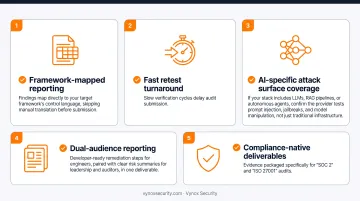
Look for these five things:
- Framework-mapped reporting: Findings map directly to your target framework's control language, skipping manual translation before submission.
- Fast retest turnaround: Slow verification cycles delay audit submission. Vynox, for example, offers same-day retesting once a fix hits staging.
- AI-specific attack surface coverage: If your stack includes LLMs, RAG pipelines, or autonomous agents, confirm the provider tests prompt injection, jailbreaks, and model manipulation, not just traditional infrastructure.
- Dual-audience reporting: Developer-ready remediation steps for engineers, paired with clear risk summaries for leadership and auditors, in one deliverable.
- Compliance-native deliverables: Some providers, including Vynox, package evidence specifically for SOC 2 and ISO 27001 audits, skipping the back-and-forth of translating findings into audit language.
The right partner shortens the distance between "we ran a test" and "our auditor accepted the evidence." If you're evaluating options, a discovery call is usually enough to confirm whether a provider's reporting format and turnaround actually fit your audit timeline.
Frequently Asked Questions
What is required to be a pen tester?
Certification isn't always mandatory, but most professional pen testers hold credentials like OSCP, CompTIA PenTest+, or CEH. These are typically combined with hands-on experience in networking, scripting, and exploitation techniques.
How much does a pen test usually cost?
Pricing varies widely based on scope, target complexity, and testing methodology (black, gray, or white box). Flat industry averages can be misleading, so request a scoped quote based on your specific environment.
Do I legally need a penetration test to be compliant?
Only PCI DSS explicitly mandates it. SOC 2 and ISO 27001 treat pentesting as the most credible way to satisfy a broader vulnerability management requirement, not a rigid legal obligation.
Is a vulnerability scan the same as a penetration test for compliance purposes?
No. Automated scanning identifies known weaknesses, while manual penetration testing validates whether those weaknesses are exploitable in a real attack. Most frameworks treat these as separate, complementary activities.
Can I use an internal team instead of a third-party pentester for compliance?
Some frameworks, including PCI DSS, allow internal testing if organizational independence exists between the tester and system owner. Auditors generally prefer third-party testing for its credibility and depth of evidence.
How long does a compliance pentest report stay valid?
Most frameworks expect annual refreshes at minimum. Significant system or infrastructure changes require additional testing, regardless of when the last report was issued.