
This matters for any organization building or maintaining a web app — especially AI-powered SaaS platforms, healthcare portals, and fintech products under compliance pressure. A single overlooked flaw, like broken authentication, can expose customer data and trigger a breach notification nobody wants to write.
Despite being widely referenced, most teams don't actually know what happens during an engagement — the specific steps, methods, and decisions testers make along the way. This guide breaks down the exact steps, methodologies, and tools used in a professional web application pentest, plus when one is warranted.
Key Takeaways
- Web app pentesting follows six stages: planning, recon, vulnerability analysis, exploitation, post-exploitation, and reporting.
- Manual testing pairs with tools like Burp Suite, SQLMap, and Nmap, mapped to OWASP Top 10 and WSTG.
- Scope extends beyond the app to APIs, user roles, cloud infrastructure, and multi-tenant boundaries.
- Testing stays legal only under a signed contract and clear rules of engagement.
- AI-powered apps add attack surface (chatbots, LLM features) that traditional pentesting often misses.
What Is Web Application Penetration Testing? (And Why It's Used)
Web application penetration testing is an authorized, simulated attack against a web app designed to identify and validate exploitable vulnerabilities in its logic, code, and configuration. The outcome is a prioritized report of confirmed vulnerabilities with remediation guidance — not just a printout of automated scan hits.
That distinction matters. Per NIST's technical guide to information security testing, vulnerability scanners identify potential weaknesses and often generate false positives that require manual validation. Penetration testing goes further: assessors mimic real-world attacks and attempt actual exploitation to confirm impact.
Scanning tells you what might be wrong. Pentesting tells you what an attacker could actually do with it.
Why Organizations Perform Web App Pentests
Compliance is a major driver. SOC 2, PCI DSS, ISO 27001, and HIPAA all factor into audit evidence requirements, though the specifics vary:
- PCI DSS v4.0.1 explicitly mandates internal and external testing at least every 12 months and after significant application changes, using a documented, industry-accepted methodology (PCI Security Standards Council, 2024)
- SOC 2 and ISO 27001 don't mandate a fixed annual pentest cadence in their public materials, but auditors routinely expect testing evidence mapped to specific controls
- HIPAA requires periodic technical evaluation, without naming penetration testing specifically
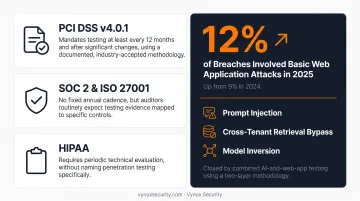
Beyond compliance, there's real urgency. Verizon's 2025 Data Breach Investigations Report found that Basic Web Application Attacks accounted for 12% of breaches, up from 9% the year prior. Without testing, flaws like broken access control or injection remain exploitable until an attacker eventually finds them.
For AI-powered businesses, testing needs to extend further still. Chatbots and LLM-integrated features introduce an attack surface most traditional pentesting firms simply don't test for, including prompt injection, cross-tenant retrieval bypass, and model inversion. This is the gap that combined AI-and-web-app testing approaches, like Vynox's two-layer methodology, are built to close.
Web Application Penetration Testing Steps: The Complete Methodology
Legitimate engagements follow the same general sequence regardless of tester or firm, moving from passive information gathering to active exploitation and finally to validated, actionable reporting. Depth and duration vary with app complexity and scope, but the order rarely changes.
Step 1: Planning and Scoping
Before any technical work begins, both parties sign a Statement of Work and Rules of Engagement. This defines in-scope URLs, user roles, testing environments (staging versus production), and the testing window. Skipping this step is how engagements end up in legal gray areas, since it's the foundation everything else depends on.
Step 2: Reconnaissance and Information Gathering
Testers map the app's architecture and technology stack using both passive and active techniques:
- Passive: Google dorking, archived-page review, subdomain enumeration
- Active: Nmap fingerprinting, HTTP header analysis, error-page inspection
The goal here is building a picture of what's actually there, not breaking anything yet.
Step 3: Vulnerability Analysis and Threat Modeling
Testers analyze everything gathered so far against the OWASP Top 10 and the Web Security Testing Guide (WSTG) checklist, flagging likely weak points: injection entry points, weak authentication flows, misconfigured headers or cookies. This step narrows a huge attack surface into a prioritized target list.
Step 4: Exploitation
This is where testers actively attempt to exploit flagged vulnerabilities: SQL injection, cross-site scripting, broken access control. This step confirms whether the flaw is genuinely exploitable and assesses the business impact it could cause, rather than just proving it exists in theory.
Step 5: Post-Exploitation
Once a tester gains initial access, they determine how far an attacker could realistically go: lateral movement, data exfiltration, persistence mechanisms. This step is what separates a real severity assessment from a guess.
Step 6: Reporting, Remediation, and Retesting
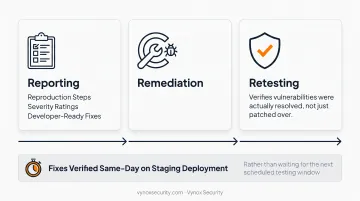
Findings get documented with reproduction steps, severity ratings, and developer-ready fixes. Then comes retesting, which verifies the vulnerabilities were actually resolved, not just patched over. Vynox, for instance, verifies fixes the same day they're pushed to staging, rather than making clients wait for the next scheduled testing window.
Common Methods and Tools Used in Web App Pentesting
Most engagements combine manual and automated testing, because each catches what the other misses. Manual testing is human-driven: testers reason through business logic flaws that no scanner would recognize as a problem.
Automated approaches (SAST, DAST, IAST) provide repeatable coverage across the codebase and running application. What they can't do is judge context or chain findings together the way a human tester can.
Core testing techniques include:
- SQL injection and other injection attacks
- Cross-site scripting (XSS)
- Authentication and session management testing
- Broken access control checks
- Business logic abuse (workflows that function as designed but produce unintended, exploitable outcomes)
| Tool | Primary Purpose |
|---|---|
| Burp Suite | Testing, finding, and exploiting web vulnerabilities |
| OWASP ZAP | Open-source web application security testing |
| Nmap | Network discovery and service/version detection |
| SQLMap | Automated SQL injection detection and exploitation |
| Metasploit | Exploit development and execution framework |
Testers rely on standardized checklists like the OWASP WSTG to ensure consistent, repeatable coverage across engagements, so results don't depend on which individual tester happens to be assigned that week. Vynox follows the same discipline: testers combine manual, expert-driven work across recon, exploitation, and reporting with AI-augmented tooling that supports human judgment without replacing it.
What Gets Tested: Scope Considerations Beyond the App Itself
A thorough pentest doesn't stop at the login page. It extends into several adjacent areas that attackers routinely target.
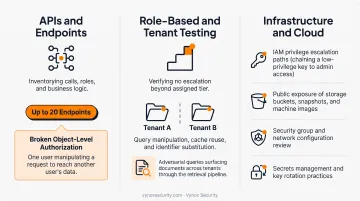
APIs and endpoints. Testers inventory how many API calls exist, what roles can access them, and what business logic each one performs. A standard engagement scope often covers up to 20 endpoints, checking for issues like Broken Object-Level Authorization , where one user can manipulate a request to access another user's data.
Role-based and tenant testing. This means assessing access from lowest-privilege to highest-privilege users, then verifying nobody can escalate beyond their assigned tier. In multi-tenant SaaS apps, testers also confirm tenant segregation holds: Tenant A genuinely cannot see Tenant B's data through query manipulation, cache reuse, or identifier substitution.
For SaaS products layering in AI-powered retrieval, this scope extends further. Testers check whether adversarial queries can surface documents belonging to other tenants through the RAG pipeline itself.
Infrastructure and cloud considerations. Server misconfigurations, exposed cloud metadata, and access key handling all fall in scope for cloud-hosted apps. Specific checks typically include:
- IAM privilege escalation paths (chaining a low-privilege key to admin access)
- Public exposure of storage buckets, snapshots, and machine images
- Security group and network configuration review
- Secrets management and key rotation practices
A single misconfigured storage bucket can expose far more than anyone expects: customer records, source code, or in AI-powered products, model weights and training data.
Common Misconceptions and Legal Considerations
A few misunderstandings come up in nearly every conversation about pentesting.
"A vulnerability scan is basically a pentest." It isn't: scanning finds potential issues automatically, while pentesting validates real exploitability through manual, human-driven attack attempts. One produces a list of maybes. The other produces confirmed, business-relevant risk.
Legality. Web application pentesting is fully legal when conducted under signed authorization and a defined rules-of-engagement document. Testing without permission is unauthorized hacking, illegal under frameworks like the US Computer Fraud and Abuse Act and the UK Computer Misuse Act. Written authorization is the entire difference between a security service and a crime.
"We tested once, we're covered." An annual test made sense when release cycles were slow, but it doesn't match how most teams ship code now.
Continuous, sprint-aligned testing fits modern CI/CD better, catching vulnerabilities introduced between annual cycles in the same sprint they're deployed rather than months later. Vynox's PTaaS model works this way, pairing sprint-aligned validation with same-day retest turnaround so security doesn't become a bottleneck to shipping.
Passing doesn't mean permanent safety. A pentest is a point-in-time assessment. New code, feature updates, or a fresh dependency can introduce vulnerabilities the day after a clean report ships.
Frequently Asked Questions
What is web application pentesting?
It's an authorized simulated attack used to find and validate exploitable vulnerabilities in a web app's design, code, and configuration. The goal is confirmed, actionable findings, not just a list of potential issues.
Is web application pentesting illegal?
It's legal when conducted under signed authorization and an agreed scope. Without that consent, the same activity constitutes illegal unauthorized access under laws like the CFAA or Computer Misuse Act.
What is the difference between API pentesting and web application pentesting?
API pentesting focuses narrowly on endpoints, tokens, and business logic behind those calls. Web app pentesting covers the full application, including frontend, backend, session handling, and infrastructure, with APIs as just one component.
How long does a web application penetration test take?
Timelines typically range from about one to several weeks depending on app complexity and scope. Modern providers, including Vynox, can deliver web application engagements in 5 to 10 business days.
What is the difference between vulnerability scanning and penetration testing?
Scanning is automated and surface-level, flagging potential issues that often need manual review. Penetration testing involves human-driven exploitation to confirm real business impact behind each finding.
How often should web applications be penetration tested?
At minimum, annually or after major releases. Continuous testing models aligned with sprint cycles are increasingly preferred for apps under active development, since they catch new vulnerabilities as code ships rather than months later.