The contract never mentioned the LLM. It never mentioned the RAG pipeline. There was no clause authorizing, or even acknowledging, adversarial testing of the model itself.
That gap isn't rare. Most pentest contract templates circulating online were written for web and network testing, long before generative AI became a core product feature. Applied to an AI-powered product, they leave scope, authorization, and liability blind spots that surface at the worst possible time: during a customer security review, or after a breach.
This article covers what belongs in a solid penetration testing contract, a sample structure to adapt, the legal considerations that make agreements enforceable, how the RFP process leads to a signed SOW, and the specific clauses AI-native companies need to add.
Key Takeaways
- A missing or vague SOW annex is the single biggest driver of scope disputes in testing contracts.
- Written authorization is mandatory, not optional: skipping it turns testing into a CFAA or Computer Misuse Act violation.
- Standard templates rarely cover LLMs, RAG pipelines, or autonomous agents, so AI companies need to add clauses.
- Legal review before signing applies even to well-known, open-source contract templates.
- Retest provisions and compliance mapping determine how fast findings actually turn into fixed code.
What Is a Penetration Testing Contract and Why It Matters
A penetration testing contract is the legally binding document that authorizes a tester to simulate attacks against specified systems. It sets the rules, protections, and expectations for both the client and the security firm before a single exploit attempt happens.
Without a signed agreement, testing isn't a security service. The same actions that make it valuable also make it a crime: accessing systems without documented authorization, regardless of intent.
The contract does two jobs at once:
- Protects the tester from unauthorized-access claims by documenting exactly what was permitted, when, and by whom
- Protects the client from scope creep, mishandled data, unexpected downtime, or a tester exceeding what was agreed
This matters more than most engineering teams assume. Plenty of dev teams shipping products, AI-powered ones included, don't have in-house security or legal counsel dedicated to vetting these agreements.
That gap makes a clear, well-structured contract essential. It functions as the primary defense against a bad engagement, well beyond a formality attached to a purchase order.
In practice, most real-world engagements combine three documents:
- A Master Service Agreement (MSA) covering the ongoing relationship terms
- A Statement of Work (SOW) specific to each testing engagement
- Often a standalone NDA protecting sensitive data uncovered during testing
Each piece plays a different role, and mixing them up is one of the most common contract mistakes we see. The next sections break down exactly what belongs in each document.
Essential Components of a Penetration Testing Agreement
Statement of Work (SOW) and Scope Definition
The SOW defines exactly what gets tested, the methods allowed, and what's explicitly excluded. Ambiguity here is the most common breeding ground for disputes.
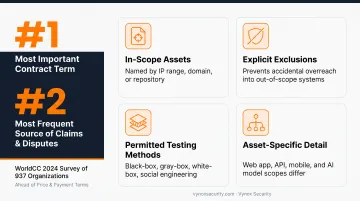
WorldCC's 2024 survey of 937 organizations found scope and specification issues rank #1 among the most important contract terms and #2 among the most frequent sources of claims and disputes, ahead of price and payment terms.
A tight SOW should specify:
- In-scope assets by name, IP range, domain, or repository
- Explicitly excluded systems, a common gap that causes accidental overreach
- Permitted testing methods (black-box, gray-box, white-box, social engineering)
- Asset-specific detail, since a web app SOW looks nothing like one for an API, a mobile app, or an AI model
Confidentiality and Non-Disclosure Terms
Beyond defining scope, NDA clauses protect data uncovered mid-test: source code, credentials, customer records. For AI companies, that list needs to expand. Proprietary training data, model weights, and system prompts are sensitive assets a generic NDA template won't name.
Data-handling terms should also define:
- How assessment evidence is stored and transmitted (encrypted, not email attachments)
- Retention periods for scan data and screenshots
- Secure destruction of evidence once the engagement closes
Authorization and Rules of Engagement
Beyond confidentiality, written authorization is what legally separates ethical testing from a crime. Under the U.S. Computer Fraud and Abuse Act and the UK's Computer Misuse Act, unauthorized access to a computer system is an offense regardless of intent.
NIST's guidance on security testing recommends finalizing documented management approval and Rules of Engagement before testing starts. Coverage should include assessor operating hours, emergency contacts, and clear instructions on whether testing halts if an incident is discovered.
The Rules of Engagement (RoE) should define:
- Testing windows (dates, times, time zones)
- Prohibited techniques, such as live DoS without prior written approval
- Emergency contacts and escalation paths
- "Kill switch" procedures for pausing or stopping a test mid-engagement
Liability, Indemnification, and Insurance
Once testing is authorized, these clauses determine who's on the hook if testing causes damage, say, a scan that knocks a production database offline. WorldCC's negotiation data ranks limitation of liability as the single most negotiated contract term overall, with indemnification close behind at #3.
Look for:
- A stated liability cap tied to contract value
- Named insurance coverage (errors & omissions, cyber liability)
- Indemnification language covering both parties, not just the client
Reporting, Deliverables, and Remediation Support
With liability addressed, deliverables should be spelled out, not implied. At minimum, expect severity-rated findings (typically via CVSS), reproduction steps, remediation guidance specific to the client's stack, and a defined retest window.
Vague deliverables, like "a report will be provided," leave room for a thin writeup that doesn't help an engineering team close anything. A contract naming the report sections upfront (executive summary, technical findings, evidence, compliance mapping) prevents that.
Payment Terms, Timeline, and Termination
Once deliverables are clear, payment structure matters as much as price. Lump-sum arrangements are simpler but riskier if scope shifts mid-engagement. Milestone-based billing tied to phases (scoping, testing, reporting, retest) spreads risk more evenly for both sides.
The contract should also lock in an agreed timeline with milestone dates, termination-without-penalty conditions for either party, and clarity on what happens to partial deliverables if the engagement ends early.
Penetration Testing Contract Template: Sample Structure and Standards to Reference
Most teams don't need to write a contract from scratch. They need a skeleton to adapt with their own SOW annex and legal counsel's input:
- Parties & Definitions — names, roles, and key terms
- Purpose/Recitals — a brief statement of why the agreement exists
- Term & Termination — engagement duration, renewal, exit conditions
- Scope — referencing the SOW as a separate annex, not embedded in the body
- Confidentiality — NDA terms and data-handling obligations
- Liability & Indemnification — risk allocation and insurance requirements
- Signatures — authorized signatories from both parties
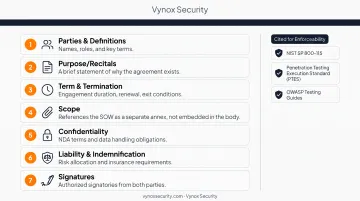
Referencing recognized standards strengthens enforceability. Citing frameworks like NIST SP 800-115, the Penetration Testing Execution Standard (PTES), or OWASP's testing guides gives both parties a shared technical baseline instead of vague language like "industry-standard testing."
Why Generic Templates Fall Short
Even with the right standards cited, a one-size-fits-all template pulled from a search result rarely accounts for the assets actually being tested. The SOW annex needs customization based on what's in scope: web, mobile, API, cloud, or an AI system with its own attack surface entirely. A contract scoped for a REST API pentest, for example, won't cover the prompt injection and model inversion testing an LLM-based product needs.
End-of-Contract Provisions
Beyond scoping the right assets, the contract needs to spell out what happens after testing wraps. Before signing, confirm it addresses:
- Refund or credit conditions if deliverables are unsatisfactory or incomplete
- How unmet obligations are resolved before final payment
- Whether handoff or renewal terms are clearly defined at close
No template, open-source or paid, replaces legal counsel, so have a lawyer review the final draft before signing. Templates are a starting point, not a substitute for legal advice.
Is Penetration Testing Legal? Key Legal Considerations
Penetration testing is legal only with explicit, documented authorization. Without it, the same technical actions become a crime.
- United States: The Computer Fraud and Abuse Act criminalizes accessing a protected computer without authorization or exceeding authorized access, regardless of intent. The Department of Justice's 2022 charging policy discourages prosecuting good-faith security research, but that's internal guidance, not statutory immunity.
- United Kingdom: The Computer Misuse Act 1990 makes it an offense to intentionally access a system without authorization, knowing that access is unauthorized.
- India: The Information Technology Act, 2000 (Sections 43 and 66) criminalizes unauthorized access to computer systems and data, with penalties scaling based on the harm caused.
A signed contract with clearly defined Rules of Engagement (RoE) keeps testers on the right side of these laws.
Data Protection and Cross-Border Considerations
Testers often encounter personal data mid-engagement, whether it's customer PII in a database or patient records on a healthcare platform. Contracts need to address how that data gets handled under GDPR for EU-connected data, CCPA for California consumer data, HIPAA for healthcare clients handling PHI, and India's DPDP Act when Indian data subjects are involved.
Engagements spanning multiple jurisdictions, or touching regulated sectors like healthcare and finance, carry extra compliance weight. A contract for a healthcare SaaS platform looks different from one for a marketing tool, and legal review becomes non-negotiable once multiple regulatory regimes overlap.
From RFP to Signed Contract: Steps of a Penetration Test Engagement
An RFP, or Request for Proposal, is the document an organization sends to prospective testing vendors. It outlines requirements, the systems in scope, and the criteria used to compare proposals before selecting a vendor.
A typical engagement moves through a predictable sequence:
- RFP or inquiry: the client shares initial requirements
- Discovery/scoping call: mapping the attack surface and testing priorities
- Proposal & SOW drafting: the vendor proposes scope, methodology, and pricing
- Contract signing: MSA, SOW, and NDA get executed
- Testing execution: the actual assessment
- Reporting: findings delivered with severity ratings and remediation guidance
- Retest/remediation verification: confirming fixes actually close the gaps
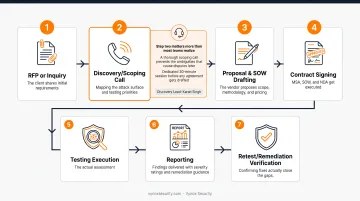
Step two matters more than most teams realize. A thorough scoping call prevents the ambiguities that cause disputes later.
Vynox Security's team, including discovery lead Karan Singh, runs this as a dedicated 30-minute session before any agreement gets drafted. The call maps the AI and infrastructure stack, flags the highest-risk areas, and recommends the right engagement tier before pricing gets discussed.
Timelines Vary Widely by Vendor Model
Traditional firms following a fixed, annual-cycle model often need 4 to 8 weeks from signed contract to final report. Vynox and other PTaaS-style providers instead structure delivery around individual service lines:
- API testing: 3–5 business days
- AI and LLM testing: 5–7 business days
- Most engagements overall: 5–15 business days
- AI Red Teaming: 3–5 weeks, reflecting its scenario-driven depth
Why AI Systems Need Specialized Contract Language
Standard pentest contracts were built around servers, endpoints, and networks. They weren't written with model weights, system prompts, training data, RAG vector stores, or autonomous agent action logs in mind, and that gap shows up exactly where it hurts most: the scope section.
Clauses AI Agreements Should Add
An AI-aware contract needs language covering:
- Data handling for prompts and training data, treating training sets, fine-tuning data, and embeddings as protected assets rather than generic customer data
- Staging vs. production model boundaries, specifying which environment is authorized for testing, since destructive techniques carry far more risk against a live agent than a sandbox
- Explicit consent for adversarial techniques, naming and authorizing jailbreak and prompt injection methods mapped to the OWASP Top 10 for LLM Applications, rather than assuming coverage under a generic testing clause
Compliance Mapping and Indemnification Clauses
Findings should tie directly to the controls auditors actually check. A contract referencing SOC 2 and ISO 27001 AI-specific control mapping upfront turns testing evidence into audit-ready material automatically, instead of leaving a compliance team to translate technical findings months later.
AI systems also raise liability questions traditional contracts never anticipated. Who's responsible if a test triggers a hallucinated output that gets logged somewhere unintended, or an autonomous agent hijacked mid-test sends an email or deletes a record it shouldn't touch? These scenarios need their own indemnification language, not a footnote under general liability.
How Vynox Approaches This
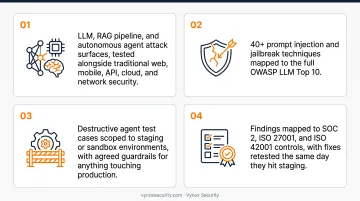
Vynox Security builds its engagements around this exact gap. Its methodology covers:
- LLM, RAG pipeline, and autonomous agent attack surfaces, tested alongside traditional web, mobile, API, cloud, and network security
- 40+ prompt injection and jailbreak techniques mapped to the full OWASP LLM Top 10
- Destructive agent test cases scoped to staging or sandbox environments, with agreed guardrails for anything touching production
- Findings mapped to SOC 2, ISO 27001, and ISO 42001 controls, with fixes retested the same day they hit staging
Frequently Asked Questions
What should be included in a penetration test agreement?
A solid agreement covers scope through the SOW, written authorization, confidentiality terms, liability and indemnification, defined deliverables, and payment terms. Skipping any one of these leaves a gap somewhere else.
What are the steps of a penetration test?
Engagements typically move from a scoping call through proposal and contract signing, then testing, reporting, and a final retest to confirm fixes worked. Scoping is where most disputes get prevented or created.
Is penetration testing legal for companies?
Yes, but only with explicit written authorization from the system owner. Laws like the U.S. Computer Fraud and Abuse Act (CFAA) and the UK Computer Misuse Act criminalize unauthorized access regardless of intent, and data protection laws still apply to anything discovered mid-test.
What is an RFP for penetration testing?
An RFP is a document a client issues to prospective vendors, outlining requirements and scope. This lets the client compare proposals before selecting a testing partner and signing a contract.
Do I need a lawyer to review my penetration testing contract?
Yes, especially for regulated industries or when adapting a generic template found online. Legal counsel catches jurisdiction-specific gaps and liability terms templates alone won't cover.
Can a standard penetration testing contract cover AI and LLM systems?
Usually not. Standard contracts rarely name model weights, training data, or prompt injection as tested assets, so AI companies need added clauses covering data handling, model scope, and compliance mapping.