What is included in a penetration test?
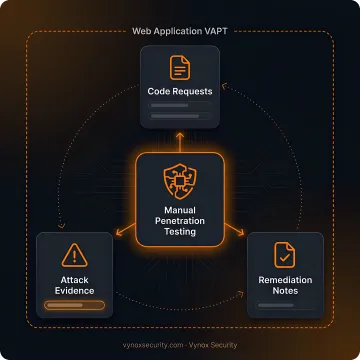
A Vynox penetration test includes manual reconnaissance, targeted exploitation attempts, validation of confirmed vulnerabilities, and a final report for technical and leadership audiences. Depending on scope, testing can cover web applications, APIs, mobile apps, cloud environments, networks, or AI systems. Each confirmed finding includes evidence, CVSS severity, reproduction steps, and developer-ready remediation guidance rather than a list of unverified scanner alerts.
How long does penetration testing take?
Most Vynox engagements are delivered within 5–15 business days, depending on the technology, scope, and testing depth. Cloud and API assessments may take 3–5 business days, while web, mobile, and network tests commonly take 5–10 business days. More comprehensive AI red-team exercises typically require 3–5 weeks because they involve scenario-driven, multi-step adversarial testing across the full system.
Is penetration testing different from vulnerability scanning?
Yes. A vulnerability scan automatically identifies potential weaknesses, while penetration testing uses human-led techniques to determine whether weaknesses are real, exploitable, and impactful. Vynox manually tests authentication, authorization, business logic, cloud permissions, and attack chains that scanners often miss. The result is a prioritized assessment of actual risk, supported by proof and practical guidance for remediation.
Do you test AI and LLM applications?
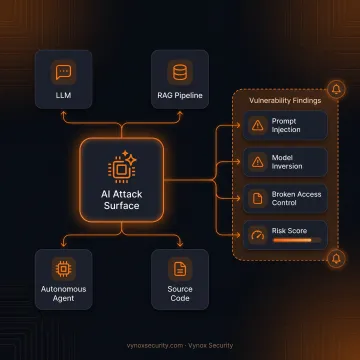
Yes. Vynox tests LLM applications, RAG pipelines, autonomous agents, and related AI infrastructure. Assessments cover the OWASP LLM Top 10 and use more than 40 prompt injection and jailbreak techniques. Testing can identify system-prompt exposure, guardrail bypasses, insecure tool calls, cross-tenant retrieval, data exfiltration, agent privilege escalation, and model inversion or extraction risks.
Can a penetration test support SOC 2 or ISO 27001 readiness?
Yes. Vynox provides penetration-test findings and evidence mapped to SOC 2 and ISO 27001 control requirements, helping teams prepare material for auditors and customer security questionnaires. This is not a certification audit, but it supplies independent security-testing evidence, prioritized remediation guidance, and assessor-ready reporting. Compliance Readiness engagements are designed for organizations working toward these assurance milestones.
Will Vynox need access to our source code?
Source code is not required for standard black-box penetration testing. Vynox can assess running web applications, APIs, mobile binaries, cloud configurations, and networks using an attacker’s perspective. If your team wants earlier detection of implementation-level issues, a separate manual Source Code Review can examine authentication logic, input handling, secrets management, dependencies, and AI-specific orchestration or retrieval code.
What happens after vulnerabilities are found?
After testing, your team receives an executive summary and technical findings with severity ratings, evidence, reproduction steps, and stack-specific recommendations. Vynox works to make remediation understandable for both engineers and leadership. For continuous PTaaS engagements, findings are tracked in the dashboard, and fixes deployed to staging can be retested the same day to confirm that remediation is effective.
How do we choose between Rapid Secure and Deep Secure?
Rapid Secure is suited to teams that need focused, compliance-ready testing with fast turnaround for an audit, customer questionnaire, or upcoming release. Deep Secure provides broader adversarial coverage for mature security programs, including more extensive testing and AI red teaming where appropriate. A free 30-minute discovery call reviews your attack surface, priorities, timeline, and the engagement tier that best fits your goals.