Choosing the wrong assessment means you either pay for exploitation depth you don't need yet, or you skip the detection-and-response validation your security team actually requires. The global average cost of a data breach hit $4.99 million in 2026, up 12% year over year, according to IBM's Cost of a Data Breach Report 2026. That gap between "we tested something" and "we tested the right thing" gets expensive fast.
This gets more complicated as organizations ship LLMs, RAG pipelines, and AI agents. Traditional testing was never built for prompt injection or agent hijacking. This article covers definitions, methodology, and a practical framework for deciding which approach fits your stack.
Key Takeaways
- Pentesting hunts broadly for vulnerabilities in days or weeks; red teaming chases one objective over months.
- Red teaming tests people, process, and technology covertly; pentesting stays announced and technical.
- Start with pentesting for fundamentals, then add red teaming once a SOC or IR function exists.
- AI-powered companies need both approaches extended to cover LLMs, RAG pipelines, and autonomous agents.
- Mature programs run both continuously as complementary practices, not a one-time choice.
Red Teaming vs Penetration Testing: Quick Comparison
Before diving into definitions, here's how the two approaches stack up side by side.
| Factor | Penetration Testing | Red Teaming |
|---|---|---|
| Objective | Identify and document as many exploitable vulnerabilities as possible within scope | Achieve a specific adversarial goal while testing detection and response |
| Scope | Defined systems, applications, or network segments | Entire organization: people, process, physical, and technical layers |
| Duration | 1-3 weeks | 3 weeks to several months |
| Awareness | Usually announced to internal IT/security teams | Usually covert, known only to a small group of executives |
| Cost | Lower; roughly $5,000-$40,000 for a scoped engagement | Higher; often $30,000-$250,000+ |
| Ideal For | Compliance (SOC 2, PCI DSS, HIPAA), pre-launch checks, security baselines | Mature programs validating SOC/incident response against advanced threats |
Praetorian, a security consultancy, estimates red team engagements typically run 2x to 5x the cost of a comparable pentest, largely due to longer duration, broader scope, and specialized personnel. That's a practitioner estimate rather than a fixed market rule, but it's a useful budgeting reference.
The table gives you the shape of the decision. The next sections explain why the numbers look the way they do.
What is Penetration Testing?
Penetration testing is a structured, scoped security assessment where testers exploit vulnerabilities in defined systems, applications, or networks using an established methodology such as PTES or the OWASP Web Security Testing Guide. The tester knows the boundaries going in, and so does your IT team.
The core benefit is a prioritized, actionable vulnerability list mapped to remediation steps. That's what feeds engineering sprints and closes audit gaps, not a narrative about whether an attacker could have gotten in undetected.
For compliance-focused teams, this matters directly. SOC 2 and ISO 27001 auditors expect a current pentest report as evidence.
Vynox Security structures its reports around this reality: executive summaries for auditors, technical findings with reproduction steps for engineers, CVSS scores, and remediation guidance mapped to specific control requirements.
Rather than handing over a generic PDF that a compliance team then has to interpret, the findings arrive tagged to the framework requirement they satisfy.
Common Subtypes
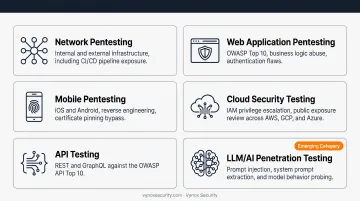
Penetration testing isn't one thing. It spans several distinct engagement types:
- Network pentesting: internal and external infrastructure, including CI/CD pipeline exposure
- Web application pentesting: OWASP Top 10, business logic abuse, authentication flaws
- Mobile pentesting: iOS and Android, reverse engineering, certificate pinning bypass
- Cloud security testing: IAM privilege escalation, public exposure review across AWS, GCP, and Azure
- API testing: REST and GraphQL against the OWASP API Top 10
- LLM/AI penetration testing: an emerging category covering prompt injection, system prompt extraction, and model behavior probing
Use Cases of Penetration Testing
Pentesting fits naturally into a few recurring moments: pre-launch validation of new features, post-remediation verification, and periodic testing tied to a compliance cycle.
- A SaaS company validates a new release before it ships to enterprise customers
- A healthcare organization tests systems handling PHI ahead of a HIPAA review
- An AI startup validates an LLM-powered feature before shipping it to production
That last one matters more than it used to. High- and critical-severity application vulnerabilities took an average of 54.81 days to remediate in 2025, according to Edgescan's 2026 Vulnerability Statistics Report. Unpatched issues don't sit quietly; they sit exposed. For AI startups, Vynox scopes this specific use case around 40+ prompt injection and jailbreak techniques plus full OWASP LLM Top 10 coverage. Delivery typically takes 5-7 business days, well under the 4-8 week timelines common at traditional firms.
What is Red Teaming?
Red teaming is a covert, objective-driven simulation of a real-world adversary. Testers use any viable tactic, cyber, physical, or social engineering, to achieve a specific goal like data exfiltration or domain compromise. There's no checklist of vulnerabilities to find, only one mission: get in, get the objective, and see if anyone notices.
The core benefit is proof. It reveals how your people, processes, and detection tooling perform against a real attack path, not a simulated one confined to a spreadsheet. That's directly tied to incident response maturity and attacker dwell time.
Dwell time is the reason this matters. Mandiant's M-Trends 2026 report puts the global median attacker dwell time at 14 days, up from 11 days the prior year, based on more than 500,000 hours of incident investigations. Organizations only caught the activity internally in 52% of cases.
If you've invested in a SOC, EDR, and SIEM stack, red teaming is how you confirm those tools actually catch something rather than just generating alerts nobody reads.
Variations Worth Knowing
Two variations adapt red teaming to different needs. Purple teaming turns the exercise collaborative: red and blue teams work together in real time to close detection gaps faster. Scoped or limited red team exercises narrow the engagement for teams not yet ready for a full multi-week simulation.
Use Cases of Red Teaming
Red teaming fits organizations validating incident response plans, testing SOC detection thresholds, or preparing for advanced persistent threat scenarios.
- Financial services firms testing regulatory-driven adversarial assurance requirements
- Critical infrastructure organizations validating detection against nation-state-style tactics
- AI-native companies testing whether their team can detect autonomous agent misuse or prompt-injection-driven data exfiltration
That third scenario is a newer battleground. Vynox's AI Red Teaming service simulates objectives such as:
- System prompt extraction in under 10 queries
- Agent hijacking through tool-call injection
- Goal redirection of autonomous agents
- Data exfiltration through legitimate tool channels
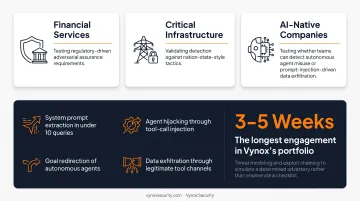
This engagement runs 3-5 weeks, the longest in Vynox's portfolio. That length reflects the threat modeling and exploit chaining needed to simulate a determined adversary rather than enumerate a checklist.
Red Teaming vs Penetration Testing: Which One Do You Need?
The decision comes down to five factors:
- Security maturity: Do you have a functioning SOC or incident response capability?
- Budget: Can you support a $30,000-$250,000+ engagement, or does $5,000-$40,000 fit better?
- Compliance deadlines: Is an auditor or enterprise prospect asking for a current pentest report?
- Attack surface: Does your stack include LLMs, RAG pipelines, or autonomous agents?
- What you actually need proof of: Vulnerabilities that need fixing, or detection that needs validating?
Choose penetration testing if you need compliance evidence, you're validating a new release, or you're an early-stage program still building fundamentals. Choose red teaming if your defenses are mature and you need proof that detection and response actually work under pressure.
The AI Gap Traditional Testing Misses
Here's the complication: traditional pentesting and red teaming were built for classic infrastructure. They often miss AI-specific vulnerabilities entirely: prompt injection, RAG data leakage, and agent tool misuse simply weren't in scope when PTES and OWASP WSTG were written.
This is why Vynox Security runs both methodologies through a two-layer model:
- Layer one covers AI-specific attack surfaces: LLMs, RAG pipelines, autonomous agents, and model inversion, with full OWASP LLM Top 10 coverage and 40+ prompt injection and jailbreak techniques per engagement.
- Layer two covers supporting infrastructure: web, mobile, cloud, network, and API.
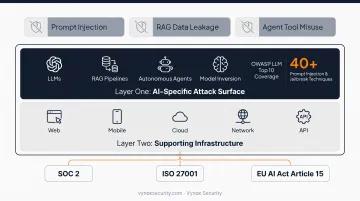
Both run within a single engagement rather than as two separate workstreams, so findings from either layer map directly to SOC 2, ISO 27001, and EU AI Act Article 15 evidence requirements.
In practice, this looks like an AI-native startup facing a SOC 2 deadline while also shipping an agentic feature with tool access. A conventional pentest firm would clear the infrastructure checklist and stop there, leaving the agent's tool-call permissions and RAG retrieval path completely unexamined.
Closing that gap means testing both layers together, not bolting an AI review onto a traditional report after the fact.
If you're shipping AI features and need both infrastructure and AI-specific coverage in one engagement, Vynox's discovery team runs a free 30-minute scoping call to map your stack and recommend the right engagement type and tier. You can book that directly at cal.id/karan-singh.
Conclusion
Neither approach is inherently better. Pentesting answers "what's vulnerable?" Red teaming answers "can we detect and stop an attack?" Those are different questions, and decision clarity comes from matching the method to your security maturity and your actual goals, not from picking whichever sounds more advanced.
Get the match right and the payoff is concrete:
- Faster remediation once vulnerabilities are found
- Audit-ready evidence for SOC 2 and ISO 27001 reviews
- Confidence to ship LLM and agent-based products, knowing both classic and AI-specific attack surfaces have been tested
Frequently Asked Questions
What is the difference between a red team assessment and a penetration test?
A pentest finds and documents as many vulnerabilities as possible within a defined scope. Red teaming simulates a real adversary pursuing one specific goal to test detection and response across the whole organization.
Which is more expensive, red teaming or penetration testing?
Red team engagements typically cost 2x-5x more than pentests, according to Praetorian, due to longer duration and broader scope. Expect roughly $5,000-$40,000 for a pentest versus $30,000-$250,000+ for red teaming.
Can a small business or startup benefit from red teaming?
Most startups should build security fundamentals with penetration testing first. Red teaming makes sense once you have a functioning SOC or incident response capability to actually test.
How often should we run penetration tests versus red team engagements?
Pentests typically run quarterly, annually, or with major releases; PCI DSS requires them at least annually and after significant changes. Red team exercises are usually annual or every 12-18 months for mature programs.
Do red teaming and penetration testing cover AI systems like LLMs and AI agents?
Traditional methodologies weren't designed for AI-specific risks like prompt injection or RAG data leakage. Vynox Security's AI-native testing covers the full OWASP LLM Top 10 and 40+ jailbreak techniques to close that gap.
Should our security team know about a red team engagement in advance?
Most red team engagements are covert, known only to a small group of executives, to produce realistic results. Some organizations opt for a collaborative purple team approach instead.