Many organizations have never tested whether a compromised credential, a rogue insider, or a jailbroken AI model could actually move sensitive data past their monitoring tools without tripping an alert. Perimeter controls get audited constantly. The exit path almost never does.
This guide breaks down what exfiltration testing actually is, how the methodology works step by step, which channels it covers — including the AI and LLM-specific leakage paths traditional pentest firms routinely miss — and how to choose a testing partner that covers the full attack chain, not just half of it.
Key Takeaways
- Exfiltration testing checks whether DLP, SIEM, and egress monitoring catch data leaving your environment — not just whether attackers get in
- It targets the "last mile" of an attack: the moment stolen data crosses the network boundary
- Modern engagements must cover network, cloud, API, and AI/LLM channels like RAG pipelines and autonomous agents
- Reports from this testing double as audit-ready evidence for SOC 2 and ISO 27001 requirements
What Is Exfiltration Testing?
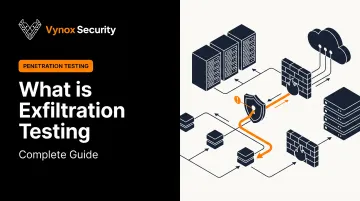
Exfiltration testing is a controlled, simulated attempt to extract sensitive data from an organization's systems, designed specifically to measure whether detection and prevention controls actually work. It's not theoretical. Testers try to move real (test) data out through real channels and see what fires and what doesn't.
Infiltration Gets You In. Exfiltration Gets You Paid.
There's a meaningful difference between the two:
| Term | Definition |
|---|---|
| Infiltration | Gaining unauthorized access to a system or network |
| Exfiltration | Successfully removing valuable data from that system |
Attackers need to succeed at both. Most security testing only validates the first. NIST's CNSSI 4009 glossary defines exfiltration plainly as the "unauthorized transfer of information from an information system," a transfer that either happens undetected or doesn't happen at all.
That detection gap is bigger than most teams assume. According to Google's Mandiant M-Trends 2026 report, based on over 500,000 hours of frontline investigations, the global median dwell time (how long an attacker sits undetected inside a network) was 14 days in 2025, up from 11 days in 2024.
That's nearly two weeks where an adversary can quietly map your environment and stage data for extraction, with your monitoring stack none the wiser.
Why Traditional Pentests Stop Short
Standard penetration tests are typically scoped to stop once "initial access achieved" gets checked off. Rules of engagement often box testers out of touching production data flows, so the exfiltration path never actually gets exercised. The result: a clean pentest report that says nothing about whether your DLP tooling would ever catch a real theft in progress.
Not every organization carries the same level of exposure, though. Who actually needs this kind of testing?
- Organizations storing PII, healthcare, or financial records
- Companies with proprietary source code or model weights worth protecting
- AI-native teams running LLMs, RAG pipelines, or autonomous agents that touch sensitive training or inference data
- Any business that's already SOC 2 or ISO 27001 certified but has never proven its egress controls work
How Exfiltration Testing Works: Step-by-Step Methodology
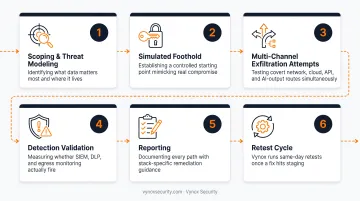
A well-run engagement follows a deliberate, structured sequence that mirrors how a real attacker would actually operate, moving through each phase methodically rather than relying on a single script.
1. Scoping & Threat Modeling Testers identify what data matters most (customer records, model weights, system prompts), where it lives (databases, cloud buckets, vector stores, API responses), and the likely paths an attacker would take to move it.
2. Simulated Foothold Testers establish a controlled starting point, mimicking a compromised credential, insider-level access, or a post-exploitation scenario, depending on what's being tested.
3. Multi-Channel Exfiltration Attempts Testers try to move data out through several routes at once:
- Covert network channels
- Cloud storage APIs
- Application and endpoint interfaces
- AI system outputs, where applicable
4. Detection Validation This is the step most organizations skip entirely. Testers measure whether SIEM alerts fire, whether DLP policies block the transfer, and whether egress monitoring flags the anomaly in real time. In many cases, the data leaves without triggering a single alert.
5. Reporting Testers document every successful exfiltration path with reproduction steps and remediation guidance specific to the technology stack involved, not generic advice that engineers have to translate themselves.
6. Retest Cycle Testers verify fixes once they're deployed. Vynox, for example, runs same-day retests once a fix hits staging, giving teams confirmation the same day rather than three weeks later when the next quarterly cycle rolls around.
Types of Data Exfiltration Vectors and Channels Tested
Comprehensive testing has to cover far more ground than a single network scan. Here's what each channel category actually involves.
Network-Based Exfiltration
Covert channels remain a favorite among attackers precisely because they hide in plain sight:
- DNS tunneling: smuggling data inside DNS queries
- ICMP exfiltration: using ping packets as a data carrier
- Abuse of allowed outbound ports: routing stolen data through ports your firewall already trusts
Cloud & SaaS Exfiltration
Misconfiguration, not sophisticated hacking, causes most cloud leaks:
- Publicly exposed storage buckets, snapshots, or AMIs
- Overly permissive API tokens with broader scope than intended
- Third-party integrations that quietly sync more data than anyone realizes
Application & API Exfiltration
APIs often return more than the front end ever uses, creating a silent leak path:
- Excessive data exposure in API responses
- Broken object-level authorization (IDOR-style flaws) letting one user pull another's records
- Endpoints returning far more data than the front end ever displays
AI/LLM-Specific Exfiltration
This is where legacy pentest firms fall short, because these leakage paths simply didn't exist five years ago:
- Prompt injection causing system prompt or context leakage
- RAG pipeline document leakage: a documented risk in production deployments
- Training data extraction attempts, where model queries recover memorized records rather than generalized outputs
- Cross-tenant retrieval bypass in shared RAG environments
The risk is not theoretical: the ICLR 2025 paper Follow My Instruction and Spill the Beans found a 100% datastore-leakage success rate across 25 customized GPTs, extracting 41% of a 77,000-word book using only 100 queries.
Comprehensive AI security testing needs full OWASP LLM Top 10 coverage, paired with dozens of prompt injection and jailbreak techniques, not a single canned test script.
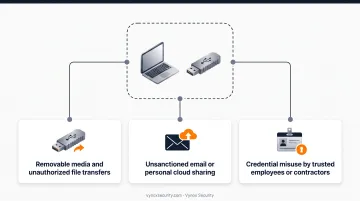
Insider and Endpoint Vectors
Not every leak originates from outside the network:
- Removable media and unauthorized file transfers
- Unsanctioned email or personal cloud sharing
- Credential misuse by trusted employees or contractors
Exfiltration Testing vs. Related Security Assessments
Exfiltration Testing vs. Traditional Penetration Testing
Standard pentests focus on proving access is possible. Exfiltration testing stress-tests something different: whether stolen data can actually leave the environment undetected. NIST SP 800-115 does permit deeper testing of what can be "gleaned, changed, or removed" once access is achieved — but in practice, most engagements never get scoped that far.
Think of them as complementary, not interchangeable. A pentest tells you the door was unlocked. Exfiltration testing tells you whether anyone would notice if someone walked out with the filing cabinet.
Exfiltration Testing and Compliance (SOC 2, ISO 27001)
Both frameworks require documented evidence that data loss prevention controls actually function:
| Framework | Relevant Control | What It Requires |
|---|---|---|
| SOC 2 | CC6.7 | Restricts and monitors transmission, movement, and removal of information |
| SOC 2 | CC7.2 | Monitors systems for anomalies indicative of malicious activity |
| ISO 27001 | Annex A 8.12 | Data leakage prevention measures |
| ISO 27001 | Annex A 8.16 | Monitoring for anomalous behavior |
Exfiltration test reports serve as the documented proof auditors ask for under these controls. Without a real test, "we have DLP" is just a claim.
The financial stakes back this up. IBM's Cost of a Data Breach Report 2026 puts the global average cost of a breach involving AI model inversion at $6 million. That figure reflects how difficult it's becoming to protect training data and sensitive model context once an attacker gets a foothold.
Vynox structures its reporting around exactly this need: findings map directly to SOC 2 and ISO 27001 control evidence, plus EU AI Act Article 15 adversarial testing requirements and ISO 42001. The result is a single engagement that produces an assessor-ready evidence pack instead of a separate compliance project.
Choosing the Right Exfiltration Testing Partner
Not every security vendor is built to test AI-specific leakage paths, and that gap matters more every quarter your product ships new model features.
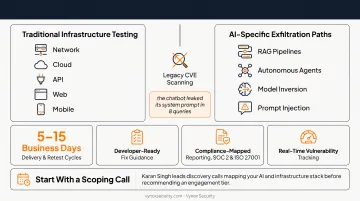
Look for a provider that covers both layers: traditional infrastructure testing (network, cloud, API, web, mobile) and AI-specific exfiltration paths (RAG pipelines, autonomous agents, model inversion, prompt injection).
Legacy pentest firms built around CVE scanning often miss the second layer entirely, because there's no CVE for "the chatbot leaked its system prompt in 8 queries."
Other criteria worth prioritizing:
- Fast delivery and retest cycles: most engagements run in 5–15 business days, with same-day retests once fixes hit staging
- Developer-ready fix guidance with reproduction steps, not generic PDF findings
- Compliance-mapped reporting that plugs directly into SOC 2 and ISO 27001 evidence packs
- Delivers real-time vulnerability tracking through a dashboard, so engineering doesn't wait weeks for a final report to start triaging critical findings
Start with a scoping conversation. Before any testing begins, mapping which systems and data types matter most saves time and money. Vynox's discovery calls, led by team members like Karan Singh, walk through your AI and infrastructure stack and flag the highest-risk exfiltration paths. The team then recommends the right engagement tier before you commit to anything.
Frequently Asked Questions
What is the difference between infiltration and exfiltration testing?
Infiltration testing checks how attackers get in. Exfiltration testing checks whether stolen data can actually get out undetected, a distinct and often untested part of the attack chain.
How often should organizations run exfiltration testing?
Cadence should align with major infrastructure or AI model changes. Fast-moving AI products benefit from continuous, per-sprint testing rather than an annual check-the-box audit.
Can exfiltration testing detect insider threats?
Yes. Simulating insider-style access, such as a trusted credential misused to move data, is core to the methodology and makes it effective for evaluating insider risk specifically.
What tools or techniques are used in data exfiltration testing?
Common categories include DNS tunneling, covert HTTPS channels, cloud API abuse, and validation checks against DLP and SIEM tooling to confirm alerts actually trigger.
Is exfiltration testing part of penetration testing or a separate service?
It can run as either a standalone engagement or a component within a broader red team or penetration testing scope, depending on what the organization needs validated.
How does exfiltration testing apply to AI and LLM-based systems?
AI systems introduce new leakage paths like prompt injection, system prompt extraction, and RAG document exposure. These require specialized testing methodology, not the traditional network-focused approach alone.