The stakes keep climbing. Verizon's 2024 Data Breach Investigations Report found a 180% year-over-year jump in breaches that started with vulnerability exploitation, with web applications as the top entry point. Picking the wrong testing approach — or skipping one entirely — leaves that gap wide open.
This article breaks down what each approach actually does, where they overlap, where they diverge, and how to decide which one (or both) your organization needs right now.
Key Takeaways
- Security testing broadly scans, audits, and analyzes systems to flag weaknesses without exploiting them.
- Penetration testing narrows that focus: experts actively exploit flaws to prove real-world impact.
- One is proactive hygiene; the other is offensive risk validation
- AI systems add attack surfaces (prompt injection, RAG leakage) neither approach catches.
- Your choice depends on compliance stage, data sensitivity, and whether you need breadth or depth
Security Testing vs Penetration Testing: Quick Comparison
Here's the side-by-side breakdown most teams are actually looking for:
| Dimension | Security Testing | Penetration Testing |
|---|---|---|
| Scope | Broad : code, configurations, network, compliance posture | Narrow : deep dive into specific systems or attack surfaces |
| Approach | Proactive identification, generally non-invasive | Offensive simulation, includes actual exploitation |
| Depth | Surface-level view across many components | In-depth investigation of exploitable flaws and business impact |
| Frequency | Continuous or scheduled (daily/weekly scans, periodic audits) | Periodic (quarterly, biannually, or per major release) |
| Reporting | List of potential vulnerabilities, general guidance | Risk scores, reproduction steps, remediation guidance |
| Cost | Lower, driven by automation | Higher, reflects manual expert labor |
Frequency and Timeline
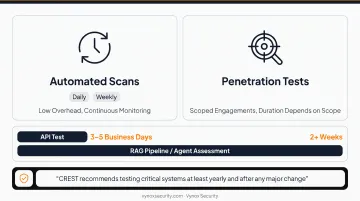
Automated scans can run daily or weekly with almost no overhead. Penetration tests are different: they're scoped engagements, and duration depends entirely on what's being tested.
A focused API test might wrap in a few business days, while a full RAG pipeline or agent assessment can take two weeks or more. CREST's guidance on the topic recommends testing critical systems at least yearly and after any major change, regardless of how frequently automated scanning runs in between.
Cost
There's no single market-wide dollar figure that fairly represents "security testing" versus "penetration testing" costs: pricing depends on scope, testing days, and the expertise involved.
What's consistent across vendors is the why: scanning tools are largely automated and cheap to run repeatedly, while a manual pentest requires skilled human testers working through a defined scope, which naturally costs more per engagement.
What Is Security Testing?
Security testing is the baseline hygiene layer. It's the ongoing, largely automated process of identifying potential weaknesses across your code, infrastructure, and configurations, without actively exploiting anything found.
For AI-powered businesses especially, this baseline matters because the attack surface keeps expanding. Skipping it risks more than a breach: it leaves you with nothing to show a SOC 2 auditor.
Core benefits include:
- Continuous visibility into emerging risks as code ships
- Faster compliance readiness through documented, repeatable checks
- A shrinking attack surface over time as issues get caught earlier
Common Methods
Security testing spans several distinct techniques:
- Static analysis (SAST): reviews source code for insecure patterns before deployment
- Dynamic analysis (DAST): probes running applications for exploitable behavior
- Vulnerability scanning: matches systems against known-vulnerability databases
- Security audits and risk assessments: evaluate policies, configurations, and controls holistically
Where It Fits and Its Limits
Security testing typically lives inside the development lifecycle: automated scans in CI/CD pipelines, routine audits, and pre-release checks. SaaS companies and IT service providers under SOC 2 monitoring rely on this layer heavily because it's cheap to run continuously and satisfies a good chunk of audit evidence requirements.
But it has a ceiling. NIST's guidance on information security testing notes that vulnerability scanners can carry a high false-positive rate and mainly catch surface-level issues. They often miss risks that only emerge when multiple vulnerabilities are chained together. That's exactly the gap penetration testing exists to fill.
What Is Penetration Testing?
Penetration testing takes everything security testing flags and asks a harder question: can someone actually break in? Testers actively exploit vulnerabilities the same way a real attacker would, then document the impact.
This matters most for organizations handling sensitive data or shipping AI systems, because traditional pentesting was built for infrastructure, not for LLMs. Traditional methods typically miss:
- Prompt injection that overrides system instructions
- Data exfiltration through manipulated RAG queries
- System prompt extraction (achievable in under 10 queries in some cases)
- Agent tool-call hijacking into unintended actions
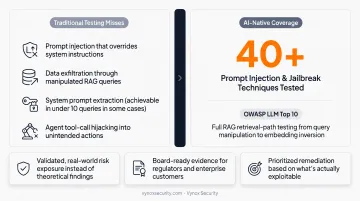
This is precisely the coverage gap AI-native platforms are built to close. Vynox Security's approach, for instance, runs 40+ prompt injection and jailbreak techniques per engagement.
Testing also covers the full RAG retrieval path, from query manipulation to embedding inversion, mapped against the OWASP LLM Top 10 framework. This framework specifically identifies prompt injection and vector/embedding weaknesses as leading generative-AI risks.
Core benefits include:
- Validated, real-world risk exposure instead of theoretical findings
- Board-ready evidence for regulators and enterprise customers
- Prioritized remediation based on what's actually exploitable
Variations and Specialized Types
Penetration testing isn't a single test either. Depending on how much internal knowledge testers are given, engagements range from black box (no internal access) to white box (full source visibility) to gray box (partial access). Beyond that, testing splits by target:
- Network and cloud (AWS, GCP, Azure) penetration testing
- Web application and API testing
- Mobile app testing (iOS and Android)
- AI/LLM, RAG pipeline, and autonomous agent testing
Choosing the right depth and target type depends on what the organization needs to validate, whether that's a compliance requirement, a pre-launch check, or coverage for a newly deployed AI feature. That question of timing is exactly where penetration testing requirements start to get formal.
Where It's Mandatory
Penetration testing shows up at specific moments: pre-launch validation, compliance mandates, and post-incident verification. PCI DSS 4.0.1 explicitly requires internal and external penetration testing at least every 12 months and after significant changes. Healthcare organizations under HIPAA and providers pursuing SOC 2 Type II face similar expectations from auditors, even where the exact cadence isn't universally codified.
Security Testing vs Penetration Testing: Which One Should You Choose?
The honest answer: it depends on where you sit. Weigh these four factors before deciding:
- Compliance stage: First SOC 2 or ISO 27001 cycle? Start with security testing and a fast, compliance-ready pentest.
- Data sensitivity: Handling patient records, financial data, or PII? Penetration testing isn't optional.
- Stack complexity: Shipping LLMs, RAG, or agents? You need AI-specific testing, not generic infrastructure scans.
- Budget: Continuous scanning is cheap; deep adversarial testing costs more but proves what actually matters.
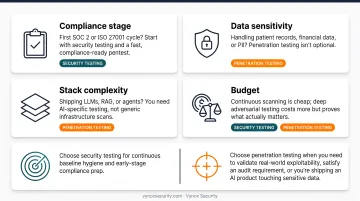
Choose security testing for continuous baseline hygiene and early-stage compliance prep. Choose penetration testing when you need to validate real-world exploitability, satisfy an audit requirement, or you're shipping an AI product touching sensitive data.
Real-World Example
A verified G2 review from a client identified only as Roy M. describes exactly this decision point. His organization handled patient identifiable data — a context where routine scanning alone wasn't going to satisfy stakeholders or regulators.
He noted the engagement's "combination of thoroughness and pragmatism," adding that testing "remained focused on the real-world security risks of handling patient identifiable data."
That's the pattern across regulated industries: a scanning report shows potential issues, but auditors, boards, and enterprise customers want proof someone tried to break in and documented what happened.
Common triggers for making that jump include an LLM feature going to production, a SOC 2 audit cycle, an enterprise security questionnaire, or unusual model behavior surfacing in production.
If any of that sounds familiar, scope the right engagement before a deadline forces the decision. Book a free 30-minute discovery call with Karan Singh to map your AI and infrastructure attack surface and get indicative pricing and timelines.
Conclusion
There's no universal winner between security testing and penetration testing — only the right fit for where your organization sits in its security maturity. Security testing builds the ongoing hygiene that keeps known issues from piling up. Penetration testing proves, under real conditions, whether your defenses actually hold.
Getting this right connects directly to outcomes that matter: audit readiness and reduced breach risk. For teams shipping LLMs and agent-based products, it means the confidence to launch AI features without wondering what a determined attacker might find first. Vynox Security tests both layers, ensuring that confidence is earned, not assumed.
Frequently Asked Questions
What is the difference between a pen tester and a security engineer?
A security engineer builds and maintains defensive controls like firewalls, access policies, and monitoring. A pen tester actively tries to break through those controls to find exploitable gaps.
Is penetration testing a type of security testing?
Yes. Penetration testing is a specialized subset of security testing, focused on active exploitation rather than passive identification.
How often should you conduct security testing vs penetration testing?
Security testing and scanning should run continuously or frequently, often weekly or per code push. Penetration testing is typically conducted quarterly, biannually, or ahead of major releases.
Can automated tools replace manual penetration testing?
No. Automation handles broad, repeatable checks efficiently, but it can't replicate the human creativity needed to chain exploits together or uncover business-logic flaws unique to your application.
Do AI systems like LLMs need a different type of penetration testing?
Yes. LLMs, RAG pipelines, and AI agents introduce risks like prompt injection and retrieval-based data leakage that require purpose-built AI security testing methodologies, not generic infrastructure scans.
How much does penetration testing cost compared to general security testing?
Automated security testing costs less because tooling scales cheaply. Penetration testing costs more, reflecting the manual, expert effort and deeper scope needed to validate real exploitability.