Introduction
Kubernetes pentesting is a structured, adversarial security assessment of a cluster's control plane, worker nodes, workloads, and RBAC configuration, designed to uncover exploitable weaknesses before attackers do.
This guide is for DevOps, platform engineering, and security teams running containerized workloads in production. It matters because Kubernetes ships with default-insecure settings, such as anonymous API server access and permissive default RBAC bindings. Combine that with a complex attack surface and mounting pressure from SOC 2 and ISO 27001 auditors, and proving your cluster is actually defensible becomes non-negotiable.
Many teams confuse "Kubernetes security" with container image scanning or a cloud configuration review. Those are useful, but they're not the same thing. Real pentesting simulates how an attacker would actually move through your cluster, chaining small misconfigurations into full compromise.
Below, you'll find the methodology, a step-by-step breakdown of attack phases, a practical checklist, the tools testers rely on, and guidance on when to bring in specialists.
TL;DR
- Kubernetes pentesting simulates real attacker behavior across three models: external, assumed breach, and compromised container
- The methodology runs recon → enumeration → exploitation → privilege escalation/lateral movement → persistence and reporting
- Compromise typically stems from exposed kubelet/etcd ports, loose RBAC, privileged pods, or default service account tokens
- Tools like kube-hunter, kube-bench, KubiScan, and Peirates help you self-assess, but don't replace a full engagement
- Run tests on a cadence tied to your deployment cycle, not as a once-a-year compliance checkbox
What Is Kubernetes Pentesting?
Kubernetes pentesting is an authorized, simulated attack against a cluster's API server, kubelet, etcd, RBAC bindings, network policies, and running workloads. The goal is to find exploitable misconfigurations and vulnerabilities before someone with bad intentions does.
The outcome matters more than the method. A good engagement delivers:
- A validated, prioritized list of exploitable weaknesses, not a generic best-practices deviation report
- Proof-of-concept exploitation showing how a finding actually plays out
- Remediation guidance written for the engineers who'll fix it, not just the auditors who'll read about it
This is where pentesting parts ways with two things it often gets lumped in with:
| Approach | What It Does | Proves Exploitability? |
|---|---|---|
| Vulnerability scanning | Automated and surface-level; flags known CVEs and stops there | No |
| CIS benchmark audits | Checks configuration against a standard | No |
| Pentesting | Chains findings into a real attack path, from initial foothold to cluster compromise | Yes |
That last column is the entire point: pentesting proves impact, not just potential.
Why Kubernetes Pentesting Matters for Modern Infrastructure
Kubernetes has become the default runtime for microservices, internal APIs, and increasingly, AI workloads: model-serving pods, RAG pipelines, and inference endpoints all tend to land on the same clusters as everything else. Every new workload type is another slice of attack surface to defend.
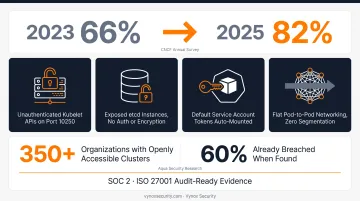
Adoption backs this up. 82% of container users ran Kubernetes in production in 2025, up sharply from 66% just two years earlier, according to CNCF's annual survey. That's a lot of clusters, and a lot of default configurations nobody's revisited since launch day.
Without testing, the same problems keep showing up:
- Unauthenticated kubelet APIs sitting wide open on port 10250
- Exposed etcd instances with no auth and no encryption
- Default service account tokens auto-mounted into pods that don't need them
- Flat pod-to-pod networking with zero segmentation
The consequences aren't theoretical. Aqua Security's research found openly accessible clusters belonging to more than 350 organizations, and at least 60% of the clusters examined had already been breached by the time researchers found them.
Compliance is now part of the pressure too. SOC 2 and ISO 27001 audits now expect evidence that technical vulnerabilities are actively managed, and findings need to map to specific controls rather than sit as a vague "improve security" recommendation.
That compliance burden only grows for organizations running AI workloads on Kubernetes, where LLMs and RAG pipelines add another layer of risk on top of the cluster itself. Vynox Security tests AI systems and the infrastructure underneath them together, so a hardened model doesn't end up sitting on a cluster with an exposed dashboard.
Kubernetes Pentesting Methodology: A Step-by-Step Breakdown
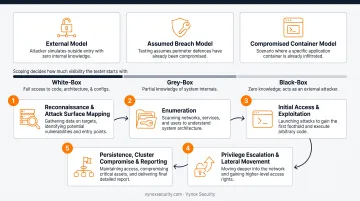
Every engagement starts from one of three attacker perspectives:
- External Model: an unauthenticated attacker hitting exposed services or APIs from outside
- Assumed Breach Model: an attacker who already has stolen credentials or internal network access
- Compromised Container Model: an attacker who's already landed inside a running pod
Scoping decides how much visibility the tester starts with: white-box (full config access), grey-box (partial or RBAC visibility), or black-box (external only). This choice shapes which of the following phases actually apply.
Reconnaissance & attack surface mapping: Testers fingerprint exposed services, the API server, kubelet, etcd, and any dashboard instances through port scanning and OSINT tools like Shodan and Censys. Identifying the exact Kubernetes version matters here too, since it determines which CVEs are even relevant.
Enumeration: Next comes mapping namespaces, pods, secrets, ConfigMaps, service accounts, and RBAC role bindings, usually through
kubectlor direct API calls. This builds a picture of privilege boundaries and where sensitive data actually lives.Initial access & exploitation: Common entry points include unauthenticated kubelet ports, vulnerable web applications sitting behind ingress, command injection flaws, or exposed dashboards. Any of these can hand a tester a foothold inside a pod or a node.
Privilege escalation & lateral movement: From that foothold, testers abuse RBAC misconfigurations, permissions to create pods, list secrets, or bind roles, and steal service account tokens. Testers also attempt container escape through hostPath mounts, privileged flags, or Docker socket access.
Persistence, cluster compromise & reporting: Testers demonstrate full impact by deploying mirror pods, planting malicious admission webhooks, or stealing a cluster-admin token. The engagement closes with reproducible steps and remediation guidance written for the developers who'll implement fixes.
Kubernetes Pentest Checklist: Common Misconfigurations & Tools
Datadog's 2025 research found 13% of EKS clusters had a dangerous node role and 10% of GKE clusters had a privileged service account. These misconfigurations go unnoticed until someone actively looks for them.
Access & Exposure Risks
- Unauthenticated kubelet ports (10250/10255) accepting requests
- Exposed etcd (port 2379) with no authentication or encryption in transit
- Exposed dashboard instances reachable without credentials
- Overly permissive RBAC, especially cluster-admin role sprawl
- Default service account auto-mount left enabled on pods that don't need API access
Workload & Runtime Risks
- Privileged pods allowed to run without restriction
- hostPath, hostNetwork, or hostPID permitted on workloads
- No network policies enforced, meaning flat pod-to-pod traffic
- Secrets stored unencrypted at rest
- No admission controllers or Pod Security Standards enforced
Tools Testers Rely On
- kube-hunter: automated scanning for cluster weaknesses
- kube-bench: CIS benchmark configuration checks
- kubeaudit and kubesec: manifest and config auditing
- KubiScan: RBAC risk analysis
- Peirates: post-exploitation once a foothold is established
For hands-on practice, Kubernetes Goat is a deliberately vulnerable cluster teams can spin up to train staff on these exact attack paths without touching production.
A checklist is a solid starting point for internal self-assessment. It won't replace the manual exploitation chaining that reveals what a misconfiguration actually costs you in business impact. That's where a structured engagement earns its keep.
Common Pitfalls, Legal Considerations & When to Bring in Experts
Kubernetes pentesting requires explicit written authorization scoped to the specific cluster and namespaces being tested. Testing systems you don't own or lack permission for is illegal, regardless of intent.
A persistent misconception treats cloud-managed Kubernetes (EKS, AKS, GKE) as fully secured by the provider. It isn't. The shared responsibility model means the provider secures the control plane infrastructure, while RBAC, workload configurations, and network policies stay yours to manage on all three platforms.
Another common mistake is treating a single point-in-time pentest as sufficient. RBAC drifts, new deployments ship weekly, and image updates constantly reintroduce risk that a report from six months ago never accounted for.
For teams shipping frequently, continuous validation aligned to sprint cadence makes more sense than an annual snapshot. This is the model Vynox Security runs through PTaaS-style engagements:
- Same-day retest turnaround once a fix is pushed to staging
- Developer-ready remediation guidance with clear reproduction steps
- Compliance-mapped reporting built for SOC 2 and ISO 27001 evidence requirements
If your infrastructure spans both cloud environments and Kubernetes workloads, a discovery call is the fastest way to scope exactly what needs testing and how it fits your existing cadence.
Frequently Asked Questions
What is the Kubernetes Pentest checklist?
It covers checks for exposed kubelet and etcd ports, RBAC overprivilege, privileged pods, missing network policies, and unauthenticated dashboards. See the checklist section above for the full breakdown.
Is pentesting illegal?
Pentesting is legal only with explicit written authorization from the system owner. Testing without consent, even against your own employer's systems without formal sign-off, can violate computer misuse laws.
How often should Kubernetes clusters be pentested?
Test after major cluster changes, before compliance audits, and ideally on a recurring cadence, quarterly or per major release, rather than treating it as a one-time event.
What's the difference between Kubernetes pentesting and vulnerability scanning?
Scanning tools automatically flag known CVEs and configuration deviations. Pentesting manually chains those findings together to prove real-world exploitability and actual business impact.
What tools are commonly used for Kubernetes pentesting?
Kube-hunter, kube-bench, kubeaudit, KubiScan, and Peirates cover scanning, CIS benchmarking, configuration auditing, RBAC analysis, and post-exploitation respectively.
Does Kubernetes pentesting cover managed clusters like EKS, AKS, and GKE?
Yes, with scope adjusted to the customer-managed layers, RBAC, workloads, network policies, and IAM integration, since cloud providers secure the underlying control plane infrastructure themselves.