Coalfire's guidance for security leaders notes that banks, insurers, and large enterprises will simply block procurement without a SOC 2 report on file. Yet plenty of companies still stumble on their first attempt, tripped up by scope creep, missing evidence, or controls that read well on paper but were never tested against real-world attacks.
This guide breaks down a phase-by-phase checklist for audit readiness, explains how to read your readiness assessment results, and flags the mistakes that most often derail a first SOC 2 audit.
Key Takeaways
- SOC 2 is voluntary on paper but a baseline expectation for closing enterprise and mid-market deals
- Audit readiness runs through four phases: scoping, remediation, third-party audit, continuous monitoring
- Type 1 checks control design at a single point in time; Type 2 checks operating effectiveness over 3–12 months
- Readiness results fall into three buckets: audit-ready, minor gaps, or not audit-ready — each needing a different next step
- Untested technical controls, especially around AI systems, are a frequent gap that auditors flag
What You Need for SOC 2 Audit Readiness
Walking into SOC 2 prep without documentation, ownership, or a defined scope is how a six-week project turns into a six-month one. Nail these fundamentals before the real work starts.
Documentation and Tools Required
Every organization needs a baseline set of artifacts before an auditor ever gets involved:
- Security policies covering access control, incident response, change management, and data handling
- System description outlining infrastructure, data flows, and service commitments to customers
- Controls matrix mapping each control to the Trust Services Criteria, with owner, testing frequency, and evidence type
- Access logs showing provisioning and de-provisioning of user accounts
- Change management records documenting approvals and testing before code hits production
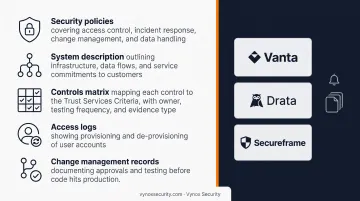
Most teams outgrow spreadsheets fast. Compliance automation platforms like Vanta, Drata, and Secureframe centralize evidence collection, ping control owners when evidence goes stale, and cut the manual chasing that eats weeks of prep time.
Scoping and Preconditions
Security (the Common Criteria) is mandatory for every SOC 2 examination. Availability, Confidentiality, Processing Integrity, and Privacy are optional, selected based on client contracts and data sensitivity.
Lock these down before starting:
- Start with Security alone in year one; add Availability or other criteria as customer needs evolve
- Decide Type 1 vs. Type 2 early. Type 2 evaluates operating effectiveness over 3–12 months; Type 1 only confirms design at a single point in time
- Get buy-in from security, engineering, product, and sales. SOC 2 fails fastest when it's treated as "security's problem"
The SOC 2 Compliance Checklist: 4 Phases to Audit Readiness
Every organization's controls look different, but nearly all SOC 2 programs move through the same four phases. Skip one, and you raise the odds of an auditor exception.
Phase 1: Preparation and Scoping
This phase defines your compliance objectives, report type, and in-scope systems.
- Determine why you're pursuing SOC 2 — customer requirement, competitive differentiator, or genuine security maturity goal
- Select Type 1 vs. Type 2 based on client expectations and your realistic timeline
- Build an inventory of in-scope systems, cloud environments, and critical vendors
Phase 2: Gap Analysis and Remediation
This is an internal self-assessment against the Trust Services Criteria to surface missing policies or weak controls.
- Conduct a gap analysis against CC1–CC9 common criteria and any additional Trust Services Criteria selected
- Prioritize remediation by business risk and assign clear control ownership
- Implement and stress-test controls — access management, encryption, change management — before moving forward
Phase 3: Third-Party Attestation Audit
Engage an independent, AICPA-affiliated CPA firm to test and attest to your controls.
- Collect evidence matched to your report type: point-in-time snapshots for Type 1, or logs and test results spanning months for Type 2
- Select an auditor with experience in your industry and tech stack. An auditor unfamiliar with AI infrastructure will slow you down with basic questions
- Respond promptly to follow-ups and document remediation of any exceptions raised
Timelines vary by report type. Linford & Company reports that the Type 2 review period typically runs 6, 9, or 12 months, with the final report generally available one to two months after the review period ends.
Type 1 audits move faster, usually wrapping in a matter of weeks since there's no observation window to wait out.
Phase 4: Maintaining Continuous Compliance
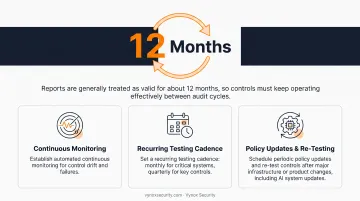
Reports are generally treated as valid for about 12 months, so controls must keep operating effectively between audit cycles.
- Establish automated continuous monitoring for control drift and failures
- Set a recurring testing cadence — monthly for critical systems, quarterly for key controls
- Schedule periodic policy updates and re-test controls after major infrastructure or product changes, including AI system updates
How to Interpret Your SOC 2 Readiness Assessment Results
Misreading a readiness assessment means walking into a formal audit unprepared, risking a qualified opinion or adverse finding that damages customer trust right when you need it most. Results land in one of three buckets:
- Audit-Ready: Controls are fully documented, tested, and evidence is centralized with no material gaps. Next step: schedule the formal audit with your chosen CPA firm.
- Minor Gaps: A small number of controls lack complete documentation or consistent evidence (incomplete access reviews are a common example). Next step: targeted remediation with a defined timeline before audit kickoff.
- Not Audit-Ready: Critical controls are missing, untested, or contradicted by evidence (for example, no incident response plan or unpatched vulnerabilities). Next step: a structured remediation project, potentially including third-party security testing, before you re-attempt the assessment.
Don't confuse "minor gaps" with "safe to proceed." A readiness assessment is meant to catch these issues before your CPA firm does, when fixing them is cheaper and faster.
Common Mistakes That Delay SOC 2 Audit Readiness
Most delays trace back to a small set of recurring errors:
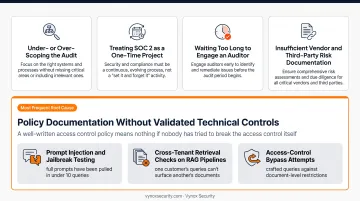
- Under- or over-scoping the audit: missing critical systems on one end, or burning weeks auditing systems no customer cares about on the other
- Treating SOC 2 as a one-time project: compliance lapses after the first report when it isn’t run as ongoing governance
- Waiting too long to engage an auditor: scheduling slips and remediation gets rushed right before fieldwork
- Insufficient vendor and third-party risk documentation: a frequent source of auditor follow-ups that stall the process
The mistake we see most often, though, is relying only on policy documentation without validating that technical controls actually hold up under attack. A well-written access control policy means nothing if nobody has tried to break the access control itself.
This gap shows up constantly in AI-powered products. Teams document their security posture thoroughly, then skip independent penetration testing of their APIs, infrastructure, and increasingly their LLM or RAG systems. That leaves auditors without evidence that access and data-protection controls survive real-world conditions, not just a design review.
Independent AI security testing closes that evidence gap. Teams working with specialists such as Vynox Security typically validate controls with tests such as:
- Prompt injection and jailbreak testing: checks whether system prompts can be overridden or extracted (full prompts have been pulled in under 10 queries)
- Cross-tenant retrieval checks on RAG pipelines so one customer’s queries can’t surface another’s documents
- Access-control bypass attempts with crafted queries against document-level restrictions
Mapped to SOC 2 control requirements, those findings give auditors evidence instead of assertions—and remove a common source of last-mile delay.
Best Practices to Accelerate SOC 2 Audit Readiness
A handful of habits separate teams that breeze through renewal from teams that scramble every twelve months.
- Assign a dedicated compliance owner — an internal lead or consultant who drives accountability across security, engineering, and leadership
- Use a compliance automation platform to centralize evidence collection and cut manual audit prep
- Validate technical controls with independent security testing before the audit, not after an auditor asks for it
- Maintain a consistent testing and review cadence rather than scrambling before each renewal
Independent testing is where readiness often stalls. Vynox Security's AI-native penetration testing covers infrastructure, APIs, and LLM/RAG systems in one engagement, with developer-ready remediation guidance and evidence packs mapped to SOC 2 and ISO 27001.
Its Rapid Secure tier supports an active audit cycle: most infrastructure engagements deliver in 5–10 business days, with findings prioritized by certification impact. For heavier regulatory exposure (for example, EU AI Act high-risk classifications), the Deep Secure tier runs a 3–5 week AI red teaming engagement that should be scheduled well ahead of the audit window.
Teams that run PTaaS-style continuous testing aligned to sprints and model updates enter the Type 2 observation period with evidence already accumulating. That beats booking a last-minute pentest around auditor deadlines and hoping the report lands in time.
Frequently Asked Questions
What is a SOC 2 Type 2 compliance checklist?
A SOC 2 Type 2 checklist covers the same scoping, control implementation, and evidence steps as Type 1, but requires proof that controls operated effectively over a 3–12 month observation period. That means audit logs and access reviews, not point-in-time snapshots.
What is required for SOC 2 compliance?
You need documented policies, implemented controls mapped to the Security criterion (plus any optional Trust Services Criteria relevant to your business), evidence that controls actually operate, and a successful audit by an independent CPA firm.
Is SOC 2 compliance mandatory?
SOC 2 is voluntary, but it's become a de facto requirement for winning enterprise and mid-market customers, especially in SaaS and AI-powered software where procurement teams won't move forward without it.
How much does a SOC 2 audit cost?
Costs vary widely based on report type, organization size, scope complexity, and the number of systems and vendors involved. Readiness assessments and remediation work add to the total, so budget for both, not just the audit fee.
Do I need a readiness assessment before my SOC 2 audit?
It's not required, but strongly recommended. Catching gaps in a readiness assessment is far cheaper than discovering them mid-audit, when a CPA firm is already billing hours.
How often do I need a new SOC 2 audit?
SOC 2 reports are generally considered valid for about 12 months. Most organizations undergo a fresh audit annually, with the next examination period starting right where the previous one ended to avoid coverage gaps.