
Introduction
Security teams used to treat penetration testing like an annual checkup: hire a firm, run the test, file the report, move on for twelve months. That model is breaking down.
Modern engineering teams ship code daily. Cloud environments spin up and tear down in minutes. AI features like LLMs, RAG pipelines, and autonomous agents get updated on sprint cycles, not yearly ones. A pentest report from March is stale by June.
Security teams are stretched thin, and budgets rarely grow as fast as the attack surface does. McKinsey's 2025 global survey found 88% of organizations now use AI regularly in at least one business function, with 23% already scaling autonomous agents in production. Testing cadence has not kept up.
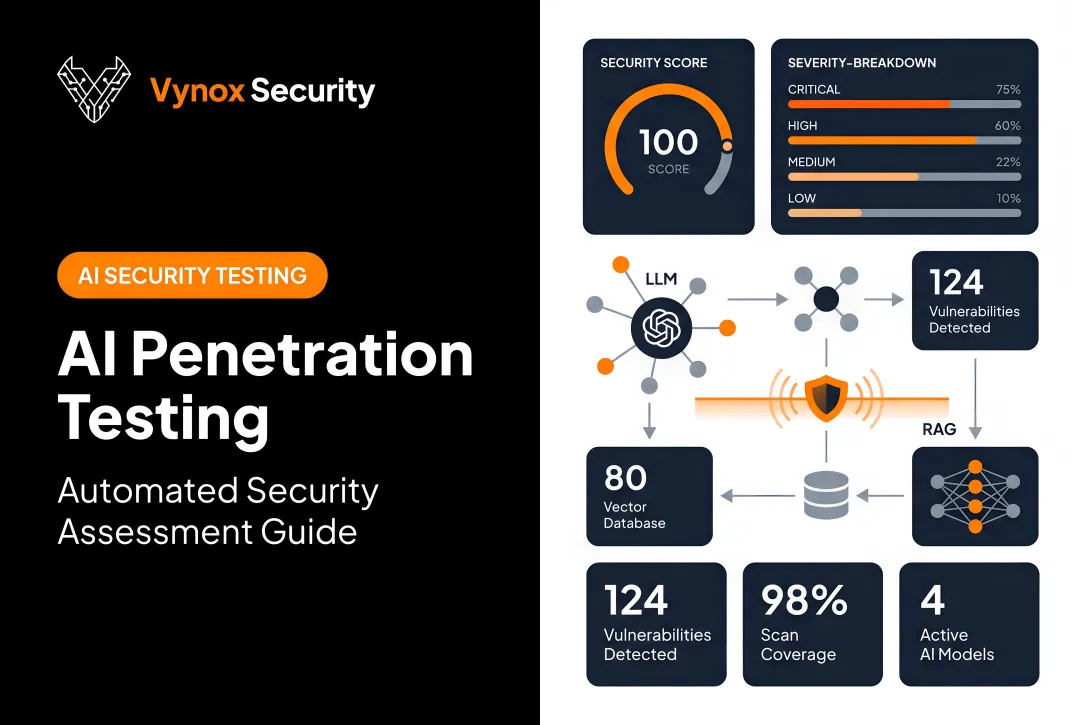
This guide covers what automated penetration testing is, how it works, and where it beats (and loses to) manual testing and PTaaS. It also explains why AI-powered products need something automated tools alone were never built to deliver.
Key Takeaways
- Automated pentesting actively exploits vulnerabilities, unlike scanning, which only flags them
- Scheduled, recurring testing catches risks that slip in between audit cycles
- Automation wins on speed and coverage; humans win on judgment and novel attack chains
- Mature security programs blend automated, manual, and PTaaS testing
- LLMs, RAG pipelines, and AI agents need purpose-built testing beyond traditional scanners
What Is Automated Penetration Testing?
Automated penetration testing uses software tools, scripts, and predefined attack techniques to simulate real-world cyberattacks against networks, applications, and systems, without a human tester manually executing every step. The tool probes, chains basic exploits, and often attempts exploitation on its own, following logic built from known vulnerability patterns and attack playbooks.
Automated Pentesting vs. Vulnerability Scanning
These two terms get used interchangeably, and that's a mistake. NIST's technical testing guidance draws a clear line between them:
- Vulnerability scanning identifies the possible existence of weaknesses — outdated software, missing patches, misconfigurations
- Automated pentesting goes further: it actively attempts exploitation to confirm whether a flagged issue is genuinely exploitable
A scanner might tell you a server is running an outdated library. An automated pentest tool tries to actually exploit that library to prove real risk exists, not just theoretical risk.
From Scripted Checks to Continuous Validation
Automated pentesting has evolved from basic scripted checks into a core piece of Continuous Threat Exposure Management (CTEM), a framework built around continually evaluating exposure rather than testing once a year.
Gartner, which coined the CTEM concept, forecasts that organizations prioritizing continuous exposure validation over point-in-time testing will see roughly two-thirds fewer breaches by 2026, according to its 2024 cybersecurity trends analysis.
Automated tools are what make that cadence realistic. Running a full manual pentest every week isn't financially feasible for most companies.
Automated tools still leave room for human testers. They absorb the repetitive load (recon, known-CVE checks, basic exploit attempts) so people can focus on judgment-driven work: chaining vulnerabilities, testing business logic, and finding paths a script was never told to look for.
How Does Automated Penetration Testing Work?
Most automated pentesting platforms follow a consistent workflow, whether they're testing a web app, a cloud environment, or an API. It generally runs through five stages:
- Reconnaissance and asset discovery: The tool maps the target environment: exposed services, subdomains, open ports, applications, and devices attackers could reach.
- Vulnerability scanning: The tool checks discovered assets against databases of known CVEs, misconfigurations, and outdated software versions.
- Automated exploitation: Using pre-built scripts and attack playbooks, the tool tries to exploit identified weaknesses. That step confirms real, exploitable risk rather than a theoretical CVE-database finding.
- Reporting and prioritization: The platform compiles findings into a report ranked by severity and exploitability, usually with remediation guidance attached.
- Continuous re-testing loop: The cycle repeats. Many platforms run scans daily, weekly, or on each deployment to verify fixes and catch gaps new code introduces.
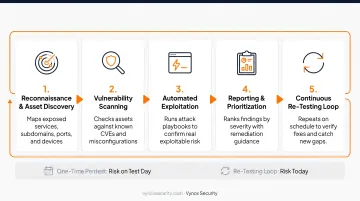
That last stage is where automated testing earns its keep. A one-time pentest tells you what your risk looked like on the day of the test. A re-testing loop tells you what it looks like today, which matters far more when you're deploying multiple times a week.
Automated vs. Manual vs. PTaaS Penetration Testing
Three delivery models dominate the market, and they're not interchangeable:
- Automated pentesting: Tool-driven, fast, scalable. Strong at broad, repeatable coverage of known vulnerability classes.
- Manual pentesting: Human-led, deep, creative. Testers chain findings and exploit business logic no script anticipates.
- PTaaS (Penetration Testing as a Service): Hybrid model that pairs human testers with platform-driven scheduling, dashboards, and reporting.
| Factor | Automated | Manual | PTaaS |
|---|---|---|---|
| Speed | Fastest (hours) | Slowest (weeks) | Fast, continuous cadence |
| Cost | Lowest per-run cost | Highest cost per engagement | Mid-to-high, spread across a subscription |
| Scope/Depth | Broad but shallow | Narrow but deep | Broad coverage with human depth |
| Accuracy | Good for known issues, weaker on novel ones | Highest — humans validate context | High, backed by human review |
| Scalability | Excellent across multi-cloud environments | Limited by tester availability | Strong, without sacrificing oversight |
| Ideal use case | Baseline, recurring coverage | Critical systems, complex logic | Growing companies needing both speed and depth |
Automated tools cover known vulnerability classes at scale, but they only follow the rules they were built with. A script can't improvise. Manual testers can chain three unrelated low-severity findings into one critical path that no playbook is written to attempt.
That's why mature programs rarely pick a single model. They blend all three: automation for continuous baseline coverage, manual testing for critical or complex systems, and PTaaS as the middle ground with human oversight built in.
Done well, that mix (speed from automation, validation from humans, retests tied to sprint cycles) closes the gap between "tested once" and "tested continuously" without paying for a full manual engagement every month.
Benefits and Limitations of Automated Penetration Testing
Automated testing earns its place in a security program, but it has real ceilings.
Key Benefits
- Speed and scalability: Tools scan large, multi-cloud environments far faster than any human team, making daily or weekly assessments realistic.
- Cost-efficiency: Cuts reliance on expensive specialized labor for routine checks, so frequent testing stays viable as you grow.
- Consistency and compliance alignment: Repeatable, standardized runs support CTEM-style programs and continuous validation expectations in emerging regulations.
Key Limitations
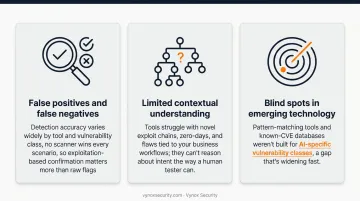
- False positives and false negatives: Detection accuracy varies widely by tool and vulnerability class—no scanner wins every scenario—so exploitation-based confirmation matters more than raw flags.
- Limited contextual understanding: Tools struggle with novel exploit chains, zero-days, and flaws tied to your business workflows; they can't reason about intent the way a human tester can.
- Blind spots in emerging technology: Pattern-matching tools and known-CVE databases weren't built for AI-specific vulnerability classes—a gap that's widening fast, and the focus of the next section.
The AI Blind Spot: Why Automated Tools Alone Can't Secure LLMs and AI Agents
As organizations deploy LLMs, RAG pipelines, and autonomous agents, they introduce attack surfaces that didn't exist five years ago: prompt injection, jailbreaks, insecure tool use, and data leakage through retrieval pipelines.
Traditional automated scanners, built to match known CVE signatures, weren't designed to test for any of this.
The OWASP LLM Top 10
The OWASP GenAI Security Project's 2025 Top 10 has become the emerging standard for categorizing these risks. It covers behavioral and architectural weaknesses including:
- Prompt injection and system prompt leakage
- Sensitive information disclosure and data/model poisoning
- Excessive agency in autonomous systems
- Vector and embedding weaknesses in retrieval pipelines
- Supply chain risk and unbounded consumption
None of these map cleanly to a CVE. They require adversarial probing designed specifically for how LLMs and agents behave.
Where AI-Native Testing Fills the Gap
Vynox Security addresses this gap by combining automated technique coverage with expert-led testing across the full OWASP LLM Top 10—not a generic scanner pointed at an AI product.
That includes:
- 40+ prompt injection and jailbreak techniques, including multi-turn chains, encoding bypasses, and indirect injection via documents
- RAG pipeline assessments for cross-tenant retrieval bypass, access-control gaps, and embedding inversion
- Autonomous agent evaluations for tool-call injection, privilege escalation, and goal hijacking with real operational impact
Findings map directly to SOC 2 and ISO 27001 AI-specific control requirements, giving compliance-conscious teams audit-ready evidence alongside developer-ready fix guidance with reproduction steps.
Even AI-native testing leans on automation for speed. Judging whether a jailbreak broke a guardrail, or whether an agent's tool call is real risk, still needs human review. A hybrid, continuous cadence—aligned to sprints and model updates, not an annual date—works best for teams shipping AI products.
Choosing the Right Automated Penetration Testing Strategy
Not every automated pentesting provider is built the same way. A few things separate the ones worth paying for from the ones that just generate noisy reports.
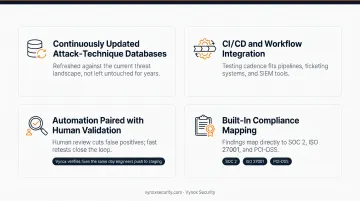
- Continuously updated attack-technique databases — Look for providers that refresh vulnerability and technique libraries against the current threat landscape, not libraries left untouched for years.
- CI/CD and workflow integration — Confirm testing cadence fits your pipelines, ticketing systems, and SIEM tools so remediation stays inside existing workflows.
- Automation paired with human validation — Human review cuts false positives; fast retests close the loop after fixes ship. Vynox, for example, verifies fixes the same day engineers push them to staging.
- Built-in compliance mapping — Reporting should map directly to SOC 2, ISO 27001, and PCI-DSS so results double as audit evidence, not only a findings list.
Get these four right, and automated testing gives security and engineering a cadence they can run every release—not a once-a-year audit scramble.
Frequently Asked Questions
Can penetration testing be automated?
Many stages of pentesting — reconnaissance, scanning, and even exploitation of known vulnerabilities — can be automated effectively. Complex business-logic flaws and AI-specific testing still benefit significantly from human expertise.
Is AI taking over penetration testing?
AI and automation are accelerating and scaling pentesting workflows, but human testers remain essential for interpreting context, validating findings, and testing novel or AI-specific attack scenarios.
Is penetration testing legal?
Penetration testing is legal when conducted with explicit written authorization and a defined scope from the system owner. Testing without that authorization can constitute a criminal offense under laws like the CFAA.
What's the difference between automated penetration testing and vulnerability scanning?
Vulnerability scanning only identifies potential weaknesses. Automated pentesting goes further by actively attempting to exploit them, confirming real-world risk rather than a theoretical one.
Can automated penetration testing replace manual, human-led testing?
Automation handles scale and repetition well, but it cannot fully replace manual testing for complex logic flaws, novel exploits, or AI-specific vulnerabilities that require human judgment.
How does the cost of automated penetration testing compare to manual testing?
Automated testing is generally more affordable and can run more frequently. Manual and hybrid PTaaS engagements cost more but deliver deeper, context-aware coverage that automation alone can't match.