Introduction
Release trains are getting shorter. Teams are more distributed than ever. AI features are shipping into production faster than most security programs can keep up with. And auditors are asking harder questions about cloud-hosted data.
That combination is exactly why cloud application testing has moved from "nice to have" to a core release requirement heading into 2026.
Most conversations about cloud testing stay stuck on infrastructure talking points like scalability and cost. The real value is operational: faster releases without breakage, fewer customer-facing incidents, and audit-ready evidence when someone asks for it.
This article breaks down what cloud application testing actually is, why it matters for 2026 workloads specifically, and how to get real, measurable value out of it instead of treating it as a checkbox.
Key Takeaways
- Cloud application testing validates functionality, performance, and security on on-demand infrastructure—no physical lab required
- Faster releases, lower costs, broader coverage, and a stronger security posture
- Skipping it leads to inconsistent performance, higher defect rates, and audit gaps
- 2026 best practice pairs functional/performance testing with continuous, sprint-aligned security validation
What Is Cloud Application Testing?
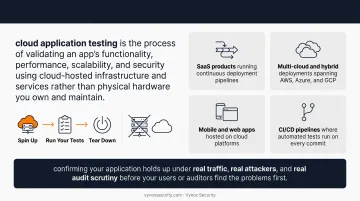
In plain terms: cloud application testing is the process of validating an app's functionality, performance, scalability, and security using cloud-hosted infrastructure and services rather than physical hardware you own and maintain.
Instead of racking servers or buying a device lab, you rent test environments on demand: spin them up, run your tests, tear them down.
It's typically applied across:
- SaaS products running continuous deployment pipelines
- Multi-cloud and hybrid deployments spanning AWS, Azure, and GCP
- Mobile and web apps hosted on cloud platforms
- CI/CD pipelines where automated tests run on every commit
The real goal is confirming your application holds up under real traffic, real attackers, and real audit scrutiny before your users or auditors find the problems first.
Key Benefits of Cloud Application Testing for 2026
The benefits below aren't abstract cloud advantages. They map directly to metrics teams already track: release speed, cost per cycle, coverage breadth, and risk exposure.
What's changed for 2026 is the stakes. AI-driven features, distributed teams, and tighter compliance timelines mean these benefits now carry more operational weight than they did even two years ago.
Faster Release Cycles Through On-Demand Scalability
Elastic cloud resources let teams spin up parallel test environments instantly instead of waiting on hardware provisioning. That's a fundamental shift from the old model, where a test environment request could sit in a queue for days.
That translates to running parallel regression, load, and configuration tests across multiple environments at once: no provisioning delays, no waiting your turn for a shared lab.
The impact is measurable. In one AWS demonstration, a test suite that took 35 minutes running sequentially dropped to just 6 minutes across 10 parallel compute environments, including provisioning time. That's the test-environment bottleneck that stalls release trains, removed almost entirely.
KPIs this impacts:
- Release frequency
- Regression cycle time
- Defect leakage rate
This advantage matters most for high-velocity teams running frequent CI/CD deployments, or apps facing unpredictable traffic spikes where waiting for infrastructure simply isn't an option.
Lower Infrastructure and Testing Costs
A pay-as-you-go cloud testing model removes the need to buy and maintain physical labs, device inventories, and software licenses that sit idle most of the year.
Teams rent testing capacity only during active cycles, then scale back down immediately after. No racks of phones gathering dust between release cycles.
One widely cited case: L'Oréal reported cutting quality-automation costs substantially after moving to cloud-based device testing, while also testing twice as many device and browser combinations as before. Most organizations see the same pattern: lower fixed costs and broader coverage at the same time.
KPIs this impacts:
- Testing cost per release
- Infrastructure utilization rate
- Total cost of ownership
This matters most for startups without capital for physical infrastructure, and for enterprises managing multiple product lines that would otherwise need separate labs for each.
Broader Test Coverage Under Real-World Conditions
Cloud testing lets you cover browsers, devices, operating systems, regions, and network conditions simultaneously, without owning a single one of those configurations yourself.
You can simulate global traffic patterns, varying latency, and device fragmentation in the same cycle.
Why it matters: performance problems translate directly into lost users. Google's analysis of over 11 million mobile landing pages found that increasing load time from one second to ten seconds raises the probability of a mobile visitor bouncing by 123%. A configuration you never tested is a configuration where that risk goes unmeasured.
KPIs this impacts:
- Defect escape rate
- Customer-reported issues
- Breadth of environments tested
This advantage matters most for consumer-facing or global products with a diverse device and geographic footprint, where "we didn't test that region" isn't an acceptable answer anymore.
Stronger Security and Compliance Posture in Cloud Environments
Modern cloud application testing increasingly includes dedicated security validation, not just functional checks. That means examining access controls, data encryption, tenant isolation, and exposed APIs that are unique to cloud-hosted apps.
On the ground, that means catching misconfigured storage buckets, weak IAM policies, and vulnerable APIs before attackers or auditors do.
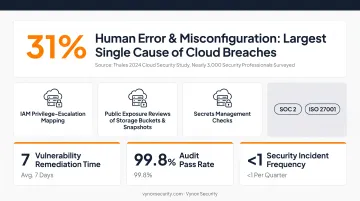
The stakes are real. Thales' 2024 Cloud Security Study, surveying nearly 3,000 security professionals, found that human error and misconfiguration accounted for 31% of cloud breaches, the largest single cause identified in the study.
This is the gap specialists like Vynox Security are built to close. Their cloud infrastructure testing covers IAM privilege-escalation mapping, public exposure reviews of storage buckets and snapshots, and secrets management checks. Paired with application and AI-stack security assessments, a single engagement can produce compliance-ready evidence mapped to SOC 2 and ISO 27001 controls.
KPIs this impacts:
- Vulnerability remediation time
- Audit pass rate
- Security incident frequency
This matters most for organizations handling sensitive data, pursuing compliance certifications, or deploying AI-powered features that expand the cloud attack surface in ways traditional tools weren't built to check.
Types of Cloud Application Testing
Cloud application testing isn't one activity. It spans several test types, each addressing a different risk category specific to cloud environments.
| Test Type | What It Validates |
|---|---|
| Functional | Features behave as intended for the user |
| Performance/Load/Stress | Behavior under variable and peak traffic |
| Scalability | Auto-scaling responds correctly to demand |
| Security | Vulnerabilities, access controls, exposed surfaces |
| Compatibility | Cross-browser and cross-device consistency |
| Multi-tenancy/SaaS | Tenant data stays properly isolated |
Most 2026 cloud-native and SaaS apps need several of these types layered together, not run in isolation. That matters even more when AI features sit in the stack:
- A model update can introduce a new vulnerability or performance regression without a code change you would normally retest
- Shared tenancy and elastic scale create failure modes that single-type test runs miss
- One-time pre-launch checks fall behind sprint and model-release cadence
Security, scalability, and multi-tenancy checks in particular work best on a continuous cycle tied to releases—not as a one-off gate before go-live.
What Happens When Cloud Application Testing Is Missing or Ignored
Skipping cloud application testing rarely causes an immediate, visible failure. It causes a slow accumulation of risk that eventually surfaces at the worst possible moment.
Common consequences include:
- Inconsistent performance across regions, devices, or traffic loads
- Higher defect rates discovered by customers instead of QA
- Reactive firefighting after outages or security incidents rather than planned fixes
- Rising costs from emergency patches and delayed compliance audits
- Coverage gaps that widen as the user base and feature set grow
- Undetected cloud misconfigurations that surface later as security or compliance failures
Atlassian's April 2022 outage shows what this looks like in practice. A maintenance script incorrectly deleted 883 cloud sites belonging to 775 customers — some were unavailable for up to 14 days.
Atlassian's own post-incident review noted that the faulty IDs didn't exist in staging, so pre-production testing never caught the fault before it hit production.
That's the pattern: gaps in testing don't announce themselves. They wait.
Best Practices to Maximize Value from Cloud Application Testing in 2026
Cloud testing delivers the most value when it's built into your CI/CD pipeline, not run as an occasional side project.
A few practices separate teams that get real value from those still treating testing as a checkbox:
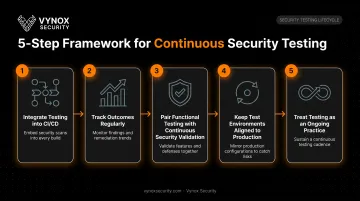
- Integrate testing into CI/CD, not as a separate gate. Automated suites should run on every merge, with fast feedback so failures get fixed immediately.
- Track outcomes regularly. Monitor defect rates, cost per cycle, and coverage breadth, then adjust cloud resource allocation based on what you find.
- Pair functional and performance testing with continuous security validation. Work with specialized partners such as Vynox Security to validate cloud infrastructure and AI-powered features every sprint or model update, rather than through a single annual audit.
- Keep test environments aligned to production. Testing against a mismatched environment produces false confidence, not real answers.
- Treat testing as an ongoing practice. Gains in speed, cost, coverage, and risk reduction compound when you apply them consistently instead of as a one-off before launch.
None of this needs to happen all at once. Start with CI/CD integration, add security validation alongside it, and let the practice mature from there.
Frequently Asked Questions
What is cloud application testing?
Cloud application testing validates an app's functionality, performance, and security using on-demand cloud infrastructure instead of owned hardware. It covers everything from load testing to security checks across cloud-hosted environments.
What skills are needed for cloud application testing?
Test automation experience, familiarity with cloud platforms like AWS, Azure, or GCP, basic scripting, and awareness of security and compliance requirements. Most teams build these skills gradually rather than hiring for all of them at once.
What are the best tools for cloud testing?
BrowserStack for cross-browser and device testing, JMeter or BlazeMeter for performance and load testing, and dedicated security testing platforms for vulnerability assessment. Most teams combine several tools rather than relying on one.
How is cloud application testing different from traditional testing?
Traditional testing relies on fixed, owned infrastructure with limited capacity. Cloud testing uses on-demand, scalable resources, which typically means lower fixed costs and far broader coverage across devices, regions, and traffic conditions.
Is cloud application testing secure enough for sensitive data?
Security depends on how the environment is configured, not the cloud model itself. Encryption, access controls, and dedicated security testing determine whether sensitive data stays protected. The cloud alone doesn't guarantee it.
How much does cloud application testing typically cost?
Costs are usage-based and vary by scope, but they're generally far lower than maintaining in-house device labs and testing hardware for equivalent coverage. Most teams pay only for the capacity they use during active test cycles.