That timeline shift has caught a lot of organizations off guard. Many businesses struggle with a basic question: is segmentation even required? The honest answer is more nuanced than most compliance checklists suggest, and getting it wrong leads to one of two expensive outcomes — a bloated assessment scope that costs far more than necessary, or false confidence in controls nobody ever actually tested.
This guide breaks down what counts as in-scope, which PCI DSS requirements actually govern segmentation, how validation testing works under Requirement 11.4, and the mistakes that most often blow up an audit.
Key Takeaways
- Segmentation isn't technically mandatory, but skipping it puts your entire network in PCI scope
- CDE boundary controls sit under Requirements 1.2.6, 1.3.1–1.3.2, 1.4.1–1.4.2, and 1.2.7
- Active penetration testing of segmentation is mandatory under 11.4.5; firewall rule reviews alone don't count
- Testing cadence: 12 months for most organizations, 6 months for service providers, plus after any segmentation change
- "Segmentation on paper" (documented but never tested) is the single most common audit failure point
What Is Network Segmentation?
Network segmentation means dividing a network into isolated zones so systems can't freely talk to each other. Organizations typically enforce this using:
- VLANs to logically separate traffic at the switch level
- Firewalls and access control lists (ACLs) to filter what's allowed between zones
- Physical separation for the highest-sensitivity systems
In a PCI DSS context, segmentation exists for one purpose: isolating the cardholder data environment (CDE) from the rest of your corporate network. If that isolation works and can be proven, everything outside the boundary generally falls out of assessment scope.
Most organizations rely on traditional zone-based segmentation — VLANs and firewall rules drawing a hard line around the CDE.
A newer approach, microsegmentation, applies finer-grained rules at the individual workload or application level rather than the network zone. It's increasingly common in cloud and containerized environments, and we'll come back to it in the best-practices section below.
Does PCI DSS Require Network Segmentation? Understanding Scope and the CDE
Here's the part that trips up nearly everyone: segmentation itself is not a mandatory PCI DSS requirement. The PCI Security Standards Council frames it as a strongly recommended method to reduce assessment scope, cost, and risk — not an obligation in its own right.
But skip it, and the consequence is severe. Without adequate segmentation, your entire network is in scope, and every connected system must meet every applicable PCI DSS control. There's no partial credit for "mostly separated."
The Three Scope Categories
The PCI SSC defines scope using three categories:
| Category | Definition | PCI DSS controls apply? |
|---|---|---|
| CDE systems | Store, process, or transmit cardholder/sensitive authentication data, or have unrestricted connectivity to systems that do | Yes, fully |
| Connected-to / security-impacting | Can access the CDE, affect its configuration or security, or provide segmentation/security services to it | Yes, fully |
| Out-of-scope | Properly isolated such that even a compromise couldn't affect cardholder data security | No |
Notice that last row carries a catch: a system can't just be labeled "out of scope" on a network diagram. It has to be demonstrated to be isolated.
That's the burden-of-proof principle in a nutshell: a system is assumed in scope until segmentation is documented and proven to isolate it. Assessors don't take your word for it; they expect evidence.
The Real Cost of Getting Scoping Wrong
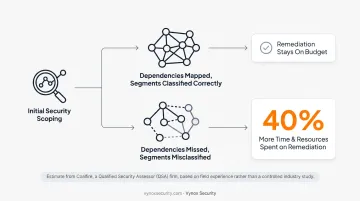
Coalfire, a Qualified Security Assessor firm, has estimated that organizations can spend roughly 40% more time and resources on remediation when initial scoping misses dependencies or misclassifies segments.
That figure comes from one assessor's field experience rather than a controlled industry study, but it matches what most security teams already know: fixing a scoping mistake after the fact costs far more than getting the architecture right up front.
PCI DSS Requirements That Govern Segmentation
PCI DSS v4.0.1 doesn't have a single "segmentation requirement." Instead, several requirements under Requirement 1 work together to define and enforce the CDE boundary.
| Requirement | What it asks for | Why it matters for segmentation |
|---|---|---|
| 1.2.6 | Security features defined for any insecure services, protocols, or ports allowed across the boundary | Forces documented business justification for every permitted connection |
| 1.3.1 | Inbound CDE traffic restricted to only what's necessary; everything else denied | Enforces least-privilege at the boundary going in |
| 1.3.2 | Outbound CDE traffic restricted to only what's necessary; everything else denied | Limits unauthorized paths out, including data exfiltration routes |
| 1.4.1 | Network security controls implemented between trusted and untrusted networks | Establishes the CDE as a distinct trust zone |
| 1.4.2 | Inbound traffic from untrusted to trusted networks limited to authorized services | Governs the specific paths that reach toward the CDE |
| 1.2.7 | Network security control rulesets reviewed at least every six months | Confirms rules still match business need — configs drift over time |
Source: PCI DSS v4.0.1 standard, PCI Security Standards Council.
None of these are future-dated. As of March 31, 2025, they are fully enforceable under v4.0.1, the only active version of the standard. Assessors check every one of these boxes today.
Segmentation Testing and Validation: Meeting Requirement 11.4
This is where most compliance programs fall apart, because documenting segmentation and proving it works are two entirely different exercises.
Requirement 11.4.1 requires a defined, documented penetration testing methodology that explicitly validates segmentation and scope-reduction controls. A configuration review that only checks whether firewall rules look reasonable on paper does not meet it.
Testing Cadence
- Most organizations: at least every 12 months, under Requirement 11.4.5
- Service providers: at least every 6 months, under the additional Requirement 11.4.6
- After any change to segmentation controls or methods, regardless of cadence. This isn't limited to "significant" changes; any modification to the segmentation setup triggers retesting
What Doesn't Count as Testing
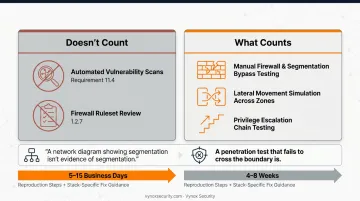
Automated vulnerability scans do not satisfy Requirement 11.4. Neither does a firewall ruleset review under 1.2.7. Both are legitimate, mandatory activities in their own right, but the standard treats them as separate obligations. Assessors want active, simulated attempts to bypass the segmentation boundary, using an exploitation-based methodology.
The most common real-world failure is what practitioners often call "segmentation on paper." VLANs exist. Firewall rules are documented. Diagrams look clean. But nobody has ever actually tried to cross from an out-of-scope segment into the CDE to confirm the boundary holds under an active attack attempt.
A network diagram showing segmentation isn't evidence of segmentation. A penetration test that fails to cross the boundary is.
Vynox Security's network penetration testing addresses this with manual firewall and segmentation bypass testing, lateral movement simulation across zones, and privilege escalation chain testing—not automated scanning dressed up as a pentest.
Findings include reproduction steps and stack-specific fix guidance, so engineers know exactly what to patch instead of decoding a generic CVE writeup.
A standard Vynox network engagement runs 5–15 business days, versus the 4–8 weeks typical of traditional firms. That timeline helps when a segmentation change or assessment window is approaching. If you need evidence formatted for a QSA's PCI checklist, flag it during scoping so the report structure matches what your assessor expects.
Modern Architectures Add Complexity
Zero trust, multi-cloud, and hybrid CDE setups make this validation harder, not easier. The PCI SSC addressed this directly in its September 2024 Information Supplement on scoping and segmentation guidance for modern network architectures.
The guidance clarifies that zero trust's continuous authentication model does not automatically reduce scope on its own. Multi-cloud environments still require inventorying every provider, boundary, and inter-provider path before segmentation claims can hold up.
Best Practices for Implementing PCI DSS Segmentation
Getting segmentation right starts before you touch a single firewall rule.
- Map data flow first. Classify every system as in-scope, connected-to, or out-of-scope before designing any boundary. Skip this step and you'll be retrofitting segmentation around guesswork.
- Layer your controls. Combine logical separation (VLANs, subnets) with physical separation where feasible, plus least-privilege ACLs and firewall rules enforcing the CDE boundary.
- Don't confuse access control with segmentation. RBAC and MFA control who authenticates. Segmentation controls what a device can reach even after authentication. You need both; one doesn't substitute for the other.
- Build in continuous validation. Review rulesets every six months per Requirement 1.2.7, and re-test the actual segmentation boundary after any infrastructure change — not just once a year on autopilot.
Those same layering principles extend further in cloud-native and containerized environments, where microsegmentation is often a better fit. Traditional VLAN-based zones don't map cleanly to workloads that spin up and down constantly.
Microsegmentation applies rules at the individual workload level rather than the network segment, which tightens the blast radius if something inside the perimeter is compromised.
Common Segmentation Mistakes That Undermine PCI Compliance
A few patterns show up again and again in failed assessments:
- Unvalidated “segmentation.” VLANs and firewall rules look correct on paper, but no one has proven they block unauthorized traffic in practice.
- Shared staging and production. Staging and production in the same VPC or network without hard isolation can pull the full development environment into scope.
- Annual-only testing. Requirement 11.4.5 sets a 12-month minimum and also triggers on any segmentation change. Skipping interim tests leaves real gaps.
- Cloud treated like on-prem. Multi-cloud and hybrid CDEs add shared management planes, provider-side infrastructure, and inter-provider paths that need their own scoping review (as PCI SSC modern-architecture guidance stresses).
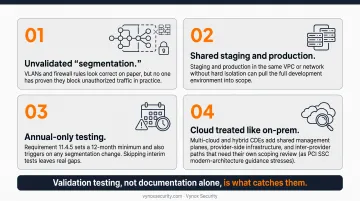
These gaps keep showing up in assessments. Validation testing, not documentation alone, is what catches them.
Frequently Asked Questions
What is network segmentation?
Network segmentation is the practice of isolating network zones using VLANs, firewalls, or ACLs to control traffic flow between systems. In PCI DSS, it's used to limit what falls inside the cardholder data environment's assessment scope.
Does PCI DSS require network segmentation?
No, segmentation itself isn't mandated. It's the PCI SSC's recognized method for reducing CDE scope, cost, and audit complexity. Skipping it means your entire network falls in scope.
What official guidance covers PCI DSS scoping and network segmentation?
The PCI SSC's PCI DSS Scoping and Segmentation Guidance for Modern Network Architectures, published September 2024. It focuses specifically on cloud, hybrid, and zero trust environments.
How often must PCI DSS segmentation be tested?
At least every 12 months for most organizations under Requirement 11.4.5, and every 6 months for service providers under 11.4.6. Both also require retesting after any change to segmentation controls.
What's the difference between PCI DSS "scope" and "segmentation"?
Scope defines which systems must meet PCI DSS controls. Segmentation is the technical mechanism (VLANs, firewalls, ACLs) used to shrink that scope by isolating the CDE.
Can virtualization or cloud environments be used for PCI DSS segmentation?
Yes, provided hard isolation is enforced between in-scope and out-of-scope resources. That boundary still has to be included in required segmentation penetration testing, the same as an on-prem network.