Introduction
AWS security tools are native services spanning identity, threat detection, data protection, and compliance. They operate inside AWS's shared responsibility model to protect your cloud workloads. AWS secures the infrastructure. You secure everything running on top of it.
That line gets blurrier every year. In 2026, organizations aren't just running EC2 instances and S3 buckets. They're deploying LLMs on Bedrock, training models on SageMaker, and shipping autonomous agents into production. Many teams struggle to figure out which native tool covers which risk, and where the coverage simply stops.
This article breaks down the top AWS security tool trends for 2026, explains why native tools weren't built to catch AI-specific threats, unpacks what's driving these shifts, and gives you a framework for choosing the right stack.
Key Takeaways
- AI-driven threat detection is now standard across GuardDuty, Security Hub, and CNAPP integrations
- CSPM and CNAPP tooling are converging into unified dashboards instead of fragmented point solutions
- Identity-first, Zero Trust access is replacing perimeter-based security models
- Compliance automation through Audit Manager and Security Hub is cutting manual audit prep
- Native AWS tools leave gaps in LLM, RAG, and agent workloads they were never built to secure
Top AWS Security Tool Trends for 2026
Five trends define where AWS-native and partner security tooling is heading this year. Each reflects a shift from static, rule-based defense toward automated, identity-centric, and compliance-ready security.
AI-Powered Threat Detection & Autonomous Response
GuardDuty and Security Hub have moved well past static rule sets. Both now lean on machine learning, anomaly detection, and behavioral modeling to flag threats across accounts, workloads, and data stores — and increasingly, to trigger automated remediation without a human clicking "approve."
Here's how it works in practice: GuardDuty continuously ingests CloudTrail events, VPC Flow Logs, and DNS logs, feeding them into behavioral models that score anomalies in real time. Security Hub then layers automation rules and EventBridge integrations on top, so a flagged finding can trigger a Lambda function, an SSM Run Command, or a Step Functions workflow automatically.
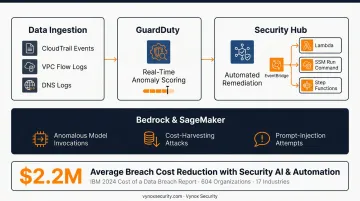
GuardDuty can now detect anomalous model invocations, cost-harvesting attacks, and prompt-injection attempts targeting Bedrock and SageMaker — by watching for deviations in CloudTrail data events tied to model calls.
IBM's 2024 Cost of a Data Breach report, covering 604 organizations across 17 industries, found that extensive use of security AI and automation was associated with an average $2.2 million reduction in breach costs. Automated detection is faster—and measurably cheaper when things go wrong.
Unified CSPM/CNAPP Convergence
Security Hub and AWS Config are consolidating fragmented visibility into fewer dashboards. Config aggregators pull configuration and compliance data across multiple accounts and AWS Organizations members into a single read-only view. Security Hub's finding-aggregator feature does the same across Regions.
Enterprises are pairing these native aggregation features with third-party CNAPP platforms to get visibility that spans AWS, Azure, and GCP simultaneously — something no single AWS-native tool provides on its own.
Fragmented tooling has long frustrated security leaders. Gartner has repeatedly flagged how juggling multiple point solutions creates overlap, blind spots, and alert fatigue—pushing many organizations toward fewer vendors with tighter integration.
Identity-First Security & Zero Trust Access
Perimeter-based security assumed a defined network edge. That assumption doesn't hold in a world of federated workforces, multi-account AWS Organizations, and API-driven everything. Identity is the new perimeter.
IAM Identity Center now centralizes workforce access, synchronizing users and groups from an existing identity provider and letting teams assign permissions across multiple AWS accounts from one place. Meanwhile, Amazon Verified Permissions uses Cedar-based policies to externalize application authorization — enabling fine-grained, least-privilege decisions on APIs and data instead of broad static permissions baked into IAM roles.
A practical example: instead of granting a service role blanket S3 access, teams write Cedar policies that permit access only to specific object prefixes, only for specific actions, only under specific conditions.
This matters because credential compromise remains a leading breach vector. Verizon's 2025 Data Breach Investigations Report found that compromised credentials were an initial-access vector in 22% of breaches reviewed. Identity sprawl isn't a theoretical risk — it's showing up in the numbers.
Data Protection & Encryption at Scale
Four services handle most of AWS's data protection workload, each with a distinct job:
- KMS — managed encryption keys used across nearly every AWS service
- CloudHSM — dedicated, single-tenant hardware security modules for organizations needing full control over cryptographic operations (FIPS 140-2/140-3 Level 3 validated in FIPS mode)
- Macie — machine learning and pattern matching to discover sensitive data, including PII and PHI, inside S3
- Certificate Manager — automated TLS certificate issuance, storage, and renewal
Macie can scan an S3 bucket overnight, flag a spreadsheet containing driver's license numbers that shouldn't be there, and fire an alert before anyone downloads it externally.
With data volumes growing and privacy regulation tightening globally, manual data discovery isn't realistic anymore. Automated scanning is now a baseline requirement.
Compliance Automation & Continuous Audit Readiness
AWS Audit Manager continuously collects evidence once an assessment is created, running resource assessments and converting raw data into audit-ready evidence — with prebuilt control mappings for PCI DSS, SOC 2, and ISO/IEC 27001:2013.
AWS Artifact plays a different role: it's where you download AWS's own compliance documents (ISO, PCI, SOC reports) rather than evidence about your controls.
Together, they're replacing the old model of scrambling for six weeks before an audit. Continuous evidence collection turns compliance readiness into an ongoing state instead of a pre-audit fire drill.
Securing AI Workloads on AWS: Where Native Tools Fall Short
As organizations deploy LLMs, RAG pipelines, and autonomous agents through Bedrock and SageMaker, they open a new attack surface that traditional cloud security tools weren't designed to test.
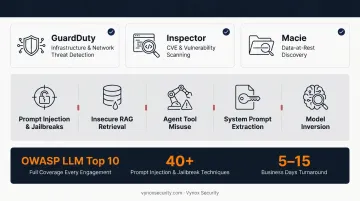
GuardDuty, Inspector, and Macie are excellent at what they were built for: infrastructure threats, CVE scanning, and data-at-rest discovery. But none of them test for:
- Prompt injection and jailbreaks — adversaries overriding system instructions to bypass guardrails
- Insecure RAG retrieval — cross-tenant data leakage, vector database poisoning, embedding inversion
- Agent tool misuse — an autonomous agent tricked into unauthorized API calls or data writes
- System prompt extraction — extracting confidential instructions in a handful of queries
- Model inversion — reconstructing proprietary training data through adversarial probing
Macie can flag sensitive data sitting in an S3 bucket. It has no way to detect when a malicious RAG query pulls that same data out through the retrieval pipeline at inference time.
GuardDuty monitors account and network anomalies. It has no visibility into the semantic logic of what an agent's tool call is actually trying to do.
Even most traditional penetration testing firms lack a defined methodology for these AI-specific vulnerability classes — leaving a coverage gap that generic scanners and conventional pentests both miss.
This is the gap Vynox Security was built to close. Vynox runs AI-native security testing alongside AWS's infrastructure tooling, with full OWASP LLM Top 10 coverage and 40+ prompt injection and jailbreak techniques in every engagement. That includes direct injection, indirect injection via documents, role-play exploits, and multi-turn attack chains.
Findings map directly to SOC 2 and ISO 27001 AI-specific controls, complementing the evidence AWS Artifact and Audit Manager already generate. Turnaround runs 5–15 business days, compared to the 4–8 weeks typical of traditional firms.
For teams running AI workloads on AWS, the practical move is pairing native AWS security services with specialized AI security testing. One covers the infrastructure layer. The other covers the model, pipeline, and agent logic layer AWS was never built to test.
What's Driving These AWS Security Trends
Three forces are pushing these shifts harder than any single AWS feature drop: scale, regulation, and cost.
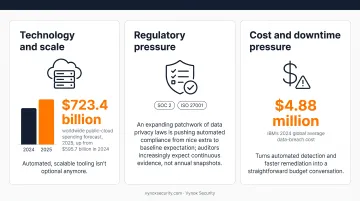
Technology and scale. Cloud adoption keeps climbing, and the volume alone is forcing automation. Gartner forecast worldwide public-cloud end-user spending would hit $723.4 billion in 2025, up from $595.7 billion in 2024. That kind of growth makes manual security review impossible to sustain. Automated, scalable tooling isn't optional anymore.
Regulatory pressure. SOC 2, ISO 27001, and an expanding patchwork of data privacy laws are pushing automated compliance features from "nice extra" into baseline expectation. Auditors increasingly expect continuous evidence, not annual snapshots.
Cost and downtime pressure. Breach costs remain steep enough to justify investment in better tooling. IBM's 2024 research put the global average data-breach cost at $4.88 million, a figure that turns automated detection and faster remediation into a straightforward budget conversation rather than a hard sell.
How to Choose the Right AWS Security Tools for Your Business
Start by mapping your tool stack against the shared responsibility model. It's the fastest way to spot gaps.
- Separate account-level from application-level coverage. IAM and GuardDuty protect the account layer. WAF and Secrets Manager protect the application layer. Most gaps show up because teams assume one covers the other.
- Prioritize Security Hub integration. Tools that feed findings into Security Hub and map directly to SOC 2, ISO 27001, or PCI DSS controls save you duplicate audit work later.
- Match tool depth to your risk profile. A five-person startup doesn't need CloudHSM. A healthcare platform handling PHI probably does.
- Factor in AI-specific testing if you're building on Bedrock or SageMaker. Native scanners won't catch prompt injection or agent misuse — that requires a specialized partner.
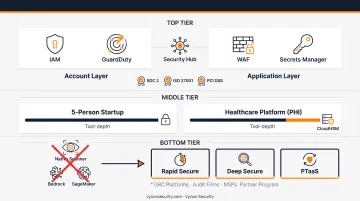
For that last point, pair generic cloud scanners with a specialized testing partner. Native AWS tools cover the account and app layers; they do not cover prompt injection, agent misuse, or model-level abuse on Bedrock and SageMaker.
Vynox Security closes that gap with engagement-based testing (not another scanner):
- Rapid Secure — fast, compliance-ready turnaround
- Deep Secure — comprehensive adversarial testing, including AI red teaming
- PTaaS — testing aligned to every sprint and every model update, not a once-a-year exercise
GRC platforms, audit firms, and MSPs can also use Vynox through the partner program: Vynox runs the testing while the partner keeps the client relationship. A discovery call is usually the fastest way to see which tier fits your stack.
Conclusion
AWS security tooling in 2026 is converging around four pillars: AI-driven detection, unified posture management, identity-first access, and compliance automation. Native tools handle infrastructure well: GuardDuty, Security Hub, KMS, and Audit Manager cover a lot of ground.
Organizations deploying AI on AWS still need coverage beyond that stack. Prompt injection, insecure RAG retrieval, and agent misuse sit outside what GuardDuty or Macie were built to catch. Close the gap by layering AI-native testing on AWS’s native controls—not by replacing them.
Adopt both layers now: harden infrastructure with native AWS tools, then validate LLMs, RAG pipelines, and agents with AI-specific testing. That combination is what holds up with customers and auditors when AI workloads move to production.
Frequently Asked Questions
What are AWS security services?
AWS security services are native tools covering identity and access management, threat detection, data protection, and compliance (for example IAM, GuardDuty, KMS, and Security Hub). They operate under AWS's shared responsibility model.
What is AWS in cybersecurity?
AWS functions as both a secure infrastructure provider and a security toolkit. It secures the underlying cloud while giving customers building blocks to secure what they run on top of it.
What is the AWS shared responsibility model?
AWS secures "of the cloud" (hardware, facilities, virtualization). Customers secure "in the cloud" (data, access configurations, and applications running on AWS).
Are AWS's native security tools enough for AI workloads like LLMs and RAG pipelines?
No. Native tools cover infrastructure well but miss AI-specific risks like prompt injection, RAG exfiltration, or agent misuse. Those gaps need specialized AI security testing—prompt injection, RAG, and agent assessments—alongside the native stack.
How much do AWS security tools cost?
Most follow pay-as-you-go pricing with free tiers — Shield Standard is free, and CloudTrail includes free core usage with metered charges beyond that. Costs scale with usage and data volume.
Do I need third-party security tools in addition to AWS native security features?
Often yes. Teams commonly add CNAPP or CSPM products plus specialized AI security testing for LLMs, RAG, and agents so coverage spans cloud configuration and AI attack surfaces AWS natives do not fully address.