Attackers aren't just getting more numerous. They're getting more efficient at finding the one misconfigured router or forgotten VPN endpoint that gives them a foothold. Verizon's 2025 Data Breach Investigations Report analyzed more than 22,000 security incidents, including 12,195 confirmed breaches, and found that exploitation of vulnerabilities grew 34% globally, with a notable share tied to zero-day attacks on perimeter devices and VPNs, according to Verizon's 2025 DBIR.
Add compliance frameworks like PCI DSS, SOC 2, and ISO 27001 into the mix, and testing your network isn't optional anymore. This article breaks down what network penetration testing actually involves, the different types and methodologies, the five-step process behind a real engagement, and how to pick a testing partner that won't leave gaps in coverage.
Key Takeaways
- Network penetration testing actively exploits weaknesses to prove real-world impact, unlike vulnerability scanning, which only flags potential issues.
- Internal and external testing answer different questions: what an insider or stolen credential can reach, versus what an outsider can breach.
- PCI DSS mandates internal and external network testing at least every 12 months.
- Black, gray, and white box methods balance tester knowledge against realism—pick the depth your risk and scope require.
- AI systems, APIs, and cloud workloads need network testing that goes beyond legacy infrastructure alone.
What Is Network Penetration Testing?
Network penetration testing is a simulated, authorized cyberattack carried out by ethical hackers against an organization's network infrastructure, systems, and connected devices. Ethical hackers exploit those weaknesses to show real-world impact, not only to catalog them.
That's the core difference between scanning and testing. A vulnerability scan checks for the possible existence of weaknesses. A penetration test attempts exploitation to confirm them—sometimes chaining several minor issues to gain far more access than any single flaw would allow on its own.
| Aspect | Vulnerability Scanning | Network Penetration Testing |
|---|---|---|
| Method | Automated | Manual exploitation with human judgment |
| Output | List of potential weaknesses | Proof of real-world impact |
| Frequency | Weekly or monthly | Typically annual, plus after major changes |
| Depth | Surface-level | Chained attack paths, lateral movement |
Who Runs These Tests, and With What
Certified pentesters and ethical hackers conduct these engagements, often holding credentials like CREST's CPSA or CRT certifications. They typically rely on a mix of:
- Network discovery scanners to map active hosts and how the network is structured
- Port and service identification tools to find open ports and listening services
- Password-cracking tools to test credential strength
- Exploitation frameworks to confirm whether a weakness can actually be leveraged
Vynox Security's approach to network testing leans heavily on manual, human-led validation rather than automated scanning alone, augmented with AI-assisted tooling. Typical engagement scope includes:
- Perimeter probing and firewall or segmentation bypass
- Lateral movement simulation
- Credential relay attacks
- Privilege escalation toward sensitive systems
Primary goals in a quality engagement:
- Uncover hidden vulnerabilities
- Pressure-test security controls under realistic conditions
- Validate incident response readiness
- Produce evidence that supports compliance audits
Why It Matters for Modern, AI-Connected Businesses
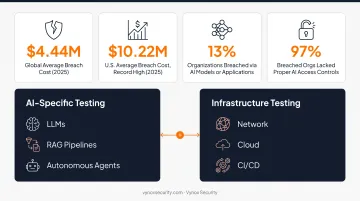
Breach costs remain brutal. IBM's 2025 Cost of a Data Breach Report put the global average at $4.44 million, while the U.S. average hit a record $10.22 million. More telling for AI-native companies: 13% of organizations reported breaches of AI models or applications, and 97% of those breached lacked proper AI access controls, according to IBM's 2025 breach report.
As networks connect to cloud services, APIs, and AI pipelines, the attack surface stretches well beyond what legacy network pentesting was built to handle. A compromised API doesn't just expose data anymore—it can poison model training pipelines or open an indirect prompt injection channel.
That is why Vynox structures its work as a two-layer model: AI-specific testing for LLMs, RAG pipelines, and agents, paired with infrastructure testing that covers the network, cloud, and CI/CD pathways feeding those AI systems.
Internal vs. External Network Penetration Testing
Both approaches simulate an attack. The difference is where that attacker starts: outside your perimeter, or already inside it.
Internal Network Penetration Testing
Internal tests assume the attacker already has network access, whether through stolen credentials, malware, or a malicious insider. Once that foothold exists, the focus shifts to:
- Lateral movement across network segments
- Privilege escalation paths
- Access to sensitive internal systems and data
Picture an employee account with unnecessary admin rights on a shared file server. A tester (or a real attacker) who compromises that single account could pivot across the network, escalate privileges, and reach systems that account was never meant to touch. That's exactly the kind of excessive-access scenario internal testing is designed to catch.
External Network Penetration Testing
External tests simulate an attacker with zero internal access. They probe internet-facing assets from the outside, including:
- Firewalls and edge routers
- Web servers and exposed applications
- VPNs and remote-access gateways
PCI DSS v4.0.1 requires this kind of testing at least once every 12 months, and again after any significant infrastructure change. A misconfigured firewall rule or an exposed app with default credentials is often all it takes to create a foothold.
Run together, the two views answer different questions: what is reachable from the outside, and how far an attacker can go once inside. Vynox covers both vectors in one Network Pentest engagement—up to 10 IPs, including CI/CD supply-chain paths—typically over 5 to 10 business days.
Penetration Testing Methodologies: Black, Gray & White Box
The amount of information a tester starts with shapes how the engagement plays out.
| Methodology | Tester's Knowledge | Best For |
|---|---|---|
| Black box | None | Simulating a true outside attacker with zero inside knowledge |
| Gray box | Partial (IP ranges, credentials) | Balancing realism with efficient coverage of specific systems |
| White box | Full (architecture, source code) | The most thorough assessment, at higher time and cost |
Black box testing is the most realistic simulation of an unknown attacker. It can take longer and may miss issues that only surface with deeper system knowledge.
Gray box testing balances the two: testers get enough context (such as IP ranges or credentials) to cover routers and applications efficiently without the full blueprint.
White box testing grants access to source code and architecture for the deepest assessment, usually at higher time and cost. NIST guidance notes that duration and cost still hinge on network size, component count, and how much intrusion the organization will allow—not on the methodology label alone.
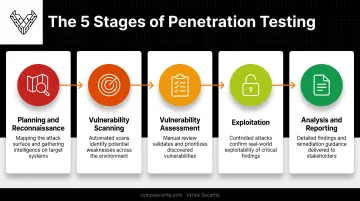
The Network Penetration Testing Process: 5 Key Steps
A real engagement follows a defined sequence, not a single scan-and-report cycle.
- Planning and reconnaissance. Testers map network topology, IP ranges, and connected devices through active probes and passive public data, and agree on rules of engagement with the client.
- Vulnerability scanning. Automated tools identify weak points such as open ports, outdated software, and misconfigurations that could serve as entry points.
- Vulnerability assessment. Testers analyze scan results and prioritize risks, often cross-referencing the National Vulnerability Database and CVSS severity scores.
- Exploitation. Testers carefully attempt to exploit confirmed vulnerabilities to prove real-world impact, without disrupting production systems.
- Analysis and reporting. The report documents exploited vulnerabilities, evidence, business risk, and prioritized remediation steps, then retesting confirms fixes hold.
Retesting is easy to deprioritize once the report lands. Vynox Security runs retests the same day a fix reaches staging, so teams confirm the gap is closed without waiting days or weeks.
Key Benefits of Network Penetration Testing
The value shows up in three concrete ways:
- Strengthened security posture. Testing finds gaps before an attacker does and sharpens incident response readiness.
- Compliance support. Documented, exploitable findings simplify SOC 2 and ISO 27001 audit readiness. Vynox maps those results straight to control evidence so they feed the audit, not a side workstream.
- Cost avoidance. Reactive incident response is expensive. With the global average breach cost at $4.44 million in 2025, per IBM's 2025 report, proactive testing is far less costly by comparison.
How Often to Test and Choosing the Right Partner
Test at least once a year. PCI DSS requires annual internal and external testing as a baseline. On top of that, retest after:
- Major infrastructure or application changes
- New system deployments
- Compliance requirements under your framework (e.g., PCI DSS, SOC 2)
When evaluating a testing partner, look for:
- A blend of automated scanning and manual, human-led exploitation
- Clear, developer-ready reporting engineers can act on without translation
- Fast retest turnaround that verifies fixes in days, not weeks
Those criteria matter more as networks stop standing alone. Most environments now tie into cloud services, APIs, and often AI systems such as LLMs and RAG pipelines—so the attack surface is wider than a classic perimeter scan.
A partner like Vynox Security covers traditional network infrastructure and AI-specific attack surfaces in one engagement, with compliance-ready evidence for SOC 2 and ISO 27001 instead of splitting work across vendors. Engagement options include:
- Rapid Secure — fast, audit-focused turnaround
- Deep Secure — full adversarial coverage
- PTaaS — sprint-aligned testing instead of a single annual snapshot
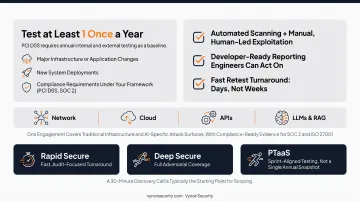
A 30-minute discovery call is typically the starting point for scoping.
Frequently Asked Questions
What's the difference between a vulnerability scan and a network penetration test?
A vulnerability scan automatically identifies potential weaknesses in your network. A penetration test actively exploits those weaknesses to demonstrate real-world impact and confirm they're genuinely exploitable.
How much does network penetration testing cost?
Cost depends on network size, testing type (black, gray, or white box), and overall scope. Most providers, including Vynox, recommend a scoped quote after a discovery call rather than a flat rate.
How often should a company perform network penetration testing?
At minimum, once a year. Retest after significant infrastructure changes, new deployments, or whenever a compliance framework like PCI DSS specifically requires it.
Can network penetration testing disrupt business operations?
Reputable testers scope engagements carefully and can run tests during off-hours to minimize impact on production systems. Rules of engagement are agreed upon before any testing begins.
Is network penetration testing required for compliance?
PCI DSS explicitly requires annual internal and external testing. SOC 2 and HIPAA don't mandate a fixed universal cadence in their public criteria, but testing evidence is commonly used to satisfy audit requirements.
How long does a network penetration test take?
Timelines vary by scope. Focused engagements typically run 5 to 10 business days, while comprehensive assessments spanning multiple attack surfaces can extend to 15 business days.