The stakes keep climbing. The global average cost of a data breach hit $4.88 million in 2024, a 10% jump from the prior year, according to IBM's Cost of a Data Breach Report. Compliance mandates like PCI DSS, SOC 2, and ISO 27001 have only accelerated adoption.
Here's the problem: a clean vulnerability scan or a well-configured firewall doesn't prove anything is actually exploitable. That gap creates false confidence and compliance headaches. This guide breaks down what network penetration testing really is, how it works step by step, and where it fits into a broader security program.
TL;DR
- Network penetration testing simulates a real, authorized cyberattack to prove exploitable vulnerabilities
- Unlike vulnerability scanning, it actively exploits weaknesses instead of just listing them
- The process runs through planning, scanning, exploitation, and reporting
- Runs internally, externally, or both, testing via black box, gray box, or white box methods
- Supports PCI DSS, SOC 2, and ISO 27001 compliance while validating real-world defenses
What Is Network Penetration Testing?
Network penetration testing is an authorized, simulated attack carried out by ethical hackers to identify and actively exploit vulnerabilities in your network infrastructure, meaning firewalls, routers, switches, servers, and endpoints. NIST defines penetration testing as security testing where evaluators mimic real-world attacks to find ways around an organization's security controls.
Why It Exists
Automated vulnerability scanners are useful, but they flag potential issues and generate plenty of false positives. NIST specifically warns that scanners can carry high false-positive rates requiring expert interpretation. A scanner might tell you a port is open and a service looks outdated.
It can't tell you whether an attacker could actually chain that weakness into a full network compromise. Pen testing closes that gap by proving exploitability. For instance, a scanner may flag SMBv1 as enabled without confirming whether that flaw actually lets an attacker pivot into a full domain takeover.
What It Isn't
Two common mix-ups worth clearing up:
- Vulnerability scanning is passive and automated. It's broad but shallow, and it doesn't confirm real-world impact.
- Red teaming is a much wider engagement that assesses an organization's overall security capability and response, not just a defined set of technical network targets.
Automated detection tools, even AI-driven ones, still can't replicate the creative, chained attack logic a skilled human tester brings. That's why pen testing remains relevant even as detection technology improves.
Internal vs. External, and the Three Testing Methodologies
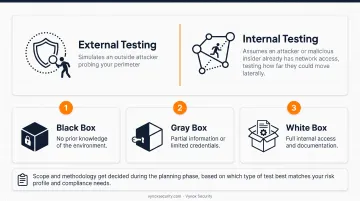
Network pen testing splits into two primary types:
- External testing targets internet-facing assets, simulating an outside attacker probing your perimeter
- Internal testing assumes an attacker or malicious insider already has network access, and tests how far they could move laterally
Layered on top of that is the tester's starting knowledge, which shapes methodology:
- Black box: no prior knowledge of the environment
- Gray box: partial information or limited credentials
- White box: full internal access and documentation
Scope and methodology get decided during the planning phase, based on which type of test best matches your risk profile and compliance needs.
How Does Network Penetration Testing Work?
Network pen testing moves through a defined sequence. Each stage builds on the last, moving from raw information gathering to a validated, remediated finding. NIST organizes this work into four phases, though many providers (including frameworks like PTES) break it into finer steps.
| Phase | What Happens |
|---|---|
| Planning | Define scope, objectives, and rules of engagement. No active testing yet. |
| Discovery | Map hosts, ports, services, and potential vulnerabilities. |
| Attack | Attempt controlled exploitation to validate findings and paths. |
| Reporting | Deliver findings, risk ratings, evidence, and remediation guidance. |
Planning and Reconnaissance
Testers start by defining scope and objectives with stakeholders, then gather intelligence on IP ranges, domains, network topology, and exposed services.
Reconnaissance splits into two modes: active, which directly probes the target, and passive, which gathers only publicly available information.
This stage blends manual coordination with automated recon tools. The most common bottleneck here is a poorly defined scope. If stakeholders aren't specific about which assets are in play, testers either miss critical systems or burn time on things that don't matter.
Scanning and Vulnerability Analysis
Testers deploy port scanners, network mappers, and vulnerability scanners to find open ports, running services, misconfigurations, and known CVEs. This produces a raw list of potential weaknesses.
That raw list isn't the finished product. Testers manually verify each finding and prioritize it using scoring systems like CVSS. A CVSS score is a prioritization input, not proof of exploitability in your specific environment, which is exactly why the next phase matters so much.
The accuracy of this stage determines how targeted and efficient exploitation will be. Sloppy triage here means wasted effort later.
Exploitation and Privilege Escalation
This is where testers attempt to actively exploit identified vulnerabilities. Common techniques include:
- Credential attacks
- SQL injection
- Man-in-the-middle attacks
- Firewall or segmentation bypass
- Lateral movement between systems
Testers carefully track how far they can escalate privileges and how long they can maintain undetected access, all without disrupting business operations. This mirrors how a real attacker would move once inside your network.
This stage separates theoretical risk from proven risk. A firewall rule that looks airtight on paper may still be bypassable in practice, and this is the only way to find out before an actual attacker does.
Reporting and Remediation
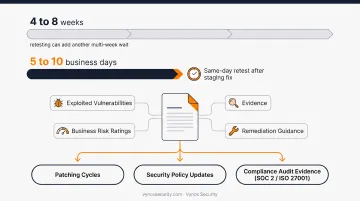
The output is a detailed report documenting exploited vulnerabilities, evidence, business risk ratings, and remediation guidance. These findings feed directly into patching cycles, security policy updates, and compliance audit evidence for frameworks like SOC 2 and ISO 27001.
Traditional pen testing firms often take 4 to 8 weeks for the full delivery-to-remediation loop, and retesting a fix can mean another multi-week wait.
Vynox Security compresses that timeline for network engagements to 5 to 10 business days. Engineers get developer-ready, stack-specific fix guidance and reproduction steps they can act on immediately, rather than generic CVE writeups. Once a fix ships to staging, retesting happens the same day, not weeks later.
Where Is Network Penetration Testing Used?
Network pen testing typically shows up at specific points in a security program's lifecycle:
- After initial infrastructure setup
- Before major compliance audits
- Following significant network changes
- On a recurring annual or continuous cadence
It delivers the most value for organizations with internet-facing assets, hybrid cloud and on-prem networks, remote workforces, and regulated industries handling sensitive data.
Industry variation matters here. PCI DSS v4.0.1 requires internal and external penetration testing at least once every 12 months, and after significant infrastructure changes, per PCI's official documentation. Healthcare organizations often face similarly frequent testing expectations tied to regulatory risk analysis requirements.
There's a newer wrinkle too. Organizations building AI-powered products increasingly need network testing paired with AI-specific assessments, covering LLMs, RAG pipelines, and autonomous agents, to get full-stack coverage.
Vynox Security's network testing treats infrastructure hosting AI workloads, CI/CD pipelines, and internal tooling as supply-chain risk rather than a generic scan add-on. Combined with its AI security testing layer, that gives teams shipping AI products a single view of both the network perimeter and the model-layer attack surface.
Conclusion
Network penetration testing works because it follows a logical progression: reconnaissance feeds scanning, scanning feeds exploitation, and exploitation feeds a remediation plan teams can actually act on. Skip a stage, and the whole exercise loses credibility.
Organizations that treat pen testing as a continuous process, rather than an annual checkbox, stay audit-ready year-round instead of scrambling before a deadline. Vynox Security applies this same reconnaissance-to-remediation approach in every network penetration testing engagement, delivering developer-ready fixes teams can implement immediately.
Frequently Asked Questions
What are the 7 steps of network pen testing?
The extended breakdown includes planning, reconnaissance, scanning, vulnerability assessment, exploitation, post-exploitation/privilege escalation, and reporting. Many providers, including NIST's framework, consolidate these into four broader phases: planning, discovery, attack, and reporting.
Is network pen testing illegal?
It's fully legal when conducted under explicit written authorization and a defined scope agreement. Unauthorized testing of any network can violate computer fraud laws, even if the intent was good-faith security research.
How difficult is network pen testing?
It requires specialized skills combining technical tool proficiency with creative, human-driven attack logic. That's precisely why most organizations outsource it to certified ethical hackers rather than relying on in-house teams.
How often should network penetration testing be performed?
At minimum, annually or after significant infrastructure changes. Compliance frameworks like PCI DSS often mandate specific cadences, such as testing every 12 months for both internal and external scope.
How much does network penetration testing cost?
Pricing varies based on scope, network size, and methodology (black, gray, or white box). Vynox Security's Rapid Secure and Deep Secure tiers, for example, offer transparent, stage-appropriate pricing from startup to enterprise budgets.
What is the difference between vulnerability scanning and penetration testing?
Vulnerability scanning is automated and identifies potential issues broadly, often with false positives. Penetration testing manually validates and actively exploits those issues to prove real-world risk and business impact.