Kubernetes now runs in production for 82% of container users, up from 66% just two years earlier, according to the 2025 CNCF Annual Cloud Native Survey. Many users struggle to secure that footprint at the same pace it grows, especially as AI workloads move in alongside traditional services.
This article breaks down the five trends redefining container security in 2026, what's driving them, how they're changing day-to-day operations, and what to watch next.
TL;DR
- Container security is shifting from reactive scanning to AI-driven, continuous, identity-first protection
- Containerized LLMs, RAG pipelines, and agents need specialized testing beyond traditional scanners
- Supply chain hardening and agentless CNAPP are replacing fragmented toolchains
- SOC 2 and ISO 27001 now map directly to container-specific controls
- Early adopters get faster remediation, stronger audit readiness, and higher developer velocity
Key Trends Shaping Container Security in 2026
Five shifts stand out this year for security and engineering leaders tracking where container risk is heading next.
AI-Powered Threat Detection and Autonomous Runtime Defense
Static, rule-based runtime monitoring can't keep up with modern container behavior. Machine learning-based behavioral baselining now flags anomalies (cryptomining processes, unexpected shell execution, unusual outbound connections) the moment they deviate from a workload's normal pattern, rather than waiting for a signature match.
The scale problem is real. Sysdig's 2025 usage report found 60% of observed containers lived for 60 seconds or less, making periodic or manual-only inspection incomplete for most of the workload population.
Mature teams using automated detection now identify threats in under 5 seconds and begin response in roughly 3.5 minutes on average. That margin matters when attack windows are measured in minutes, not hours.
Vendors are leaning into this hard. Aqua Security and Palo Alto Networks have both introduced agentic AI copilots in runtime security workflows to investigate root cause and contain incidents with less human triage.
Those are vendor claims, not independently benchmarked results. Still, manual triage alone can no longer match the pace of ephemeral, container-based attacks.
Securing Containerized AI Workloads: LLMs, RAG Pipelines, and Agents
Organizations are containerizing LLM inference servers, vector databases, and autonomous agents at scale. 66% of organizations hosting generative AI models now use Kubernetes to manage some or all of that inference, per a CNCF survey.
The problem: traditional container scanners check for known CVEs in package dependencies. They don't test for:
- Prompt injection that manipulates model behavior
- Model exfiltration through misconfigured identity paths
- Insecure agent-to-tool communication that lets an agent take unintended actions
Picture an AI startup that ships a RAG pipeline in Kubernetes pods, passes its container image scan with a clean bill of health, and goes live. Nobody tested whether the retrieval endpoint could be manipulated to surface another tenant's documents. That gap is what specialized AI-native testing, including RAG pipeline security assessments and LLM penetration testing, exists to close.
This isn't hypothetical. Unit 42 researchers demonstrated a real privilege-escalation path where a poisoned model deployed to Vertex AI led to GKE credential access. From there they could enumerate pods and service accounts, then export deployed model images and fine-tuned adapter files.
Vynox Security's RAG assessments target this class of risk: cross-tenant retrieval bypass, access-control bypass via prompt crafting, vector database poisoning, and embedding inversion. That work sits alongside traditional container hardening so both layers of the AI stack get tested.
Software Supply Chain Hardening and Verifiable Provenance
The shift here is away from grabbing whatever public image looks convenient. Teams are moving toward SBOMs, cryptographic image signing, and sourcing from continuously maintained, near-zero-CVE base images instead of ad hoc registry pulls.
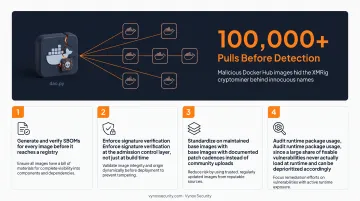
The risk is well documented. Aqua's Team Nautilus identified malicious Docker Hub images hiding the XMRig cryptominer behind innocuous names like dao.py, with individual images pulled more than 100,000 times before detection. One compromised base image can propagate vulnerabilities across hundreds of derivative containers built on top of it, silently inherited by every team that trusted the upstream source.
Practical hardening steps organizations are adopting:
- Generate and verify SBOMs for every image before it reaches a registry
- Enforce signature verification at the admission control layer, not just at build time
- Standardize on maintained base images with documented patch cadences instead of community uploads
- Audit runtime package usage, since a large share of fixable vulnerabilities never actually load at runtime and can be deprioritized accordingly
Consolidation Toward Unified, Agentless CNAPP Platforms
Siloed tooling (separate image scanners, network monitors, and compliance dashboards that don't talk to each other) is losing ground fast. In Palo Alto Networks' 2024 survey of more than 2,800 cloud security and DevOps professionals, 91% said point tools create blind spots that affect threat prevention, and 92% wanted better out-of-the-box visibility and risk prioritization.
Agentless CNAPP platforms address this by pulling code-to-runtime visibility into one system without installing per-host agents. That removes a layer of performance overhead on production nodes while still covering the full lifecycle from build through deployment to runtime. Fewer dashboards also means less alert fatigue for already-stretched security teams , a direct fix for the blind-spot problem the survey uncovered.
Zero-Trust Microsegmentation and Identity-First Access Control
Network-perimeter thinking assumes attackers stay outside the wall. Container environments don't work that way . A single compromised pod can pivot laterally unless every container-to-container and container-to-API call is authenticated on its own merits.
The practical implementation combines:
- Service mesh-enforced mTLS between every workload, regardless of network location
- Kubernetes NetworkPolicy restricting which pods can talk to which
- RBAC scoped to least privilege, so a compromised service account can't reach unrelated resources
NIST's container security guidance explicitly recommends grouping only containers with matching purpose, sensitivity, and threat posture on the same host, treating that segmentation as a core layer of defense in depth, not an optional add-on. The Vertex AI exfiltration case referenced earlier shows what happens without it: once workload identity federation was compromised, attackers could enumerate an entire cluster.
What's Driving These Container Security Trends
These shifts aren't happening in isolation. Several forces are converging at once.
- Technology advances: Machine learning now enables faster, more accurate anomaly detection than manual security review can match, particularly against ephemeral, short-lived containers.
- Market demand: Development teams ship containerized releases more frequently than ever, and many now deploy to production weekly. That pace pressures security to run continuously instead of on a quarterly or annual cycle.
- Cost pressures: Consolidating point tools into unified platforms cuts licensing overhead and reduces analyst hours chasing false positives.
- Regulatory influence: SOC 2, ISO 27001, and related frameworks increasingly expect container-specific audit evidence—image provenance, runtime controls, and hardening baselines—not generic checklists.
- Competitive dynamics: Security posture is now a differentiator in enterprise sales cycles. SaaS vendors selling to security-conscious buyers increasingly need compliance-ready evidence on hand, not a promise to "get to it".
How These Trends Are Impacting Organizations
Operational Impact
Security checks no longer wait until after deployment. Teams feel the change in three places:
- Scanning and policy checks move into CI/CD (shift-left)
- Remediation cycles shrink from weeks to hours
- Policy-driven admission control blocks non-compliant containers before they run
Business Impact
Budgets and deal cycles are shifting with the tooling model:
- Spend moves from standalone point-tool licenses toward platform consolidation and continuous testing retainers
- Compliance-ready evidence packs act as a real sales enabler on enterprise deals
- Prospects expect a finished audit trail, not a promise to fix findings later
Workforce Impact
Skills and ownership are redistributing across the org:
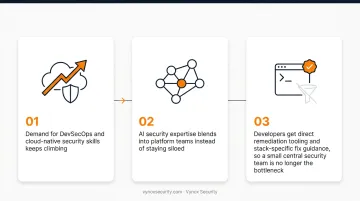
- Demand for DevSecOps and cloud-native security skills keeps climbing
- AI security expertise blends into platform teams instead of staying siloed
- Developers get direct remediation tooling and stack-specific fix guidance, so a small central security team is no longer the bottleneck
Future Signals for Container Security in 2026 and Beyond
Watch these early indicators over the next one to three years:
- Regulatory scrutiny of AI in production containers is intensifying. The EU AI Act's Article 15 already requires resilience testing against data poisoning, model poisoning, and adversarial evasion for high-risk systems. Expect more jurisdictions to follow with container-specific technical expectations.
- Confidential computing is moving toward mainstream adoption. Intel TDX, AMD SEV-SNP, and IBM Secure Execution already power the Confidential Containers project, and Microsoft's AKS Confidential Containers entered preview in 2026. Hardware-enforced isolation is becoming viable for sensitive workloads.
- Continuous, sprint-aligned testing is replacing annual audits. Teams shipping AI features every sprint need penetration testing on that same cadence. PTaaS runs alongside each model update and deployment, catching issues in the sprint they're introduced rather than months later.
Conclusion
AI-driven detection, AI workload security, supply chain hardening, platform consolidation, and zero-trust access are converging into one continuous approach to container security in 2026. Organizations that adapt early build faster remediation cycles, stronger audit readiness, and more customer trust into every release.
As containers host traditional applications and AI systems together, no single layer can be tested in isolation. A partner that covers the AI stack (LLMs, RAG pipelines, autonomous agents) and the infrastructure beneath it, like Vynox Security, keeps both layers in scope so nothing in the environment goes untested.
Frequently Asked Questions
What does container security mean?
Container security is the practice of protecting containerized applications and their supporting infrastructure across build, deploy, and runtime stages. It spans image scanning, registry access, orchestration controls, and runtime defense.
What are the biggest container security risks in 2026?
The top risks are AI workload exposure (prompt injection, model exfiltration), software supply chain compromise through vulnerable base images, and runtime privilege escalation enabling lateral movement. All three require controls beyond standard CVE scanning.
How is AI changing container security?
AI powers faster, more accurate behavioral threat detection. At the same time, containerized LLMs and agents introduce attack surfaces that traditional scanners were never built to test.
What is the difference between container security and Kubernetes security?
Container security covers the broader scope: images, runtime behavior, and registries. Kubernetes security is a subset focused specifically on orchestration-layer controls, such as RBAC, admission control, and NetworkPolicy.
How do compliance requirements like SOC 2 affect container security?
Frameworks like SOC 2 and ISO 27001 now require documented evidence of image scanning, access controls, and audit logging specific to container environments. Generic security narratives no longer satisfy auditors. They want mapped, container-specific proof.
What tools are used for container security?
Common categories include image and registry scanners, unified CNAPP platforms, runtime protection agents or agentless monitors, and policy engines for admission control. Many organizations now pair these with specialized AI security testing for containerized LLM and agent workloads.